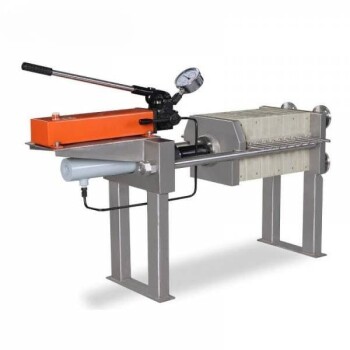
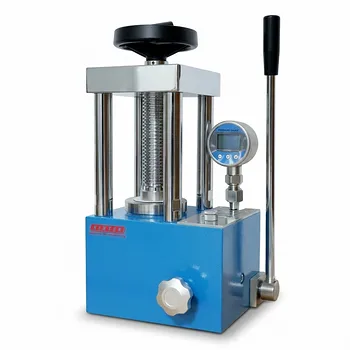
The laboratory hydraulic press serves as the primary densification tool in the fabrication of Lithium Aluminum Germanium Phosphate (LAGP) electrolytes. By utilizing precision molds, the press applies uniform, uniaxial force to compress synthesized LAGP powder into solid, cohesive units known as "green pellets."
The hydraulic press converts loose, synthesized powder into a mechanically stable "green" body. This physical compaction is the non-negotiable prerequisite for sintering, ensuring the tight particle-to-particle contact required to create a high-density solid-state electrolyte.
The Mechanics of LAGP Compaction
Applying Uniaxial Pressure
The hydraulic press operates by delivering force in a single, vertical direction. This "uniaxial" pressure is applied to LAGP powder contained within a precision mold or die.
Creating the "Green Pellet"
The immediate output of this process is a "green pellet." This is a compacted disc of material that holds its shape through mechanical interlocking and friction, rather than chemical bonding.
Ensuring Uniformity
The press must deliver pressure evenly across the surface of the mold. Uniform application ensures the pellet has consistent density throughout, preventing structural weaknesses during later processing stages.
Why Compression is Critical for Electrolytes
Establishing Particle Contact
For LAGP to function as an electrolyte, ions must move efficiently from one grain to another. The hydraulic press forces loose particles into tight contact, minimizing the gaps that impede ion flow.
The Foundation for Sintering
Pressing is not the final step; it is the preparation for sintering (heating). High-density sintering can only occur if the particles are already physically packed closely together.
Controlling Density and Porosity
By applying significant pressure, the press reduces the volume of void spaces (porosity) within the material. This packing density is directly correlated to the final mechanical strength and conductivity of the ceramic.
Understanding the Trade-offs
The "Green Strength" Limitation
While the press creates a solid pellet, the "green" body is relatively fragile compared to the final sintered ceramic. It has enough mechanical strength to be handled, but it lacks the chemical bonds formed during heat treatment.
Pressure Distribution Risks
If the hydraulic press or the mold is misaligned, pressure gradients can occur. This leads to density variations within a single pellet, which often causes warping or cracking during the subsequent sintering phase.
Density vs. Damage
Applying higher pressure generally improves density, but excessive force can damage the mold or cause lamination defects in the pellet. There is an optimal pressure window that maximizes density without compromising structural integrity.
Making the Right Choice for Your Goal
Achieving the best results requires balancing mechanical force with material limitations.
- If your primary focus is mechanical handling: Ensure the press applies enough pressure to yield a green pellet strong enough to be transferred to a furnace without crumbling.
- If your primary focus is ionic conductivity: Prioritize maximum consistent density to minimize porosity, as tight particle contact is essential for establishing efficient lithium-ion transport pathways.
The hydraulic press is not just a shaping tool; it is the instrument that establishes the structural continuity required for high-performance solid-state batteries.
Summary Table:
| Process Stage | Role of Hydraulic Press | Impact on LAGP Electrolyte |
|---|---|---|
| Powder Compaction | Applies uniform uniaxial force | Converts loose powder into a stable "green" body |
| Density Control | Reduces void spaces/porosity | Maximizes potential ionic conductivity and strength |
| Particle Contact | Establishes grain-to-grain contact | Essential prerequisite for successful sintering |
| Structural Shaping | Uses precision molds/dies | Ensures consistent pellet dimensions and mechanical handling |
Elevate Your Solid-State Battery Research with KINTEK
Precision is paramount when fabricating solid-state electrolytes like LAGP. At KINTEK, we specialize in high-performance laboratory hydraulic presses (pellet, hot, and isostatic) designed to provide the uniform pressure needed for maximum density and conductivity.
Our comprehensive range of equipment supports every stage of your material science workflow—from high-temperature furnaces (muffle, vacuum, tube) for sintering to high-pressure reactors, crushing systems, and specialized ceramics. Whether you are optimizing ionic transport or enhancing green pellet strength, KINTEK delivers the reliable tools and consumables your laboratory requires.
Ready to achieve superior pellet density? Contact our technical experts today to find the perfect pressing solution for your research goals.
Related Products
- Laboratory Hydraulic Press Split Electric Lab Pellet Press
- Laboratory Hydraulic Press Lab Pellet Press Machine for Glove Box
- Laboratory Hydraulic Press Lab Pellet Press for Button Battery
- Automatic Laboratory Hydraulic Press for XRF & KBR Pellet Press
- Automatic Laboratory Hydraulic Pellet Press Machine for Lab Use
People Also Ask
- What role does a laboratory hydraulic press play in platinum recovery research? Enhancing Sample Precision
- What are the specific applications of a lab hydraulic press in biochar evaluation? Optimize density and data accuracy.
- What are the roles of a laboratory hydraulic press and stainless steel molds in the preparation of graphite samples?
- What is the role of a laboratory hydraulic press in electrode prep? Maximize Energy Density & Sealing Precision
- Why must a laboratory hydraulic press equipped with cylindrical molds be used when preparing BZY green bodies? High Density