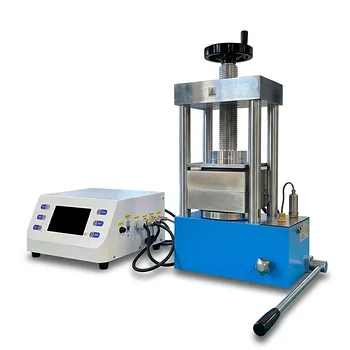
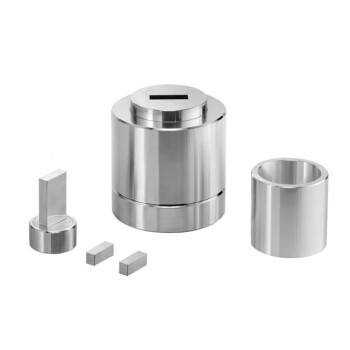
A laboratory hydraulic press and PEEK mold operate in tandem to transform loose sulfide powders into dense, functional electrolyte layers through high-pressure uniaxial compression. While the press delivers the immense force necessary to mechanically fuse particles via plastic deformation, the PEEK mold provides the critical structural containment and electrical insulation required to form precise geometries without chemically reacting with the sensitive sulfide materials.
The synergy between the hydraulic press and the PEEK mold solves the fundamental challenge of solid-state batteries: achieving intimate particle contact. The press eliminates porosity to lower grain boundary resistance, while the PEEK mold ensures the sample remains pure, electrically isolated, and dimensionally accurate under extreme mechanical stress.
The Mechanics of Densification
Applying Uniaxial Pressure
The laboratory hydraulic press acts as the engine of the process, generating high uniaxial pressure, typically ranging from 100 MPa up to 440 MPa.
This pressure is applied vertically to the powder housed within the mold. The goal is not merely to pack the powder, but to achieve a specific density required for electrochemical performance.
Plastic Deformation and Pore Elimination
Sulfide electrolytes rely on tight solid-solid contact for ion transport. The high pressure forces the electrolyte particles to undergo plastic deformation.
This deformation flattens the particles against one another, effectively eliminating the microscopic voids and pores that naturally exist in loose powder.
Reducing Grain Boundary Resistance
By removing voids, the press creates a continuous physical interface.
This densification is critical for reducing grain boundary resistance, establishing uninterrupted channels for lithium-ion transport, and ensuring high overall ionic conductivity in the final layer.
The Critical Role of the PEEK Mold
Withstanding High Compressive Forces
The PEEK (Polyether ether ketone) mold serves as the containment vessel. It creates the precise dimensions of the pellet, typically around 1mm thick.
Despite being a polymer, PEEK possesses exceptional mechanical strength. It maintains its structural integrity and resists deformation even under the immense pressures (up to several hundred MPa) exerted by the press.
Ensuring Electrical Insulation
A primary function of the PEEK mold is electrical insulation.
In a hydraulic press, the upper and lower plungers are often metallic. The PEEK mold prevents these plungers from coming into electrical contact, thereby preventing short circuits during the pressing process.
Chemical Inertness Toward Sulfides
Sulfide-based electrolytes are highly reactive chemically.
PEEK is chemically inert, meaning it will not react with the sulfide powders. This prevents contamination of the sample and ensures that no undesirable side reactions degrade the electrolyte quality during fabrication.
Understanding the Trade-offs
Pressure Limitations of Polymers
While PEEK is robust, it has a lower yield strength than hardened steel.
Operators must be careful not to exceed the specific pressure rating of the PEEK mold design. Excessive force can cause the mold to bulge or crack, compromising the dimensional accuracy of the electrolyte layer.
Balancing Density and Integrity
Applying maximum pressure yields better density but stresses the mold.
There is a trade-off between achieving the theoretical maximum density of the sulfide powder and maintaining the lifespan of the PEEK tooling. Consistent operation at the upper limits of pressure (e.g., 440 MPa) will accelerate mold wear.
Optimizing the Fabrication Process
To achieve the best results when preparing sulfide electrolyte layers, align your parameters with your specific research goals:
- If your primary focus is maximizing ionic conductivity: Prioritize higher pressures (approaching 380-440 MPa) to maximize plastic deformation and minimize grain boundary resistance, accepting a higher wear rate on your PEEK mold.
- If your primary focus is sample purity and interface stability: Leverage the chemical inertness of PEEK to prevent side reactions, ensuring the mold surfaces are clean and dry before loading reactive sulfide powders.
Success in solid-state battery fabrication relies on balancing the brute force required for densification with the material compatibility provided by the mold.
Summary Table:
| Component | Primary Function | Key Advantage |
|---|---|---|
| Laboratory Hydraulic Press | Generates 100-440 MPa uniaxial pressure | Drives plastic deformation to eliminate porosity |
| PEEK Mold | Contains powder and provides geometry | Chemically inert to sulfides & electrically insulating |
| Sulfide Powder | Active electrolyte material | Achieves high ionic conductivity via densification |
| Plungers | Delivers force from press to powder | Creates flat, uniform electrolyte pellet surfaces |
Elevate Your Battery Research with KINTEK Precision
Ready to achieve superior ionic conductivity and perfect sample purity? KINTEK specializes in advanced laboratory solutions tailored for solid-state battery innovation. From high-performance hydraulic presses (pellet, hot, and isostatic) to specialized tooling, we provide the precision you need.
Our extensive portfolio includes:
- High-Pressure Presses for perfect sulfide densification.
- Advanced Molds & Consumables including chemical-resistant PEEK and ceramics.
- Battery Research Tools such as high-temperature furnaces, vacuum systems, and electrolytic cells.
Don't let grain boundary resistance hold back your breakthroughs. Contact KINTEK today to find the perfect equipment for your lab and benefit from our expertise in high-pressure material processing!
Related Products
- Laboratory Hydraulic Press Split Electric Lab Pellet Press
- 24T 30T 60T Heated Hydraulic Press Machine with Heated Plates for Laboratory Hot Press
- Automatic Laboratory Hydraulic Pellet Press Machine for Lab Use
- Heated Hydraulic Press Machine with Integrated Manual Heated Plates for Lab Use
- 30T 40T Split Automatic Heated Hydraulic Press Machine with Heated Plates for Laboratory Hot Press
People Also Ask
- What role does a laboratory hydraulic press play in platinum recovery research? Enhancing Sample Precision
- What are the specific applications of a lab hydraulic press in biochar evaluation? Optimize density and data accuracy.
- What are the roles of a laboratory hydraulic press and stainless steel molds in the preparation of graphite samples?
- What is the role of a laboratory hydraulic press in electrode prep? Maximize Energy Density & Sealing Precision
- Why must a laboratory hydraulic press equipped with cylindrical molds be used when preparing BZY green bodies? High Density