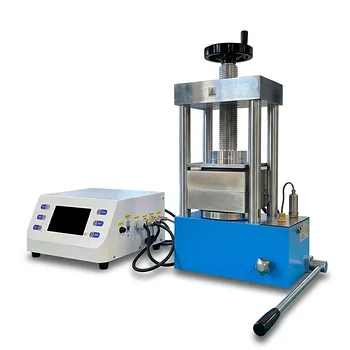
The laboratory press is the foundational tool used to transform loose raw materials into a structured "green body" before the final sintering process. By applying controlled pressure to a mixture of copper powder and pore-forming agents within a precision mold, the press establishes the initial shape, density, and mechanical integrity of the wick.
Core Takeaway: The laboratory press serves as the critical bridge between raw powder and a functional component, directly defining the packing density and pore architecture that will ultimately determine the wick's capillary efficiency and structural strength.
The Transformation from Powder to Structure
Creating the Green Body
The primary function of the laboratory press is to compress bulk copper microspheres and additives into a green compact. This intermediate state provides the necessary structural foundation and initial shape required for subsequent high-temperature processing.
Facilitating Mechanical Bonding
Under high pressure, typically around 100 MPa, the press forces copper particles into intimate contact. This pressure facilitates mechanical bonding and thermoplastic deformation between the microspheres, ensuring the sample remains intact during handling and the early stages of sintering.
Utilizing Precision Molds
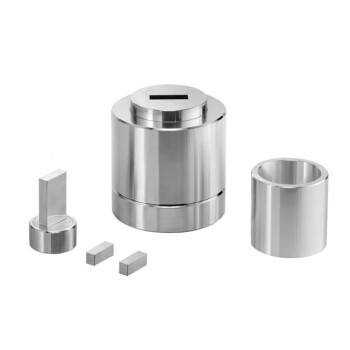
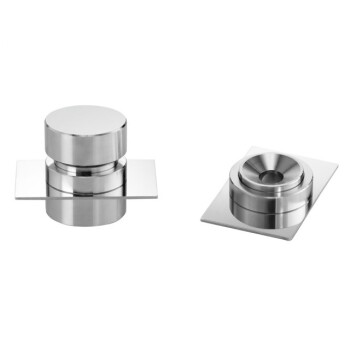
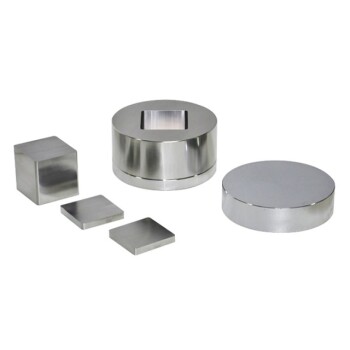
The use of specialized laboratory molds, such as 12 mm diameter precision sets, allows for the creation of standardized samples. These standardized dimensions are essential for accurately studying sintering kinetics and the structural evolution of the porous component.
Defining Wick Performance Characteristics
Controlling Packing Density
The pressure applied by the laboratory press directly determines the packing density of the copper particles. This density is the most significant factor in predicting how the wick will behave once the pore-forming agents are removed and the metal is fused.
Establishing Pore Architecture
The voids left between the compacted copper particles define the pore size distribution. By adjusting the press settings, technicians can calibrate the internal geometry to meet specific requirements for fluid transport and thermal management.
Influencing Capillary Force
Because the press determines the final spacing of the copper skeleton, it effectively dictates the capillary force performance. A tighter compaction generally results in smaller pores, which can increase the capillary lift necessary for transporting fluids against gravity.
Understanding the Trade-offs
The Risk of Over-Compaction
Applying excessive pressure can lead to over-compaction, where the porosity of the wick is reduced to a level that inhibits fluid flow. While the resulting component may be structurally very strong, its permeability will be poor, rendering it ineffective as a wick.
The Weakness of Under-Compaction
Conversely, insufficient pressure results in a green body with low structural integrity. These samples are prone to crumbling before they reach the furnace or may result in a finished product with inadequate mechanical strength for industrial applications.
Lubricant and Additive Management
The inclusion of lubricants in the powder mix is often necessary to ensure uniform density and easy removal from the mold. However, these additives must be carefully balanced, as they can interfere with the bonding process if not properly managed during the pressing phase.
Applying This to Your Project
Making the Right Choice for Your Goal
To achieve the best results with a laboratory press, you must align your pressure settings with your specific performance targets.
- If your primary focus is High Capillary Lift: Increase the compaction pressure to create a denser green body with smaller, more tightly packed pores.
- If your primary focus is Maximum Permeability: Use lower compaction pressures and a higher ratio of pore-forming agents to ensure an open, interconnected cellular structure.
- If your primary focus is Structural Durability: Utilize moderate heating during the pressing phase to encourage thermoplastic deformation and stronger mechanical interlocking.
By mastering the initial pressing phase, you ensure that the subsequent sintering process merely solidifies a perfectly engineered internal architecture.
Summary Table:
| Parameter | Impact on Wick Performance | Key Consideration |
|---|---|---|
| Compaction Pressure | Defines packing density and mechanical bonding. | Avoid over-compaction to maintain permeability. |
| Precision Molds | Ensures standardized dimensions and shape. | Essential for consistent sintering kinetics. |
| Green Body Formation | Establishes the initial structural integrity. | Must be strong enough for handling and sintering. |
| Pore Architecture | Controls capillary force and fluid transport. | Balance pore size for lift vs. flow resistance. |
Elevate Your Material Research with KINTEK Precision Solutions
Achieving the perfect balance of porosity and strength requires equipment you can trust. KINTEK specializes in high-performance laboratory equipment designed for advanced material synthesis. Whether you are forming porous copper wicks or developing new composites, our comprehensive range of hydraulic presses (pellet, hot, and isostatic) and precision molds ensures consistent, high-quality green bodies every time.
Beyond forming, KINTEK supports your entire workflow with our premium portfolio, including:
- High-Temperature Furnaces: Muffle, tube, vacuum, and atmosphere furnaces for precise sintering.
- Material Processing: Crushing and milling systems, sieving equipment, and high-pressure reactors.
- Thermal Management: Cooling solutions like ULT freezers and freeze dryers.
Ready to optimize your lab’s efficiency and results? Contact our technical experts today to find the perfect equipment tailored to your specific application!
References
- Im-Nam Jang, Yong-Sik Ahn. The Study of Copper Powder Sintering for Porous Wick Structures with High Capillary Force. DOI: 10.3390/ma16124231
This article is also based on technical information from Kintek Solution Knowledge Base .
Related Products
- Laboratory Hydraulic Press Split Electric Lab Pellet Press
- Laboratory Hydraulic Press Lab Pellet Press Machine for Glove Box
- Laboratory Hydraulic Press Lab Pellet Press for Button Battery
- 30T 40T Split Automatic Heated Hydraulic Press Machine with Heated Plates for Laboratory Hot Press
- Automatic Laboratory Hydraulic Pellet Press Machine for Lab Use
People Also Ask
- What are the roles of a laboratory hydraulic press and stainless steel molds in the preparation of graphite samples?
- What is the role of a laboratory hydraulic press in electrode prep? Maximize Energy Density & Sealing Precision
- How does a laboratory hydraulic press ensure the quality of alumina-forming alloy green bodies? Optimize CSP Research
- How is a laboratory hydraulic press used to evaluate the mechanical performance of nano-modified concrete? Expert Guide
- Why is a laboratory hydraulic press used for ASSB assembly? Achieving 392 MPa for Optimal Solid-State Battery Density