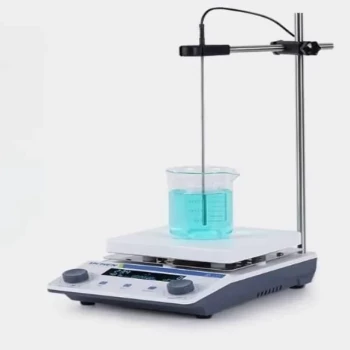
A magnetic stirrer acts as a critical catalyst for efficiency by mechanically driving the flow of wastewater to overcome mass transfer limitations. By creating high-speed forced convection, it shortens the time required for organic pollutants to diffuse from the bulk solution to the electrode surface, ensuring immediate contact with the active radicals generated at the anode.
Core Takeaway The primary role of the magnetic stirrer is to transform the electrochemical system from a diffusion-limited process to a more efficient, kinetically active state. It ensures that the rate of degradation is defined by the reaction speed at the electrode, rather than how slowly the pollutants float toward it.
The Mechanism of Enhanced Mass Transfer
Forcing Fluid Flow
The magnetic stirrer drives a stir bar at high speeds, creating forced fluid convection throughout the reactor. This mechanical energy actively transports simulated wastewater rather than relying on slow, passive natural diffusion.
Shortening Diffusion Time
The primary bottleneck in many electrochemical reactions is the time it takes for a reactant to travel to the reaction site. Stirring significantly shortens the time required for organic pollutant molecules to diffuse to the electrode surface.
Maximizing Reactant Contact
By constantly replenishing the solution at the anode surface, the stirrer ensures thorough contact between reactants and the active radicals. This direct interaction is essential for increasing the overall reaction rate and the efficiency of electrolytic oxidation.
Reducing Kinetic Barriers
Thinning the Diffusion Layer
In a stagnant solution, a thick "diffusion layer" forms around the electrode, acting as a barrier to reaction. The forced convection induced by the stirrer significantly reduces the thickness of this diffusion layer, allowing reactants to penetrate to the electrode surface much faster.
Accelerating Product Removal
Efficiency is not just about bringing reactants to the electrode; it is also about clearing the path. Stirring accelerates the transport of reaction products away from the electrode surface, preventing surface fouling or product re-adsorption that could inhibit the reaction.
Ensuring System Homogeneity
Eliminating Concentration Gradients
Without mixing, "dead zones" with low pollutant concentration can form near the electrode while the bulk solution remains untreated. The stirrer maintains electrolyte homogeneity, eliminating these concentration gradients and ensuring the entire volume of wastewater is treated uniformly.
Guaranteeing Representative Data
For the system to be monitored accurately, the solution must be uniform. Continuous mixing ensures that monitoring sensors, such as pH meters, provide representative data for the entire solution, rather than just a localized reading.
Operational Considerations
Kinetic vs. Mass Transfer Control
It is important to recognize that a magnetic stirrer primarily solves mass transfer limitations. If the reaction is limited by the intrinsic speed of the electron transfer at the electrode (kinetic control) rather than the movement of fluid, increasing stirring speed beyond a certain point will yield diminishing returns.
System Stability
While high-speed stirring is beneficial for mass transfer, extreme turbulence can occasionally interfere with delicate electrode setups or cause splashing. The goal is vigorous mixing without compromising the physical integrity of the electrical connections or the reactor volume.
Making the Right Choice for Your Goal
To optimize your electrochemical setup, align your stirring strategy with your specific experimental objectives.
- If your primary focus is Maximum Degradation Rate: Prioritize high stirring speeds to minimize the diffusion layer thickness and maximize the contact frequency between pollutants and the anode.
- If your primary focus is Data Accuracy and Monitoring: Ensure consistent, continuous mixing to eliminate concentration gradients, allowing your sensors to capture a true average of the system's pH and concentration.
Ultimately, the magnetic stirrer is not just an accessory; it is the driver of consistency that allows the electrochemical potential to fully translate into degradation performance.
Summary Table:
| Mechanism | Impact on Efficiency | Key Benefit |
|---|---|---|
| Forced Convection | Overcomes mass transfer limitations | Rapidly transports pollutants to the electrode surface |
| Diffusion Layer Thinning | Reduces physical barriers at the anode | Accelerates the penetration of reactants to active sites |
| System Homogeneity | Eliminates concentration gradients | Ensures uniform treatment and accurate sensor data |
| Product Transport | Speeds up removal of reaction products | Prevents electrode fouling and surface re-adsorption |
Elevate Your Laboratory Precision with KINTEK
Maximize the efficiency of your electrochemical systems and chemical processing with KINTEK’s professional-grade equipment. Beyond reliable magnetic stirrers, we specialize in a comprehensive range of laboratory solutions designed for high-performance research and industrial applications, including:
- Electrochemical Excellence: Advanced electrolytic cells and electrodes tailored for degradation and synthesis studies.
- High-Temperature Processing: Industry-leading muffle, tube, and vacuum furnaces.
- Pressure & Reaction Systems: High-temperature high-pressure reactors and autoclaves for demanding kinetic environments.
- Material Preparation: Precision crushing, milling systems, and hydraulic presses (pellet, hot, isostatic).
- Thermal Control: High-stability ULT freezers, cold traps, and freeze dryers.
Ready to optimize your lab's performance? Contact our experts today to discover how KINTEK’s integrated equipment and premium consumables—from PTFE products to advanced ceramics—can streamline your research and deliver consistent, high-impact results.
References
- Yinghao Zhang, Rui Zhao. Study on the Electrochemical Removal Mechanism of Oxytetracycline by a Ti/IrO2-Ta2O5 Plate. DOI: 10.3390/ijerph18041708
This article is also based on technical information from Kintek Solution Knowledge Base .
Related Products
- Laboratory Small Constant Temperature Heated Magnetic Stirrer Heater and Stirrer
- Custom PTFE Teflon Parts Manufacturer for Magnetic Stirring Bar
- High Performance Laboratory Stirrers for Diverse Applications
- Three-dimensional electromagnetic sieving instrument
- Custom PTFE Teflon Parts Manufacturer for PTFE Stirring Bar Recovery Rod
People Also Ask
- What role does a magnetic stirrer with heating play in ZnO nanoparticle synthesis? Precision Control for Quality Results
- What role does a constant temperature heating magnetic stirrer play in MFC-HAp synthesis? Achieve Material Homogeneity
- What is the function of a laboratory magnetic stirrer in Ni–Cr–P electrodeposition? Optimize Ion Transport & Coating
- Why is a laboratory magnetic stirrer required for benzoic acid esters? Boost Reaction Speed & Yield with High RPM
- What role does a laboratory magnetic stirrer play in TiO2 and TiO2-Ag sol preparation? Master Chemical Kinetics