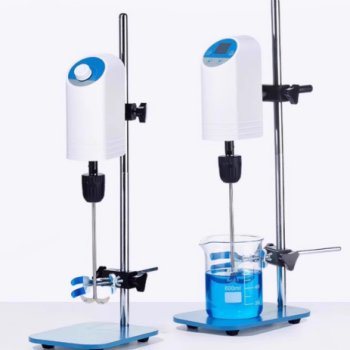
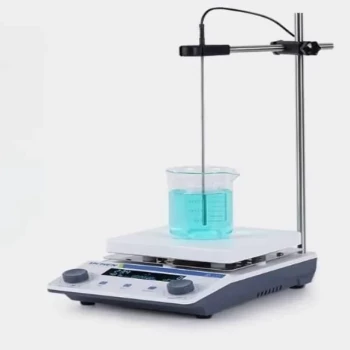
A precision stirring reactor drives the efficiency of chemical precipitation by guaranteeing the rapid and uniform dispersion of agents like sodium hydroxide or sodium sulfide into leaching solutions. By strictly regulating stirring intensity and reaction duration, this technology optimizes particle formation to enable the clean, stepwise recovery of metals such as copper, zinc, and iron.
The core advantage of this technology is the elimination of "encapsulation"—a failure mode where rapid, localized reactions trap unreacted material. Precision mixing ensures reagents are distributed evenly, preventing lost yield and ensuring high-purity separation.
The Mechanics of Controlled Precipitation
Uniform Reagent Dispersion
In metal recovery, the method of introducing reagents is as critical as the chemistry itself. A precision stirring reactor ensures that precipitating agents are dispersed instantly throughout the solution.
This prevents reagents from pooling in high concentrations, which creates inconsistent reaction zones. Uniform dispersion establishes a baseline for predictable chemical behavior across the entire vessel volume.
Optimizing Nucleation and Growth
The formation of solid metal particles happens in two stages: nucleation (birth of the particle) and growth (increase in size). The reactor allows operators to accurately control the stirring intensity to manage these phases.
By balancing energy input, the system promotes the growth of dense, settleable metal hydroxide or sulfide particles. This prevents the formation of fines (dust-like particles) that are difficult to filter later.
Solving the Encapsulation Challenge
Preventing Localized Rapid Reactions
One of the biggest risks in precipitation is the "encapsulation phenomenon." This occurs when the reaction happens too quickly in a small, localized area of the tank.
When reagents are not mixed fast enough, they react immediately upon contact with the nearest metal ions. This creates a solid shell that traps valuable solution inside, preventing it from reacting further.
Eliminating the "Shell" Effect
Precision stirring eliminates the stagnant zones where these shells form. By keeping the fluid in constant, controlled motion, the reactor ensures that the reaction occurs at the molecular level rather than forming macroscopic clumps.
This total exposure of the leaching solution to the reagent maximizes the chemical efficiency of the process.
Facilitating Stepwise Recovery
Targeting Specific Metals
Recovery processes often aim to separate metals like iron, copper, and zinc in a specific sequence. This requires precise control over the reaction environment.
Because the reactor prevents localized concentration spikes, it maintains a homogenous chemical environment (pH and reagent concentration). This stability is required to precipitate one metal specifically without accidentally co-precipitating others.
Consistent Reaction Times
The reactor allows for the accurate control of reaction time alongside mixing intensity. This temporal control ensures that the precipitation process is carried to completion for the target metal before the solution is moved to the next stage.
Understanding the Trade-offs
Equipment Complexity
Moving from standard agitation to precision stirring introduces higher mechanical complexity. These reactors often require more sophisticated drive systems and control units to maintain exact stirring speeds.
Operational Precision Required
To gain the benefits of this system, the operational parameters must be dialed in correctly. While a standard mixer is forgiving, a precision reactor requires the operator to understand the specific relationship between stirring intensity and particle shear for their specific solution.
Making the Right Choice for Your Process
To determine if a precision stirring reactor aligns with your recovery goals, consider your specific purity and yield requirements:
- If your primary focus is maximizing yield: The reactor’s ability to prevent encapsulation ensures that metal ions are not trapped inside unreacted shells, directly improving total recovery rates.
- If your primary focus is multi-metal separation: The homogenous mixing environment allows for efficient stepwise recovery, enabling you to isolate iron, copper, and zinc in distinct, high-purity stages.
By controlling the physics of mixing, you gain mastery over the chemistry of recovery.
Summary Table:
| Feature | Impact on Precipitation | Key Benefit |
|---|---|---|
| Uniform Dispersion | Prevents localized high-concentration zones | Consistent chemical behavior & predictable results |
| Nucleation Control | Balances energy input for particle growth | Prevents formation of difficult-to-filter fines |
| Mixing Precision | Eliminates the "shell" or encapsulation effect | Maximizes chemical efficiency and total metal yield |
| Stepwise Control | Maintains homogenous pH and concentration | Enables high-purity isolation of specific metals |
Elevate Your Metal Recovery Precision with KINTEK
Maximize your laboratory's efficiency and recovery yields with KINTEK’s advanced processing solutions. Our expertise in high-temperature high-pressure reactors and autoclaves, combined with precision-engineered stirring systems, ensures you eliminate encapsulation and achieve superior stepwise metal separation.
Whether you are refining copper, zinc, or iron, KINTEK provides the specialized laboratory equipment and consumables—from crushing and milling systems to PTFE products and crucibles—needed to maintain a controlled, high-purity reaction environment.
Ready to optimize your chemical precipitation process? Contact our technical experts today to find the perfect reactor system for your specific research and production needs.
References
- Arrate Santaolalla, Gorka Gallastegui. Metal Extraction and Recovery from Mobile Phone PCBs by a Combination of Bioleaching and Precipitation Processes. DOI: 10.3390/min11091004
This article is also based on technical information from Kintek Solution Knowledge Base .
Related Products
- High Performance Laboratory Stirrers for Diverse Applications
- Laboratory Small Constant Temperature Heated Magnetic Stirrer Heater and Stirrer
- Customizable Laboratory High Temperature High Pressure Reactors for Diverse Scientific Applications
- Laboratory Micro Horizontal Jar Mill for Precision Sample Preparation in Research and Analysis
- Customizable High Pressure Reactors for Advanced Scientific and Industrial Applications
People Also Ask
- How does a laboratory stirrer influence MOF product quality? Master Precision in Non-Solvothermal Synthesis
- What critical role does a Laboratory Stirrer play during leaching? Enhance Titanium-Magnesium Waste Recovery
- What is the primary function of laboratory stirring equipment in the preparation of compost leachate? Optimize Extraction
- What is a laboratory mixer? A Guide to Achieving Perfect Sample Homogeneity
- What is a laboratory mixer used for? Choose the Right Tool for Liquids or Solids