Knowledge rotary furnace How does a tilting furnace work? A Guide to Hydraulic & Mechanical Pouring Systems
Author avatar

Tech Team · Kintek Solution

Updated 2 months ago

How does a tilting furnace work? A Guide to Hydraulic & Mechanical Pouring Systems


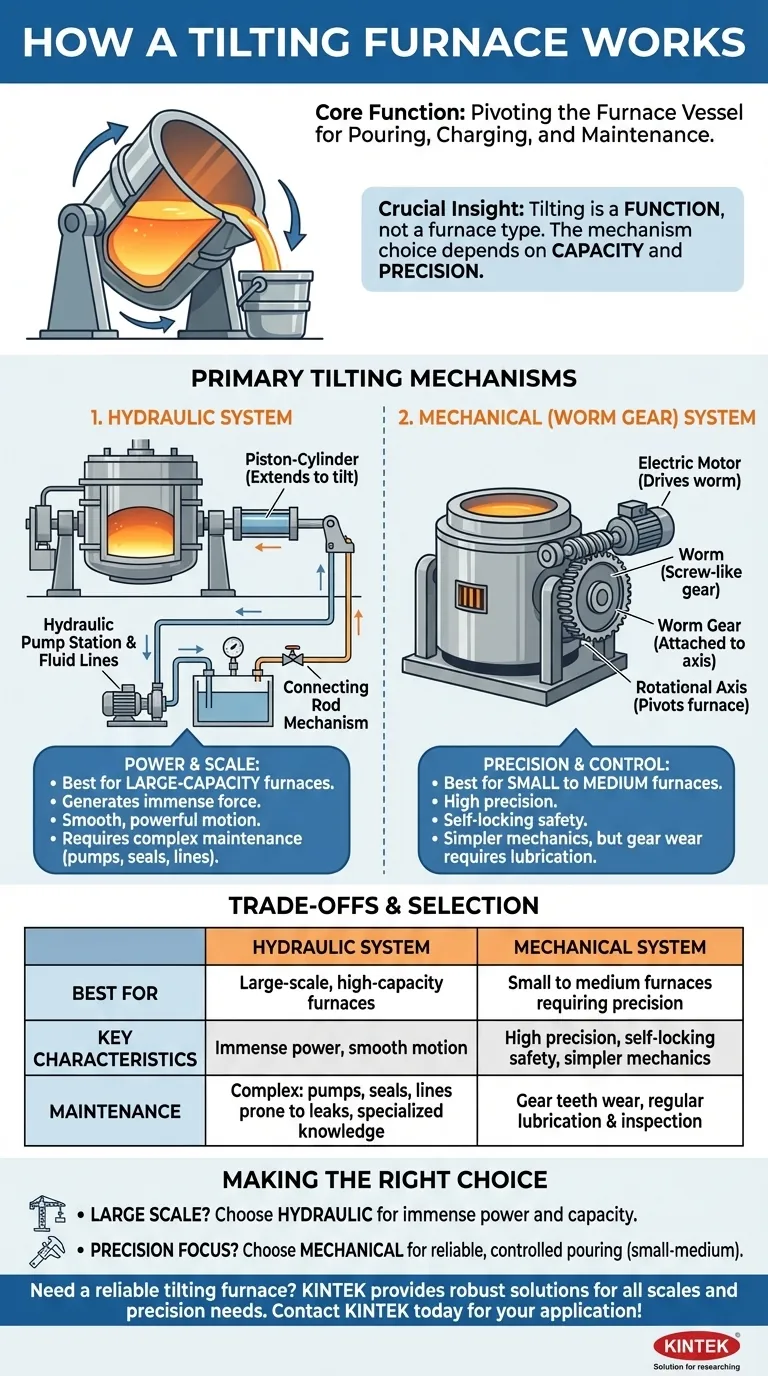
At its core, a tilting furnace works by physically pivoting the main vessel of the furnace. This is accomplished using a powerful actuation system, most commonly hydraulic pistons or a motor-driven gear mechanism. The entire furnace body rotates on a horizontal axis, allowing for the precise and controlled pouring of molten metal into a ladle or mold, as well as facilitating charging and maintenance.

The essential takeaway is that "tilting" is a function, not a single type of furnace. The choice between the two primary mechanisms—hydraulic and mechanical gear-driven—is dictated by the furnace's capacity and the level of precision required for the operation.

How does a tilting furnace work? A Guide to Hydraulic & Mechanical Pouring Systems

The Core Function of a Tilting Furnace

Before examining the mechanisms, it's crucial to understand why tilting is a fundamental requirement in many metallurgical operations. The ability to tilt the furnace serves several critical purposes.

Purpose 1: Pouring Molten Metal

The primary and most obvious function is tapping, or pouring the molten metal out of the furnace once it has reached the desired temperature and composition. A controlled tilt ensures a smooth, safe pour with minimal splashing and turbulence.

Purpose 2: Aiding in Charging and Maintenance

Tilting can also be used to position the furnace for easier charging (loading raw materials) or for maintenance tasks like electrode removal and replacement in an electric arc furnace.

Primary Tilting Mechanisms Explained

While the goal is simple—to tilt the furnace—the engineering to accomplish it for a vessel holding tons of molten metal is significant. Two designs dominate the industry.

Hydraulic Tilting Systems

A hydraulic tilting system uses the power of pressurized fluid to move the furnace. It consists of a high-pressure pump station, pipelines, and one or more hydraulic piston-cylinders connected to the furnace body.

When activated, the pump forces hydraulic fluid into the cylinders, extending the pistons. This linear force is transferred through a connecting rod mechanism, which rotates the furnace smoothly and powerfully. This method is common for larger furnaces where immense force is required.

Mechanical (Worm Gear) Tilting Systems

This mechanism relies on a motor and a specialized gear set. An electric motor drives a worm (a screw-like gear), which meshes with a large worm gear attached to the furnace's rotational axis.

As the motor turns the worm, the worm gear rotates very slowly but with tremendous torque, tilting the furnace with high precision. This system is often favored for small to medium-sized induction furnaces, typically in the 1 to 3-ton capacity range.

Understanding the Trade-offs: Hydraulic vs. Mechanical

Choosing between a hydraulic and a mechanical system involves clear engineering trade-offs related to power, control, and maintenance.

Power and Scale

Hydraulic systems generate immense force, making them the standard for large-capacity furnaces where the weight of the vessel and its contents is substantial.

Mechanical gear systems are highly effective but are generally limited to smaller-scale applications where the required torque is lower.

Precision and Control

The worm gear mechanism is naturally self-locking, meaning it cannot be driven in reverse. This provides an inherent safety feature and allows for extremely precise, non-slipping positional control during a pour.

Hydraulic systems offer very smooth and powerful motion but require more complex control valves and systems to achieve the same level of fine-tuned positioning.

Maintenance and Complexity

Hydraulic systems involve pumps, high-pressure lines, and seals that can be prone to leaks over time. Maintenance often requires specialized knowledge of hydraulic circuits.

Mechanical systems are generally simpler, but the gear teeth are subject to significant wear and require regular lubrication and inspection to prevent failure.

Making the Right Choice for Your Application

The selection of a tilting mechanism is not arbitrary; it is a direct consequence of the furnace's intended scale and operational demands.

  • If your primary focus is large-scale production: A hydraulic system is the necessary choice to handle the immense weight and provide the raw power needed to tilt high-capacity furnaces safely.
  • If your primary focus is precision for small to medium furnaces: A motor-driven worm gear system offers excellent, reliable control with simpler mechanics and inherent safety features.

Ultimately, the right tilting system is the one that safely and reliably matches the physical demands of the furnace it is designed to move.

Summary Table:

Tilting Mechanism Best For Key Characteristics
Hydraulic System Large-scale, high-capacity furnaces Immense power, smooth motion, complex maintenance
Mechanical (Worm Gear) System Small to medium furnaces requiring precision High precision, self-locking safety, simpler mechanics

Need a reliable tilting furnace for your lab or foundry?

KINTEK specializes in lab equipment and consumables, providing robust furnaces tailored to your specific metallurgical processes. Whether you require the immense power of a hydraulic system for large-scale production or the precise control of a mechanical gear system for smaller batches, our experts can help you select the right equipment to ensure safe, efficient, and controlled pouring.

Contact KINTEK today to discuss your application and find the perfect tilting furnace solution!

Visual Guide
How does a tilting furnace work? A Guide to Hydraulic & Mechanical Pouring Systems Visual Guide

Related Products

People Also Ask

Related Products

Laboratory Vacuum Tilt Rotary Tube Furnace Rotating Tube Furnace

Laboratory Vacuum Tilt Rotary Tube Furnace Rotating Tube Furnace

Discover the versatility of Laboratory Rotary Furnace: Ideal for calcination, drying, sintering, and high-temperature reactions. Adjustable rotating and tilting functions for optimal heating. Suitable for vacuum and controlled atmosphere environments. Learn more now!

High Temperature Muffle Oven Furnace for Laboratory Debinding and Pre Sintering

High Temperature Muffle Oven Furnace for Laboratory Debinding and Pre Sintering

KT-MD High temperature debinding and pre-sintering furnace for ceramic materials with various molding processes. Ideal for electronic components such as MLCC and NFC.

Electric Rotary Kiln Pyrolysis Furnace Plant Machine Calciner Small Rotary Kiln Rotating Furnace

Electric Rotary Kiln Pyrolysis Furnace Plant Machine Calciner Small Rotary Kiln Rotating Furnace

Electric rotary kiln - precisely controlled, it's ideal for calcination and drying of materials like lithium cobalate, rare earths, and non-ferrous metals.

Laboratory Muffle Oven Furnace Bottom Lifting Muffle Furnace

Laboratory Muffle Oven Furnace Bottom Lifting Muffle Furnace

Efficiently produce batches with excellent temperature uniformity using our Bottom Lifting Furnace. Features two electric lifting stages and advanced temperature control up to 1600℃.

Rotary Tube Furnace Split Multi Heating Zone Rotating Tube Furnace

Rotary Tube Furnace Split Multi Heating Zone Rotating Tube Furnace

Multi zone rotary furnace for high-precision temperature control with 2-8 independent heating zones. Ideal for lithium ion battery electrode materials and high-temperature reactions. Can work under vacuum and controlled atmosphere.

Vacuum Sealed Continuous Working Rotary Tube Furnace Rotating Tube Furnace

Vacuum Sealed Continuous Working Rotary Tube Furnace Rotating Tube Furnace

Experience efficient material processing with our vacuum-sealed rotary tube furnace. Perfect for experiments or industrial production, equipped with optional features for controlled feeding and optimized results. Order now.

Vertical High Temperature Graphite Vacuum Graphitization Furnace

Vertical High Temperature Graphite Vacuum Graphitization Furnace

Vertical high temperature graphitization furnace for carbonization and graphitization of carbon materials up to 3100℃.Suitable for shaped graphitization of carbon fiber filaments and other materials sintered in a carbon environment.Applications in metallurgy, electronics, and aerospace for producing high-quality graphite products like electrodes and crucibles.

Vacuum Heat Treat and Pressure Sintering Furnace for High Temperature Applications

Vacuum Heat Treat and Pressure Sintering Furnace for High Temperature Applications

Vacuum pressure sintering furnaces are designed for high temperature hot pressing applications in metal and ceramic sintering. Its advanced features ensure precise temperature control, reliable pressure maintenance, and a robust design for seamless operation.

Multi Heating Zones CVD Tube Furnace Machine Chemical Vapor Deposition Chamber System Equipment

Multi Heating Zones CVD Tube Furnace Machine Chemical Vapor Deposition Chamber System Equipment

KT-CTF14 Multi Heating Zones CVD Furnace - Precise Temperature Control and Gas Flow for Advanced Applications. Max temp up to 1200℃, 4 channels MFC mass flow meter, and 7" TFT touch screen controller.

Graphite Vacuum Furnace High Thermal Conductivity Film Graphitization Furnace

Graphite Vacuum Furnace High Thermal Conductivity Film Graphitization Furnace

The high thermal conductivity film graphitization furnace has uniform temperature, low energy consumption and can operate continuously.

Mesh belt controlled atmosphere furnace

Mesh belt controlled atmosphere furnace

Discover our KT-MB mesh belt sintering furnace - perfect for high-temperature sintering of electronic components & glass insulators. Available for open air or controlled atmosphere environments.

Vertical Laboratory Tube Furnace

Vertical Laboratory Tube Furnace

Elevate your experiments with our Vertical Tube Furnace. Versatile design allows for operation under various environments and heat treatment applications. Order now for precise results!

Inclined Rotary Plasma Enhanced Chemical Vapor Deposition PECVD Equipment Tube Furnace Machine

Inclined Rotary Plasma Enhanced Chemical Vapor Deposition PECVD Equipment Tube Furnace Machine

Introducing our inclined rotary PECVD furnace for precise thin film deposition. Enjoy automatic matching source, PID programmable temperature control, and high accuracy MFC mass flowmeter control. Built-in safety features for peace of mind.

Horizontal High Temperature Graphite Vacuum Graphitization Furnace

Horizontal High Temperature Graphite Vacuum Graphitization Furnace

Horizontal Graphitization Furnace: This type of furnace is designed with the heating elements placed horizontally, allowing for uniform heating of the sample. It's well-suited for graphitizing large or bulky samples that require precise temperature control and uniformity.

Controlled Nitrogen Inert Hydrogen Atmosphere Furnace

Controlled Nitrogen Inert Hydrogen Atmosphere Furnace

KT-AH Hydrogen atmosphere furnace - induction gas furnace for sintering/annealing with built-in safety features, dual housing design, and energy-saving efficiency. Ideal for lab and industrial use.

1200℃ Split Tube Furnace with Quartz Tube Laboratory Tubular Furnace

1200℃ Split Tube Furnace with Quartz Tube Laboratory Tubular Furnace

KT-TF12 split tube furnace: high-purity insulation, embedded heating wire coils, and max. 1200C. Widely used for new materials and chemical vapour deposition.

1200℃ Controlled Atmosphere Furnace Nitrogen Inert Atmosphere Furnace

1200℃ Controlled Atmosphere Furnace Nitrogen Inert Atmosphere Furnace

Discover our KT-12A Pro Controlled atmosphere furnace - high precision, heavy duty vacuum chamber, versatile smart touch screen controller, and excellent temperature uniformity up to 1200C. Ideal for both laboratory and industrial application.

1200℃ Muffle Furnace Oven for Laboratory

1200℃ Muffle Furnace Oven for Laboratory

Upgrade your lab with our 1200℃ Muffle Furnace. Achieve fast, precise heating with Japan alumina fibers and Molybdenum coils. Features TFT touch screen controller for easy programming and data analysis. Order now!

1700℃ Muffle Oven Furnace for Laboratory

1700℃ Muffle Oven Furnace for Laboratory

Get superior heat control with our 1700℃ Muffle Furnace. Equipped with intelligent temperature microprocessor, TFT touch screen controller & advanced insulation materials for precise heating up to 1700C. Order now!

1700℃ Controlled Atmosphere Furnace Nitrogen Inert Atmosphere Furnace

1700℃ Controlled Atmosphere Furnace Nitrogen Inert Atmosphere Furnace

KT-17A Controlled atmosphere furnace: 1700℃ heating, vacuum sealing technology, PID temperature control, and versatile TFT smart touch screen controller for laboratory and industrial use.


Leave Your Message