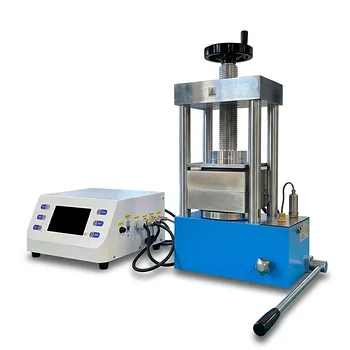
The uniaxial hydraulic press acts as the critical densification engine in the fabrication of LCO (Lithium Cobalt Oxide) and LATP (Lithium Aluminum Titanium Phosphate) composite green bodies. By applying significant pressure—specifically reaching levels such as 2 t/cm²—it forces the rearrangement of powder particles and induces plastic deformation to create a cohesive solid structure.
The primary function of the press is to eliminate voids and establish tight physical contact between cathode and electrolyte particles. This high-density interface is the mandatory prerequisite for effective elemental diffusion and solid-phase reactions during the subsequent co-sintering process.
Mechanisms of Physical Transformation
Inducing Plastic Deformation
The application of high pressure goes beyond simple packing; it causes the powder particles to undergo plastic deformation.
At pressures like 2 t/cm², the material does not just shift; it physically deforms to fill interstitial spaces. This deformation is essential for maximizing the density of the green body before heat treatment.
Particle Rearrangement
Initially, loose powders contain significant air gaps and random orientations. The uniaxial force compels these particles to rearrange into a more ordered, tightly packed configuration.
This mechanical reorganization reduces porosity and ensures that the LCO and LATP particles are physically touching, rather than separated by voids.
Establishing the Foundation for Sintering
Enabling Elemental Diffusion
The ultimate goal of the composite is to function chemically and electrically, which requires successful co-sintering.
The hydraulic press facilitates this by creating the necessary physical foundation. Without the intimate contact established by the press, the atomic migration required for diffusion cannot occur efficiently during heating.
Creating Effective Interfaces
The interface between the cathode (LCO) and the solid electrolyte (LATP) is critical for performance.
The pressing process forces these distinct materials into high-density contact. This ensures that solid-phase reactions occur exactly where needed, bonding the materials into a functional composite during the thermal cycle.
Structural Integrity and Handling
Achieving Mechanical Strength
A "green body" is an unfired ceramic object that is fragile by nature. The hydraulic press compacts the powder mixture into a disc or cylinder with sufficient mechanical strength.
This structural stability allows the sample to be ejected, handled, and loaded into sintering furnaces or high-pressure assemblies without crumbling or losing its geometric shape.
Air Removal and Gap Reduction
Before chemical bonding can occur, physical gaps must be minimized.
The compression process facilitates the expulsion of trapped air and effectively reduces the gaps between particles. This minimizes the risk of shrinkage, deformation, or micro-crack formation during the high-temperature sintering stage.
Understanding the Trade-offs
Uniaxial Limitations and Density Gradients
While uniaxial pressing is effective for shaping, it applies force from a single axis. This can occasionally lead to density gradients, where the edges or surfaces closer to the piston are denser than the center.
The Need for Subsequent Processing
The green body produced is stable but not yet fully densified for final use.
Often, the uniaxial press serves as a preliminary shaping step. As noted in broader contexts, this may need to be followed by Cold Isostatic Pressing (CIP) or high-temperature sintering to achieve total densification and eliminate all microscopic voids.
Making the Right Choice for Your Goal
To maximize the effectiveness of your uniaxial pressing stage, consider your primary objective:
- If your primary focus is electrochemical performance: Ensure you reach the high-pressure threshold (e.g., 2 t/cm²) to induce plastic deformation, as simple compaction is insufficient for effective elemental diffusion.
- If your primary focus is structural handling: Prioritize establishing a stable geometric shape with enough "green strength" to prevent cracking during transfer to the sintering furnace.
The uniaxial press does not merely shape the powder; it dictates the quality of the interface that will define the material's final performance.
Summary Table:
| Mechanism | Role in Green Body Formation | Impact on LCO/LATP Composite |
|---|---|---|
| Plastic Deformation | Material flow at high pressure (e.g., 2 t/cm²) | Maximizes density by filling interstitial spaces |
| Particle Rearrangement | Forced mechanical reorganization | Eliminates voids and establishes physical contact |
| Interface Formation | High-density contact creation | Prerequisite for elemental diffusion during sintering |
| Structural Compaction | Geometric stabilization | Provides mechanical strength for handling and firing |
| Air Expulsion | Gap reduction | Minimizes shrinkage and micro-cracks during thermal cycles |
Elevate Your Battery Research with KINTEK Precision
Achieving the perfect high-density interface for LCO and LATP composites requires more than just pressure—it requires precision. KINTEK specializes in advanced laboratory equipment designed for the most demanding material science applications. From our robust uniaxial hydraulic presses (pellet, hot, and isostatic) to our specialized high-temperature furnaces and battery research tools, we provide the end-to-end solutions necessary for superior green body formation and sintering.
Ready to optimize your solid-state battery fabrication? Contact our technical experts today to discover how KINTEK’s comprehensive range of presses, crushing systems, and high-performance consumables can enhance your lab's efficiency and results.
Related Products
- Laboratory Hydraulic Press Split Electric Lab Pellet Press
- Automatic Laboratory Hydraulic Press for XRF & KBR Pellet Press
- Laboratory Hydraulic Pellet Press for XRF KBR FTIR Lab Applications
- 24T 30T 60T Heated Hydraulic Press Machine with Heated Plates for Laboratory Hot Press
- Laboratory Manual Hydraulic Pellet Press for Lab Use
People Also Ask
- What role does a laboratory hydraulic press play in platinum recovery research? Enhancing Sample Precision
- What are the specific applications of a lab hydraulic press in biochar evaluation? Optimize density and data accuracy.
- What are the roles of a laboratory hydraulic press and stainless steel molds in the preparation of graphite samples?
- What is the role of a laboratory hydraulic press in electrode prep? Maximize Energy Density & Sealing Precision
- Why must a laboratory hydraulic press equipped with cylindrical molds be used when preparing BZY green bodies? High Density