Knowledge How does a vacuum hot press furnace achieve high densification in LLZO? Unlock Superior Ceramic Electrolyte Performance
Author avatar

Tech Team · Kintek Solution

Updated 5 days ago

How does a vacuum hot press furnace achieve high densification in LLZO? Unlock Superior Ceramic Electrolyte Performance


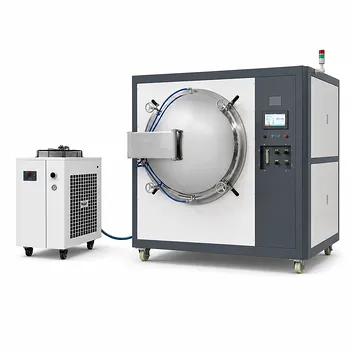
A vacuum hot press furnace achieves high densification in LLZO (Lithium Lanthanum Zirconium Oxide) ceramic materials by subjecting the powder to simultaneous high temperature and uniaxial mechanical pressure. Instead of relying solely on thermal diffusion, this process physically forces grains together under an inert gas atmosphere, effectively squeezing out pores to create a solid, highly dense electrolyte.

Core Takeaway: By coupling thermal energy with mechanical force, vacuum hot pressing activates plastic flow in ceramic particles. This allows LLZO to reach near-theoretical density and superior mechanical strength at temperatures lower than those required for conventional pressureless sintering.

The Mechanisms of Densification

The superiority of hot pressing lies in its ability to attack porosity from two directions: thermal activation and mechanical deformation.

The Role of Uniaxial Pressure

In a standard furnace, particles bond only where they naturally touch. Vacuum hot pressing applies significantly higher pressure, typically around 40 MPa.

This external force pushes the powder particles into a state of plastic flow. The grains physically deform and slide into the interstitial voids (pores) that would otherwise remain empty in a pressureless environment.

Thermal Activation and Diffusion

While pressure closes the gaps, temperature seals the bond. The process operates at high temperatures, often around 1000°C.

At this thermal level, atomic diffusion accelerates rapidly. This facilitates metallurgical bonding between the grains, ensuring that the material transforms from a compacted powder into a unified polycrystalline body.

Atmospheric Protection

Despite the name "vacuum" hot press, the primary reference notes that for LLZO, the process is often conducted under the protection of an inert gas like argon.

This controlled atmosphere is critical. It prevents oxidation and shields the material from reacting with environmental impurities, ensuring the final ceramic block maintains its chemical purity and structural integrity.

Why This Leads to Superior Performance

The goal of processing LLZO is to create a solid electrolyte with high ionic conductivity.

Eliminating Internal Pores

Conductivity is often halted by air pockets. The simultaneous application of heat and pressure effectively eliminates internal pores.

Enhancing Mechanical Properties

The result is a ceramic block with extremely high relative density. This structural compactness directly translates to superior mechanical properties, making the electrolyte robust enough to withstand the stresses of battery operation.

Understanding the Trade-offs

While vacuum hot pressing offers superior densification, it is a more complex process than standard sintering.

Complexity vs. Speed

Standard sintering (like in a box muffle furnace) relies on long durations and high temperatures to slowly grow grains. Hot pressing is faster and denser but requires sophisticated equipment to manage the simultaneous variables of pressure, heat, and gas flow.

Material Constraints

The pressure helps "difficult-to-deform" materials reach full density. However, accurate control is required to prevent abnormal grain growth, which can occur if the thermal and mechanical energies are not perfectly balanced.

Making the Right Choice for Your Goal

  • If your primary focus is Maximum Conductivity: Use vacuum hot pressing to achieve the highest possible density and eliminate porosity that blocks ion flow.
  • If your primary focus is Mechanical Strength: Choose this method to produce a compact, pore-free structure that resists cracking under stress.

Vacuum hot pressing transforms LLZO from a porous powder into a dense, high-performance ceramic by mechanically forcing particle integration under protective thermal conditions.

Summary Table:

Feature Pressureless Sintering Vacuum Hot Pressing
Mechanism Thermal diffusion only Simultaneous heat + mechanical pressure
Driving Force Surface energy reduction External uniaxial force (approx. 40 MPa)
Densification Moderate to High Near-theoretical (maximum)
Porosity Significant residual pores Minimal to zero pores
LLZO Benefit Basic ionic flow Maximum ionic conductivity & mechanical strength

Elevate Your LLZO Research with KINTEK Precision

Achieving the theoretical density of LLZO requires a perfect balance of thermal activation and mechanical force. KINTEK specializes in advanced laboratory equipment designed to meet these rigorous demands. Our high-performance vacuum hot press furnaces and isostatic presses provide the precise control needed to eliminate porosity and maximize ionic conductivity in your solid electrolyte materials.

Whether you are developing next-generation battery technologies or high-strength ceramics, KINTEK offers a comprehensive portfolio including:

  • High-temperature furnaces (Vacuum, Tube, and Muffle)
  • Hydraulic pellet and hot presses for superior densification
  • Crushing and milling systems for optimal powder preparation
  • Consumables such as high-purity ceramics and crucibles

Ready to achieve superior densification and mechanical integrity? Contact our technical experts today to find the ideal thermal and pressure solution for your laboratory.

Related Products

People Also Ask

Related Products

Vacuum Hot Press Furnace Machine Heated Vacuum Press

Vacuum Hot Press Furnace Machine Heated Vacuum Press

Discover the advantages of Vacuum Hot Press Furnace! Manufacture dense refractory metals & compounds, ceramics, and composites under high temp and pressure.

Vacuum Hot Press Furnace Heated Vacuum Press Machine Tube Furnace

Vacuum Hot Press Furnace Heated Vacuum Press Machine Tube Furnace

Reduce forming pressure & shorten sintering time with Vacuum Tube Hot Press Furnace for high-density, fine-grain materials. Ideal for refractory metals.

600T Vacuum Induction Hot Press Furnace for Heat Treat and Sintering

600T Vacuum Induction Hot Press Furnace for Heat Treat and Sintering

Discover the 600T Vacuum Induction Hot Press Furnace, designed for high-temperature sintering experiments in vacuum or protected atmospheres. Its precise temperature and pressure control, adjustable working pressure, and advanced safety features make it ideal for nonmetal materials, carbon composites, ceramics, and metal powders.

Vacuum Heat Treat Furnace with Ceramic Fiber Liner

Vacuum Heat Treat Furnace with Ceramic Fiber Liner

Vacuum furnace with polycrystalline ceramic fiber insulation liner for excellent heat insulation and uniform temperature field. Choose from 1200℃ or 1700℃ max. working temperature with high vacuum performance and precise temperature control.

High Pressure Laboratory Vacuum Tube Furnace Quartz Tubular Furnace

High Pressure Laboratory Vacuum Tube Furnace Quartz Tubular Furnace

KT-PTF High Pressure Tube Furnace: Compact split tube furnace with strong positive pressure resistance. Working temp up to 1100°C and pressure up to 15Mpa. Also works under controller atmosphere or high vacuum.

2200 ℃ Tungsten Vacuum Heat Treat and Sintering Furnace

2200 ℃ Tungsten Vacuum Heat Treat and Sintering Furnace

Experience the ultimate refractory metal furnace with our Tungsten vacuum furnace. Capable of reaching 2200℃, perfect for sintering advanced ceramics and refractory metals. Order now for high-quality results.

Vacuum Heat Treat and Molybdenum Wire Sintering Furnace for Vacuum Sintering

Vacuum Heat Treat and Molybdenum Wire Sintering Furnace for Vacuum Sintering

A vacuum molybdenum wire sintering furnace is a vertical or bedroom structure, which is suitable for withdrawal, brazing, sintering and degassing of metal materials under high vacuum and high temperature conditions. It is also suitable for dehydroxylation treatment of quartz materials.

Vacuum Heat Treat Sintering Brazing Furnace

Vacuum Heat Treat Sintering Brazing Furnace

A vacuum brazing furnace is a type of industrial furnace used for brazing, a metalworking process that joins two pieces of metal using a filler metal that melts at a lower temperature than the base metals. Vacuum brazing furnaces are typically used for high-quality applications where a strong, clean joint is required.

Molybdenum Vacuum Heat Treat Furnace

Molybdenum Vacuum Heat Treat Furnace

Discover the benefits of a high-configuration molybdenum vacuum furnace with heat shield insulation. Ideal for high-purity, vacuum environments like sapphire crystal growth and heat treatment.

2200 ℃ Graphite Vacuum Heat Treat Furnace

2200 ℃ Graphite Vacuum Heat Treat Furnace

Discover the power of the KT-VG Graphite Vacuum Furnace - with a maximum working temperature of 2200℃, it's perfect for vacuum sintering of various materials. Learn more now.

Mesh belt controlled atmosphere furnace

Mesh belt controlled atmosphere furnace

Discover our KT-MB mesh belt sintering furnace - perfect for high-temperature sintering of electronic components & glass insulators. Available for open air or controlled atmosphere environments.

Ultra-High Temperature Graphite Vacuum Graphitization Furnace

Ultra-High Temperature Graphite Vacuum Graphitization Furnace

The ultra-high temperature graphitization furnace utilizes medium frequency induction heating in a vacuum or inert gas environment. The induction coil generates an alternating magnetic field, inducing eddy currents in the graphite crucible, which heats up and radiates heat to the workpiece, bringing it to the desired temperature. This furnace is primarily used for graphitization and sintering of carbon materials, carbon fiber materials, and other composite materials.

Vacuum Heat Treat and Sintering Furnace with 9MPa Air Pressure

Vacuum Heat Treat and Sintering Furnace with 9MPa Air Pressure

The air pressure sintering furnace is a high-tech equipment commonly used for the sintering of advanced ceramic materials. It combines vacuum sintering and pressure sintering techniques to achieve high-density and high-strength ceramics.

1800℃ Muffle Oven Furnace for Laboratory

1800℃ Muffle Oven Furnace for Laboratory

KT-18 muffle furnace with Japan Al2O3 polycrystalline fibe and Silicon Molybdenum heating element, up to 1900℃, PID temperature control and 7" smart touch screen. Compact design, low heat loss, and high energy efficiency. Safety interlock system and versatile functions.

Laboratory Rapid Thermal Processing (RTP) Quartz Tube Furnace

Laboratory Rapid Thermal Processing (RTP) Quartz Tube Furnace

Get lightning-fast heating with our RTP Rapid Heating Tube Furnace. Designed for precise, high-speed heating and cooling with convenient sliding rail and TFT touch screen controller. Order now for ideal thermal processing!

Horizontal High Temperature Graphite Vacuum Graphitization Furnace

Horizontal High Temperature Graphite Vacuum Graphitization Furnace

Horizontal Graphitization Furnace: This type of furnace is designed with the heating elements placed horizontally, allowing for uniform heating of the sample. It's well-suited for graphitizing large or bulky samples that require precise temperature control and uniformity.

1700℃ Muffle Oven Furnace for Laboratory

1700℃ Muffle Oven Furnace for Laboratory

Get superior heat control with our 1700℃ Muffle Furnace. Equipped with intelligent temperature microprocessor, TFT touch screen controller & advanced insulation materials for precise heating up to 1700C. Order now!

Graphite Vacuum Furnace High Thermal Conductivity Film Graphitization Furnace

Graphite Vacuum Furnace High Thermal Conductivity Film Graphitization Furnace

The high thermal conductivity film graphitization furnace has uniform temperature, low energy consumption and can operate continuously.

Vacuum Dental Porcelain Sintering Furnace

Vacuum Dental Porcelain Sintering Furnace

Get precise and reliable results with KinTek's Vacuum Porcelain Furnace. Suitable for all porcelain powders, it features hyperbolic ceramic furnace function, voice prompt, and automatic temperature calibration.

1700℃ Laboratory High Temperature Tube Furnace with Alumina Tube

1700℃ Laboratory High Temperature Tube Furnace with Alumina Tube

Looking for a high-temperature tube furnace? Check out our 1700℃ Tube Furnace with Alumina Tube. Perfect for research and industrial applications up to 1700C.


Leave Your Message