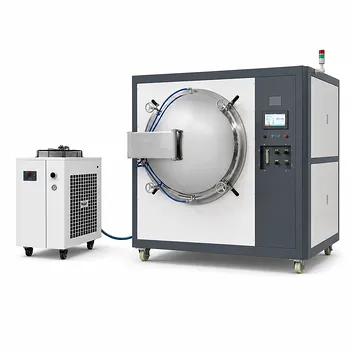
A vacuum hot-press furnace optimizes MoSi2-based composite microstructures by strictly controlling the sintering environment to simultaneously prevent oxidation and force material densification. By maintaining a high vacuum (specifically $1.33 \times 10^{-2}$ Pa) and applying mechanical pressure at temperatures up to $1700^\circ$C, the process eliminates voids and strengthens interface bonding in ways that pressureless sintering cannot achieve.
Core Takeaway Achieving high-performance MoSi2 composites requires more than just heat; it demands the synergy of thermal energy and mechanical force. The vacuum hot-press technique is essential because it drives the physical rearrangement of particles for maximum density while chemically preserving the material against oxidation, directly resulting in superior fracture toughness and hardness.
The Critical Role of Environmental Control
Preventing Chemical Degradation
The primary challenge in sintering Molybdenum Disilicide (MoSi2) is its susceptibility to oxidation at elevated temperatures. A vacuum hot-press furnace mitigates this by maintaining a precise vacuum environment, typically around 1.33×10^-2 Pa.
Preserving Material Purity
This vacuum level effectively inhibits the oxidation of both the MoSi2 matrix and any metallic components within the composite.
By removing oxygen from the equation, the furnace ensures that the final microstructure is composed of pure, high-quality phases rather than brittle oxides that would degrade performance.
Synergy of Heat and Pressure
Driving Densification
While temperature facilitates diffusion, it is the addition of uniaxial holding pressure that mechanically forces particles to rearrange.
This pressure acts as an external driving force, causing grains to slide and fit tightly together. This mechanism effectively eliminates voids between particles, leading to significantly higher relative densities than thermal sintering alone.
Optimizing Interface Bonding
The combination of pressure and high temperature (reaching 1700°C) is critical for composite reinforcement, particularly for materials containing Silicon Carbide (SiC).
The process promotes strong interface bonding between the MoSi2 matrix and SiC reinforcements. This tight bonding is necessary to transfer loads effectively across the microstructure, which directly improves the material's hardness.
Managing Phase Transformations
The furnace allows for the synergistic control of heating rates (e.g., 20°C/min) and maximum temperature.
This precise thermal profile is essential for managing phase transformations, such as those found in Zirconia (ZrO2) additives. Controlled transformation prevents micro-cracking and contributes to the toughening mechanisms of the composite.
Understanding the Trade-offs
Geometry Limitations
The application of uniaxial pressure generally limits the shapes you can produce. Vacuum hot pressing is ideal for simple geometries like plates, discs, or cylinders, but it is ill-suited for complex, near-net-shape components with intricate 3D features.
Process Efficiency
This is a batch process that requires significant cycle times to heat, hold, and cool under vacuum. Compared to continuous pressureless sintering, throughput is lower and the cost per part is generally higher, making it best suited for high-value applications where material performance is non-negotiable.
Making the Right Choice for Your Goal
To maximize the potential of MoSi2-based composites, you must prioritize specific process parameters based on your desired outcome:
- If your primary focus is Fracture Toughness: Prioritize the optimization of the heating rate ($20^\circ$C/min) and holding pressure to ensure proper phase transformation of additives like ZrO2 and robust SiC bonding.
- If your primary focus is Material Purity: Ensure your equipment can reliably maintain a deep vacuum ($1.33 \times 10^{-2}$ Pa or better) throughout the heating cycle to strictly prevent oxidation of metallic components.
Ultimate material performance is achieved not by maximizing a single variable, but by balancing the triad of vacuum integrity, thermal precision, and mechanical pressure.
Summary Table:
| Process Parameter | Controlling Mechanism | Microstructural Impact |
|---|---|---|
| High Vacuum ($1.33 \times 10^{-2}$ Pa) | Prevents oxidation & chemical degradation | High phase purity; eliminates brittle oxide layers |
| Uniaxial Pressure | Forced particle rearrangement & grain sliding | Full densification; elimination of internal voids |
| High Temp (Up to $1700^\circ$C) | Enhanced diffusion & phase transformation | Strong interface bonding; optimized reinforcement phases |
| Controlled Cooling/Heating | Thermal stress & phase management | Enhanced fracture toughness; prevention of micro-cracks |
Elevate your material science research with KINTEK's precision engineering. Whether you are developing advanced MoSi2-based composites or high-performance ceramics, our range of vacuum hot-press furnaces, crushing and milling systems, and hydraulic presses provides the exact thermal and mechanical control required for superior results. From high-temperature reactors to specialized consumables like crucibles and ceramics, KINTEK supports every stage of your lab workflow. Contact us today to discover how our high-performance laboratory equipment can optimize your sintering processes and material outcomes!
Related Products
- Vacuum Hot Press Furnace Heated Vacuum Press Machine Tube Furnace
- 600T Vacuum Induction Hot Press Furnace for Heat Treat and Sintering
- Vacuum Hot Press Furnace Machine Heated Vacuum Press
- Vacuum Hot Press Furnace Machine for Lamination and Heating
- Vacuum Heat Treat and Pressure Sintering Furnace for High Temperature Applications
People Also Ask
- What advantages does a vacuum hot press furnace provide for LSLBO ceramic electrolytes? Achieve 94% Relative Density
- What role does a Vacuum Hot Press (VHP) furnace play in the densification of austenitic stainless steel 316 composites?
- What are the advantages of using a vacuum hot pressing furnace? Superior Densification for 2024Al/Gr/SiC Composites
- What are the advantages of a vacuum hot press furnace for LTPO solid electrolytes? Boost Density and Conductivity
- What core processing conditions does a vacuum hot press furnace provide? Achieve High-Density Cu-SiC/Diamond Composites