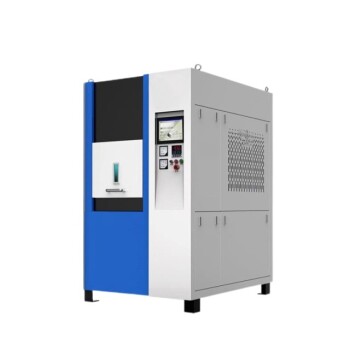
A vacuum hot pressing sintering furnace facilitates high densification by integrating a high-vacuum environment with the simultaneous application of axial pressure and precise thermal energy. Specifically for Al-30%Sc alloys, this process prevents the oxidation of reactive aluminum and scandium while utilizing 30 MPa of pressure at 630°C to accelerate atomic diffusion and mechanically close internal pores.
The core advantage of this method is the reduction of sintering activation energy. By replacing pure thermal reliance with mechanical force in an oxygen-free zone, the system achieves relative densities exceeding 93% while maintaining material purity.
The Mechanism of Densification
1. The Vacuum Barrier
Protecting Active Metals Aluminum (Al) and Scandium (Sc) are highly active metals that oxidize rapidly when exposed to air at elevated temperatures. A standard sintering atmosphere would lead to the formation of oxide layers on particle surfaces.
Ensuring Clean Bonding The high-vacuum environment is not merely for cleanliness; it is a functional requirement. It prevents oxidation and facilitates the degassing of adsorbed gases from the powder surface. This ensures that when particles come into contact, metal-to-metal bonding occurs rather than metal-oxide bonding.
2. Synergistic Pressure and Heat
Overcoming Material Resistance Pressureless sintering often fails to fully densify these alloys because the driving force (surface energy reduction) is insufficient to eliminate all pores. The furnace applies axial pressure (30 MPa), which mechanically forces powder particles together.
Accelerating Diffusion Combined with a thermal field of 630°C, this pressure significantly reduces the sintering activation energy. This "path of least resistance" accelerates atomic diffusion and material migration, allowing the material to consolidate much faster than with heat alone.
Closing Residual Pores The mechanical pressure promotes plastic flow and particle rearrangement. This effectively crushes and closes the interstitial pores between particles that thermal diffusion alone might leave behind.
3. Precision Thermal Control
Balancing Diffusion and Melting The operating temperature of 630°C is critical. It is intentionally set close to the melting point of aluminum to maximize the atomic diffusion rate, which drives the densification process.
Preventing Phase Defects However, this temperature must be strictly controlled. It is high enough to promote the formation of desirable Al3Sc and Al2Sc phases but remains below the solidus temperature to prevent localized melting. Overheating would lead to compositional segregation, ruining the alloy's uniformity.
Understanding the Trade-offs
The Cost of Complexity
While vacuum hot pressing yields superior density, it introduces significant complexity compared to conventional sintering. The equipment is expensive, and the requirement for vacuum maintenance adds to the cycle time.
Throughput Limitations
This is typically a batch process. Unlike continuous sintering belts, the need to apply uniaxial pressure limits the geometry and volume of parts that can be processed simultaneously.
Thermal Sensitivity
Operating at 630°C requires extremely precise instrumentation. A deviation of just a few degrees could either stall the densification process (if too cool) or cause the material to slump and segregate (if too hot).
Making the Right Choice for Your Goal
To maximize the quality of your Al-30%Sc alloy, consider your primary objective:
- If your primary focus is Maximum Density (>93%): Prioritize the application of high axial pressure (30 MPa) to mechanically force pore closure where thermal energy alone is insufficient.
- If your primary focus is Microstructural Purity: Ensure your vacuum system is capable of high-performance degassing to prevent oxide inclusions that degrade mechanical properties.
- If your primary focus is Homogeneity: Implement rigid temperature controls at 630°C to balance rapid atomic diffusion without crossing the threshold into localized melting.
Success in sintering Al-30%Sc relies on using pressure to compensate for the thermal limitations of these highly reactive metals.
Summary Table:
| Feature | Parameter | Impact on Al-30%Sc Alloy |
|---|---|---|
| Vacuum Environment | High-Vacuum | Prevents oxidation and ensures clean metal-to-metal bonding. |
| Sintering Temperature | 630°C | Maximizes atomic diffusion while preventing localized melting. |
| Axial Pressure | 30 MPa | Mechanically closes pores and promotes plastic flow for high density. |
| Achieved Density | >93% Relative | Delivers superior structural integrity and purity compared to pressureless methods. |
Elevate Your Material Research with KINTEK Precision
Unlock the full potential of your advanced materials with KINTEK’s high-performance laboratory solutions. Whether you are developing high-density Al-30%Sc alloys or exploring new metallurgical frontiers, our comprehensive range of vacuum hot pressing furnaces, muffle furnaces, and tube furnaces provides the precise thermal and atmospheric control you need.
From crushing and milling systems to isostatic hydraulic presses and essential ceramic crucibles, KINTEK specializes in equipping researchers with durable, high-accuracy tools. Let our expertise in high-temperature high-pressure reactors and specialized consumables accelerate your breakthroughs.
Ready to achieve superior densification and purity?
Contact KINTEK Today for a Expert Consultation
Related Products
- 600T Vacuum Induction Hot Press Furnace for Heat Treat and Sintering
- Vacuum Heat Treat and Sintering Furnace with 9MPa Air Pressure
- Vacuum Heat Treat and Pressure Sintering Furnace for High Temperature Applications
- 2200 ℃ Tungsten Vacuum Heat Treat and Sintering Furnace
- Vacuum Hot Press Furnace Heated Vacuum Press Machine Tube Furnace
People Also Ask
- What role does an induction vacuum hot pressing furnace play in sintering? Achieve 98% Density in Carbide Blocks
- What advantages does a vacuum hot press furnace provide for LSLBO ceramic electrolytes? Achieve 94% Relative Density
- What role does a Vacuum Hot Press (VHP) furnace play in the densification of austenitic stainless steel 316 composites?
- What role does mechanical pressure play during the vacuum diffusion bonding of tungsten and copper? Keys to Solid Bonding
- What are the advantages of a vacuum hot press furnace for W-50%Cu? Achieve 99.6% Density at Lower Temperatures