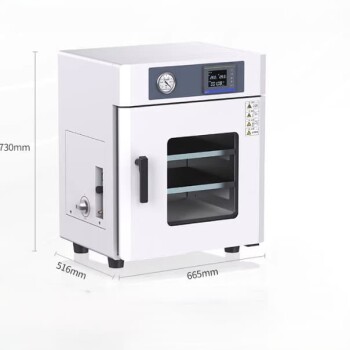
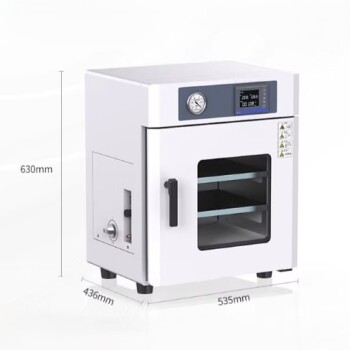
The vacuum oven is a critical preparatory tool utilized prior to the curing stage to ensure the structural integrity of non-isocyanate polyurethane (NIPU) films. Its primary function is the physical removal of trapped air and volatile solvents, which creates a dense, uniform material capable of sustaining high mechanical loads.
By actively degassing the mixture before the chemical reaction sets, the vacuum oven eliminates potential failure points like pinholes and micro-cracks. This step is the difference between a porous, weak coating and a solid, high-performance film.
The Mechanics of Defect Prevention
Eliminating Trapped Air
During the mixing of NIPU components, microscopic air bubbles are inevitably introduced into the liquid resin.
If left untreated, these bubbles become permanent voids within the material.
The vacuum oven lowers the atmospheric pressure surrounding the mixture, forcing these trapped bubbles to expand, rise to the surface, and escape.
Removing Residual Solvents
In addition to air, the preparation process often involves solvents that must be removed before the film hardens.
The vacuum environment lowers the boiling point of these solvents, facilitating their evaporation without requiring excessive heat that might prematurely trigger the chemical reaction.
Preventing Structural Weaknesses
The primary goal of this degassing process is to prevent specific defects: pinholes, micro-cracks, and hollow spots.
These microscopic defects act as stress concentrators.
By removing the precursors to these defects (air and solvents), the vacuum oven ensures the material remains continuous and solid.
Impact on Material Properties
Achieving a Dense Microstructure
Once the voids are removed, the remaining material can settle into a compact arrangement.
This results in a dense microstructure, characterized by a uniform distribution of the polymer matrix.
A dense microstructure is essential for consistent performance across the entire surface area of the film.
Enhancing Mechanical Strength
The uniformity provided by vacuum processing directly translates to high mechanical strength.
A film without internal voids can distribute physical stress more evenly.
Conversely, a film full of microscopic bubbles will be brittle and prone to cracking under pressure.
Distinguishing Preparation from Curing
The Role of the Vacuum Oven (Physical)
It is important to note that the vacuum oven is primarily used for the physical preparation of the film before the main curing cycle.
Its job is to purify the liquid state of the resin.
The Role of the Laboratory Oven (Chemical)
Once degassed, the material is typically moved to a standard laboratory oven for thermal curing.
As noted in supplementary contexts, this stage involves a continuous thermal field (e.g., 80 °C) over a long duration (12 to 15 hours).
This heat drives the chemical reaction—specifically the ring-opening of cyclic carbonates and the formation of stable urethane bonds—which locks in the dense structure created by the vacuum step.
Understanding the Trade-offs
Process Time vs. Material Integrity
Adding a vacuum degassing step increases the total production time.
However, skipping this step to speed up production is a common pitfall that results in inferior, porous films.
The time "saved" is negated by the significant loss in mechanical performance.
Temperature Management
While vacuum ovens can apply heat, applying too much heat during the vacuum stage can be detrimental.
If the curing reaction triggers while bubbles are still escaping, the bubbles may become trapped in the hardening matrix.
Therefore, the vacuum step must be carefully timed to occur before the material begins to cross-link and solidify.
Making the Right Choice for Your Goal
To achieve the best results with NIPU films, you must balance physical preparation with chemical curing.
- If your primary focus is Mechanical Strength: Prioritize a thorough vacuum degassing cycle to ensure a dense microstructure free of stress-cracking voids.
- If your primary focus is Chemical Resistance: Ensure the subsequent thermal curing cycle is sufficiently long (12–15 hours) to fully complete the cross-linking network.
Ultimately, the vacuum oven provides the flawless physical foundation required for the chemical curing process to succeed.
Summary Table:
| Feature | Function in NIPU Preparation | Impact on Final Film Quality |
|---|---|---|
| Air Removal | Degassing trapped microscopic bubbles | Prevents voids, pinholes, and micro-cracks |
| Solvent Evaporation | Lowers boiling points for low-temp removal | Ensures a solid, continuous polymer matrix |
| Pressure Control | Creates a vacuum environment | Facilitates uniform settlement of the resin |
| Structural Foundation | Physical purification before chemical curing | Maximizes mechanical strength and durability |
Elevate Your Polymer Research with KINTEK Precision
High-performance NIPU films require a flawless physical foundation. KINTEK specializes in advanced laboratory equipment, providing the precision vacuum ovens and laboratory ovens necessary to eliminate defects and ensure the structural integrity of your materials.
Beyond degassing and curing solutions, our comprehensive portfolio includes:
- High-Temperature Furnaces (Muffle, Tube, Vacuum, CVD/PECVD)
- Crushing & Milling Systems and Hydraulic Presses (Pellet, Isostatic)
- High-Pressure Reactors & Autoclaves for complex chemical synthesis
- Electrolytic Cells & Battery Research Tools
- Cooling Solutions (ULT Freezers, Freeze Dryers) and PTFE/Ceramic Consumables
Don't let trapped air or residual solvents compromise your mechanical testing. Partner with KINTEK for reliable, high-quality lab equipment tailored to your specific research needs.
Contact KINTEK Today to Optimize Your Lab Setup
References
- Mhd. Abd. Cader Mhd. Haniffa, Nai-Shang Liou. Synthesis, Characterization and the Solvent Effects on Interfacial Phenomena of Jatropha Curcas Oil Based Non-Isocyanate Polyurethane. DOI: 10.3390/polym9050162
This article is also based on technical information from Kintek Solution Knowledge Base .
Related Products
- 56L Vertical Laboratory Vacuum Drying Oven
- 23L Laboratory Vacuum Drying Oven
- Vacuum Heat Treat Sintering Brazing Furnace
- 2200 ℃ Graphite Vacuum Heat Treat Furnace
- Ultra-High Temperature Graphite Vacuum Graphitization Furnace
People Also Ask
- Why is a laboratory vacuum drying oven recommended for rice straw residues? Protect Your Biomass Integrity
- What role does a laboratory vacuum drying oven play in the preparation of modified multi-walled carbon nanotubes?
- What is the importance of using a laboratory vacuum drying oven? Preserving Slow-Release Microcapsule Integrity
- Why is a Laboratory Vacuum Drying Oven recommended for PBAT microspheres? Protect Sensitive Polymer Integrity
- What role does a laboratory vacuum drying oven play in processing nanoparticle powder samples? Protect Sample Integrity