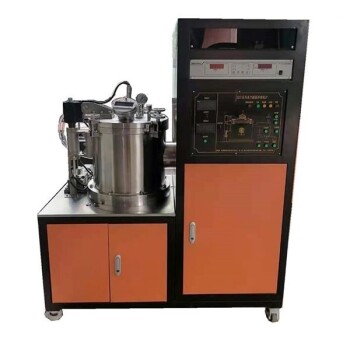
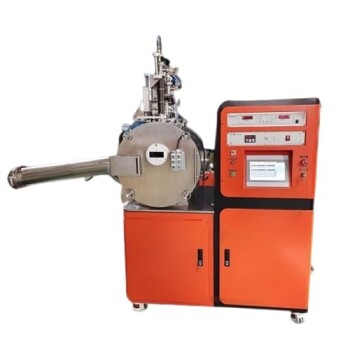
A vacuum resistance melting furnace prevents magnesium oxidation by completely replacing the furnace's internal atmosphere. Specifically, the system first evacuates the chamber to a deep vacuum ($10^{-3}$ Pa) to remove oxygen, then backfills it with high-purity argon gas to a pressure of approximately 150 Pa to physically isolate the molten AM60 alloy.
By substituting the reactive air with an inert argon shield, this technique eliminates the possibility of oxidation without introducing the contaminants associated with traditional chemical fluxes.
The Two-Step Isolation Mechanism
Step 1: Deep Vacuum Evacuation
The primary threat to molten magnesium is atmospheric oxygen. To neutralize this threat, the furnace first reduces internal pressure to $10^{-3}$ Pa.
At this pressure level, the vast majority of air molecules—including oxygen and nitrogen—are physically removed from the chamber. This creates a baseline environment where oxidation reactions simply cannot sustain themselves due to a lack of reactants.
Step 2: Argon Backfilling
Once the vacuum is established, the system introduces high-purity argon (Ar) gas.
The chamber is backfilled to a specific pressure, typically around 150 Pa. Because argon is an inert gas, it does not react with the magnesium. Instead, it acts as a protective blanket, maintaining pressure equilibrium while ensuring that no stray oxygen can reach the melt surface.
Why This Method is Superior for AM60 Refining
Eliminating Flux Inclusions
Traditional methods often use chemical fluxes to cover the melt and prevent burning.
However, these fluxes can become trapped inside the alloy, leading to flux inclusions. By using a vacuum and argon atmosphere, the furnace eliminates the need for flux entirely, resulting in a cleaner, higher-purity AM60 alloy.
Removing Environmental Hazards
Another common protection method involves using Sulfur Hexafluoride (SF6) gas.
While effective, SF6 is a potent greenhouse gas. The vacuum resistance furnace replaces SF6 with argon, providing a protection mechanism that is environmentally benign and free of greenhouse emissions.
Understanding the Operational Trade-offs
Process Precision vs. Chemical Simplicity
The shift to vacuum resistance melting represents a trade-off between chemical reliance and mechanical precision.
Traditional methods rely on adding chemicals (flux or SF6) to fight oxidation actively. The vacuum method relies on strict control of the physical environment. Success depends entirely on maintaining the integrity of the vacuum seal and the purity of the argon gas supply; a leak or impure gas source immediately compromises the protection.
Making the Right Choice for Your Goal
- If your primary focus is Alloy Purity: Choose the vacuum/argon method to eliminate the risk of flux inclusions weakening the final casting.
- If your primary focus is Environmental Compliance: Adopt this method to eliminate SF6 emissions and meet stricter sustainability standards.
Ultimate success in refining AM60 lies in the precise control of the inert atmosphere, ensuring oxygen never touches the melt.
Summary Table:
| Feature | Vacuum/Argon Method | Traditional Flux Method |
|---|---|---|
| Oxidation Control | Physical isolation via Argon | Chemical barrier layer |
| Alloy Purity | High (No flux inclusions) | Lower (Risk of inclusions) |
| Atmosphere | $10^{-3}$ Pa Vacuum + Argon | Ambient air + Flux/SF6 |
| Eco-Friendliness | High (No greenhouse gases) | Low (Uses SF6 or chemicals) |
| Key Advantage | Clean, sustainable refining | Simple equipment setup |
Elevate Your Alloy Purity with KINTEK’s Advanced Solutions
Don't let oxidation or flux inclusions compromise the integrity of your high-performance magnesium alloys. KINTEK specializes in precision laboratory equipment designed for the most demanding material science applications. Our comprehensive range of vacuum resistance furnaces, induction melting systems, and high-temperature furnaces provides the atmospheric control you need for superior AM60 refining.
Whether you are focusing on battery research, aerospace components, or advanced metallurgy, KINTEK offers the crushing, milling, and thermal processing tools required for excellence. Achieve cleaner results and meet environmental standards today—Contact our technical experts for a custom quote!
Related Products
- Non Consumable Vacuum Arc Induction Melting Furnace
- Vacuum Heat Treat Furnace and Levitation Induction Melting Furnace
- Lab-Scale Vacuum Induction Melting Furnace
- Vacuum Arc Induction Melting Furnace
- Vacuum Induction Melting Spinning System Arc Melting Furnace
People Also Ask
- What is the temperature range of the induction melting furnace? Find the Right Heat for Your Metals
- What is the use of induction melting furnace? Achieve Fast, Clean, and Precise Metal Melting
- What are the advantages of induction melting furnace? Achieve Purity, Efficiency, and Safety
- How do specialized industrial-grade small melting furnaces address challenges in precision jewelry casting? Expert Guide
- How do vacuum induction or arc melting furnaces facilitate the synthesis of U-Al-C MAX phases? Precision Heat & Purity