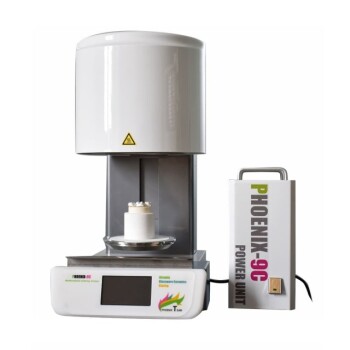
A vacuum sintering furnace controls material property distribution by precisely managing the liquid-phase sintering process to facilitate the diffusion of metallic binders. Through controlled heating, the furnace enables mass transfer between cemented carbide layers of different grain sizes, effectively erasing sharp interfaces and creating a seamless gradient of physical characteristics.
By orchestrating the migration of the metallic binder between layers, the furnace eliminates distinct structural boundaries. This allows the material to transition continuously from high hardness to high toughness, avoiding the brittleness associated with traditional, sharp-interface layering.
The Mechanics of Gradient Formation
Facilitating Mass Transfer
The core mechanism at play is liquid-phase sintering. Under the precise vacuum and temperature conditions of the furnace, the metallic binder within the material becomes liquid. This state allows the binder to migrate and diffuse actively between the various layers of the material stack.
Bridging Grain Sizes
Functionally Graded Materials (FGM) often consist of layers with different grain sizes. The vacuum furnace ensures that the liquid binder penetrates these variance zones. This interaction creates a cohesive bond that physically integrates layers that would otherwise remain distinct.
Eliminating Structural Weaknesses
Removing Distinct Interfaces
In traditional layered materials, the boundary between two layers is often a point of weakness or stress concentration. The vacuum sintering process utilizes controlled diffusion to eliminate these distinct interfaces. By blending the layers at a microscopic level, the furnace removes potential delamination points.
Continuous Property Evolution
Because the interfaces are eliminated, physical properties do not change abruptly. Instead, characteristics such as hardness and thermal stability change continuously throughout the material volume. This results in a composite that possesses the wear resistance of a hard surface and the durability of a tough core without a brittle transition zone.
Operational Criticality and Trade-offs
The Necessity of Precise Loading
Achieving a perfect gradient requires more than just temperature control; it demands strict adherence to loading regulations. Materials must be loaded onto discs using specific methods adapted to the product. Arbitrary changes to how the furnace is loaded can disrupt the thermal uniformity required for even diffusion.
The Complexity of Process Control
While the goal is a smooth gradient, the process relies on the delicate balance of binder migration. If the liquid phase is not maintained for the correct duration, the mass transfer may be incomplete, leaving residual interfaces. Conversely, incorrect processing could homogenize the material too much, negating the benefits of the intended gradient.
Optimizing FGM Production
To ensure the successful creation of Functionally Graded Materials, consider the following strategic focus areas:
- If your primary focus is Structural Integrity: Prioritize the precise control of the liquid-phase sintering duration to ensure complete interface elimination between grain layers.
- If your primary focus is Process Consistency: Strictly enforce material loading regulations and disc placement to guarantee uniform thermal exposure for every batch.
True control over FGM properties is achieved not just by heating the material, but by mastering the flow of the binder to engineer a unified, optimized structure.
Summary Table:
| Mechanism | Action in Vacuum Sintering Furnace | Impact on FGM Properties |
|---|---|---|
| Liquid-Phase Sintering | Melts metallic binder for active diffusion | Facilitates mass transfer between distinct layers |
| Grain Size Bridging | Integrates layers with varying grain dimensions | Creates a cohesive bond across structural zones |
| Interface Elimination | Removes sharp boundaries via controlled diffusion | Prevents delamination and stress concentrations |
| Property Evolution | Enables continuous transition of hardness/toughness | Combines wear resistance with core durability |
| Loading Control | Ensures uniform thermal exposure and binder flow | Guarantees consistent gradient quality across batches |
Engineer Superior Graded Materials with KINTEK Precision
Unlock the full potential of your material science research with KINTEK’s high-performance vacuum sintering furnaces. Whether you are developing Functionally Graded Materials (FGM), advanced ceramics, or cemented carbides, our equipment provides the thermal uniformity and atmosphere control essential for precise binder migration and interface elimination.
From vacuum and atmosphere furnaces to high-pressure reactors and hydraulic pellet presses, KINTEK specializes in providing laboratory equipment and consumables that guarantee process consistency and structural integrity.
Ready to optimize your material property distribution? Contact KINTEK today to discover how our customized sintering solutions can enhance your production efficiency and product durability.
References
- М. И. Баранов. AN ANTHOLOGY OF THE DISTINGUISHED ACHIEVEMENTS IN SCIENCE AND TECHNIQUE. PART 41: COMPOSITE MATERIALS: THEIR CLASSIFICATION, TECHNOLOGIES OF MAKING, PROPERTIES AND APPLICATION DOMAINS IN MODERN TECHNIQUE. DOI: 10.20998/2074-272x.2017.6.01
This article is also based on technical information from Kintek Solution Knowledge Base .
Related Products
- Vacuum Heat Treat and Molybdenum Wire Sintering Furnace for Vacuum Sintering
- Vacuum Heat Treat and Pressure Sintering Furnace for High Temperature Applications
- Vacuum Heat Treat and Sintering Furnace with 9MPa Air Pressure
- 2200 ℃ Tungsten Vacuum Heat Treat and Sintering Furnace
- Small Vacuum Heat Treat and Tungsten Wire Sintering Furnace
People Also Ask
- What is the pressure for vacuum sintering? Achieve Optimal Material Purity and Density
- What critical process conditions does a vacuum sintering furnace provide for titanium? Expert Diffusion Bonding Guide
- What are the critical functions of the vacuum system in a sintering furnace for Cu/Ti3SiC2/C/MWCNTs composites?
- What is vacuum hardness? Unlock Superior Material Performance with Vacuum Processing
- How does a vacuum environment benefit the purification of matrix powders? Optimize Diamond Tool Sintering Efficiency