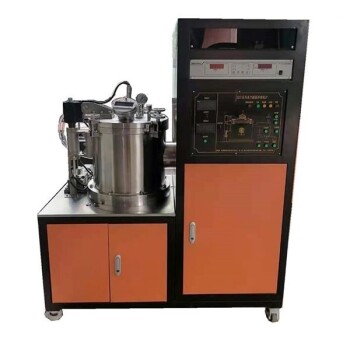
The primary role of an arc-melting furnace in this context is to synthesize "model alloys" that replicate specific microstructural phases found within a microscopic brazing seam. Because actual brazing seams are too small and complex to test individually, the furnace allows researchers to create large, macro-sized samples of specific compounds—such as alpha-Zr+gamma phases or [Zr,Ti]2(Cu,Ni)—which can then be subjected to standard electrochemical performance tests.
Core Takeaway: By scaling up microscopic phases into testable macro-sized ingots, arc-melting enables the precise measurement of electrochemical potentials. This identifies which specific components of a joint act as anodes or cathodes, revealing the fundamental causes of micro-galvanic corrosion.
Simulating Microstructure at a Macro Scale
The Challenge of Microscopic Seams
Brazed joints are often microscopically thin and chemically complex. They contain various intermetallic compounds and phases mixed together.
Attempting to measure the corrosion potential of just one of these tiny phases within a real joint is technically difficult and often yields inaccurate data due to interference from surrounding materials.
Creating "Model Alloys"
The arc-melting furnace solves this by melting pure elements to synthesize model alloys.
These are large-scale ingots that chemically and structurally simulate specific isolated phases found in the brazing seam, such as [Zr,Ti]2(Cu,Ni) compounds.
Enabling Standard Testing
Once these macro-sized samples are created, researchers can easily perform standard electrochemical tests.
This transforms a microscopic analysis problem into a manageable macroscopic testing process.
Uncovering Corrosion Mechanisms
Open-Circuit Potential (OCP) Analysis
With the model alloys prepared, researchers conduct Open-Circuit Potential (OCP) tests.
This measures the voltage inherent to that specific phase when exposed to a corrosive environment.
Identifying Micro-Galvanic Couples
By comparing the OCP of different model alloys, researchers can determine the potential difference between the various microstructures.
If one phase has a significantly different potential than its neighbor, it creates a micro-galvanic couple. This acts like a tiny battery where the "anode" phase corrodes preferentially to protect the "cathode" phase.
Scientific Basis for Optimization
Understanding these mechanisms provides hard scientific data rather than guesswork.
It allows engineers to pinpoint exactly which phase is the "weak link" causing the joint to fail.
Understanding the Trade-offs
Idealized vs. Real Conditions
While arc-melting creates excellent chemical replicas, the cooling rates in an arc furnace may differ from the rapid cooling of a thin brazing seam.
This means the grain size or exact crystalline structure of the model alloy might vary slightly from the actual joint.
Purity and Atmosphere
Just as furnace brazing relies on displacing oxygen to create ideal bonds, arc-melting requires a strictly controlled atmosphere to ensure the model alloys are pure.
Any contamination during the arc-melting process can skew the electrochemical results, leading to false conclusions about the joint's corrosion resistance.
Making the Right Choice for Your Goal
To effectively utilize arc-melting for corrosion studies, consider your specific objective:
- If your primary focus is Fundamental Research: Use the furnace to isolate every distinct phase in the phase diagram to map the full electrochemical series of the alloy system.
- If your primary focus is Process Optimization: Use the potential difference data to adjust brazing parameters (time/temperature) to minimize the formation of the specific phases identified as highly anodic (prone to corrosion).
Ultimately, the arc-melting furnace bridges the gap between microscopic observation and macroscopic testing, providing the data needed to engineer more durable joints.
Summary Table:
| Feature | Role in Brazed Joint Corrosion Study |
|---|---|
| Primary Function | Synthesizes large-scale "model alloys" to replicate microscopic phases. |
| Key Outcome | Identifies anodic and cathodic phases via Open-Circuit Potential (OCP) tests. |
| Testing Benefit | Enables standard electrochemical testing on otherwise untestable microscopic zones. |
| Mechanism Discovery | Pinpoints micro-galvanic couples that lead to joint failure. |
| Optimization Goal | Informs adjustments in brazing parameters to minimize corrosive phases. |
Elevate Your Material Research with KINTEK
Precision in metallurgy is the key to engineering durable, corrosion-resistant joints. KINTEK specializes in high-performance laboratory equipment, including advanced arc-melting and induction melting furnaces designed to synthesize high-purity model alloys for critical electrochemical studies.
From high-temperature furnaces and crushing systems to specialized electrolytic cells and electrodes, we provide the comprehensive tools necessary for detailed corrosion analysis and material optimization. Whether you are conducting fundamental research or industrial process refinement, our expert solutions ensure your results are accurate and reproducible.
Ready to bridge the gap between microscopic observation and macroscopic testing?
Contact KINTEK Today to Find the Perfect Solution for Your Lab!
References
- Siyoung Lee, Jung Gu Lee. Microstructural and Corrosion Properties of Ti-to-Zr Dissimilar Alloy Joints Brazed with a Zr-Ti-Cu-Ni Amorphous Filler Alloy. DOI: 10.3390/met11020192
This article is also based on technical information from Kintek Solution Knowledge Base .
Related Products
- Vacuum Arc Induction Melting Furnace
- Non Consumable Vacuum Arc Induction Melting Furnace
- Vacuum Heat Treat Furnace and Levitation Induction Melting Furnace
- Lab-Scale Vacuum Induction Melting Furnace
- High Temperature Muffle Oven Furnace for Laboratory Debinding and Pre Sintering
People Also Ask
- How do vacuum induction or arc melting furnaces facilitate the synthesis of U-Al-C MAX phases? Precision Heat & Purity
- What core role does a Vacuum Induction Melting furnace play in nickel-free steel production? Achieve High-Purity Alloys
- What is the primary function of a vacuum arc melting furnace in RHEA preparation? Achieving Extreme Thermal Fusion
- What is the function of vacuum arc melting equipment? Creating High-Purity Ferrochrome (CrFe) Alloys
- What is the function of a vacuum arc melting furnace? Prepare High-Purity Alx(CrFeNi)1-x High-Entropy Alloys