Hot pressing technology is the definitive method for transforming purified raw materials into high-performance thallium bromide (TlBr) semiconductor crystals. By subjecting the material to a simultaneous application of approximately 30 kN of axial pressure and a controlled temperature range of 455°C to 465°C, this process achieves the physical consolidation necessary for detector-grade electronics.
The Core Insight While purification provides the raw ingredients, hot pressing provides the necessary architecture. The process acts as a thermo-mechanical filter that eliminates internal microscopic porosity and enforces a specific crystal orientation, directly resulting in the high energy resolution and detection efficiency required for gamma-ray photon counting.
The Mechanics of Consolidation
To understand the value of hot pressing, you must look beyond simple molding. It is a precise engineering process that leverages thermo-mechanical coupling—the synergy of heat and mechanical force—to alter the material's properties.
The Thermal-Mechanical Window
The process operates within a very strict environmental window. The equipment applies a continuous pressure of roughly 30 kN while maintaining a temperature specifically between 455°C and 465°C.
Sustained Application
This environment is typically maintained for a duration of 2 hours. This sustained exposure ensures that the thermal energy and mechanical stress have sufficient time to permeate the entire volume of the material, ensuring uniformity from the core to the surface.
Structural Enhancements to the Crystal
The primary goal of this technology is to repair the structural vulnerabilities inherent in raw powder or loosely bound materials.
Eliminating Internal Porosity
The most immediate impact of hot pressing is densification. The axial pressure forces particles together, eliminating the micro-porosity (tiny air gaps) that naturally occurs between granules.
This results in "tight inter-granular bonding," transforming a porous aggregate into a solid, high-density block.
Inducing Crystal Orientation
Beyond simple density, the stress field generated by the press actively guides the lattice structure of the TlBr.
The process suppresses the formation of random defects and induces a consistent crystal orientation. This structural alignment is critical for semiconductor applications, where electron flow must be unimpeded by lattice irregularities.
Impact on Detector Performance
The physical changes engineered by hot pressing translate directly into the operational metrics of the final product—specifically, gamma-ray radiation detectors.
Enhancing Detection Efficiency
Because the process maximizes material density, the resulting crystal has a superior gamma-ray attenuation coefficient.
Simply put, the denser material is more effective at "stopping" and interacting with incoming photons, leading to higher overall detection efficiency.
Improving Energy Resolution
The elimination of internal defects and pores ensures a cleaner signal path.
By reducing structural imperfections that could trap or scatter charge carriers, the crystal exhibits better current-voltage characteristics and superior energy resolution in photon counting applications.
Critical Considerations and Constraints
While hot pressing is essential for high-quality TlBr crystals, it is a sensitive process where precision is non-negotiable.
The Requirement for Stability
The pressure applied must be continuous and stable. Fluctuations in the 30 kN force during the holding process can lead to uneven densification, resulting in a crystal that varies in quality across its geometry.
Strict Temperature Control
The operating window of 455-465°C is narrow for a reason. Deviating from this range risks failing to achieve proper sintering (if too low) or potentially degrading the material properties (if too high). The success of the molding depends entirely on the accuracy of this thermal regulation.
Making the Right Choice for Your Goal
Hot pressing is not a generic manufacturing step; it is a tuning process for semiconductor performance.
- If your primary focus is Detection Sensitivity: Prioritize the densification aspect of the process to maximize the gamma-ray attenuation coefficient, ensuring the crystal captures the maximum number of photons.
- If your primary focus is Signal Clarity: Focus on the stability of the stress field during pressing to ensure precise crystal orientation, which directly dictates energy resolution and minimizes noise.
Mastering the balance of heat and pressure is the key to unlocking the full potential of thallium bromide as a next-generation radiation detection material.
Summary Table:
| Parameter | Process Specification | Impact on TlBr Crystal Performance |
|---|---|---|
| Applied Pressure | ~30 kN (Axial) | Eliminates micro-porosity & ensures high density |
| Temperature Range | 455°C - 465°C | Enables sintering without material degradation |
| Hold Time | 2 Hours | Ensures uniformity and tight inter-granular bonding |
| Key Outcome | Crystal Orientation | Enhances energy resolution and signal clarity |
| Application | Radiation Detection | Increases gamma-ray attenuation & efficiency |
Elevate Your Semiconductor Research with KINTEK Precision
Unlock the full potential of your thallium bromide crystals and advanced materials with KINTEK’s high-performance thermal processing solutions. Whether you are developing next-generation radiation detectors or high-purity electronics, our precision hydraulic presses (pellet, hot, and isostatic) and specialized high-temperature furnaces provide the stable, repeatable environment necessary for perfect densification and lattice orientation.
From crushing and milling systems for raw material preparation to high-pressure reactors and cooling solutions for post-processing, KINTEK delivers the comprehensive laboratory equipment your facility needs to achieve superior energy resolution and detection efficiency.
Ready to optimize your material consolidation? Contact our technical experts today to find the ideal equipment for your laboratory.
References
- Aleksandra Maletin, Ivan Ristić. Degree of monomer conversion in dual cure resin-based dental cements material. DOI: 10.21175/rad.abstr.book.2023.5.1
This article is also based on technical information from Kintek Solution Knowledge Base .
Related Products
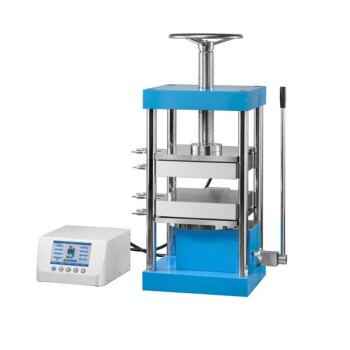
- Heated Hydraulic Press Machine with Heated Plates Split Manual Laboratory Hot Press
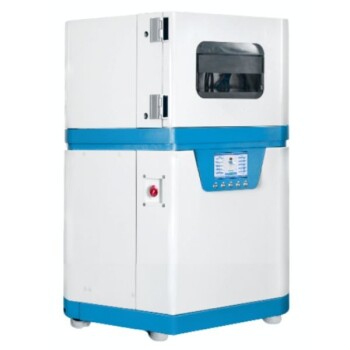
- Automatic Heated Hydraulic Press Machine with Heated Plates for Laboratory Hot Press 25T 30T 50T
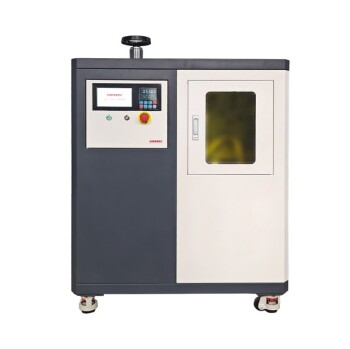
- Automatic Heated Hydraulic Press Machine with Heated Plates for Laboratory Hot Press
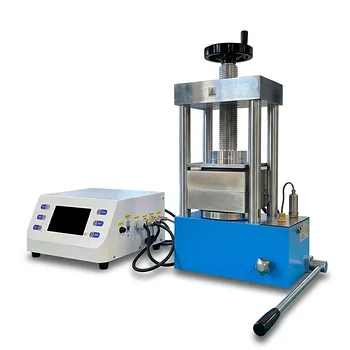
- Heated Hydraulic Press Machine with Heated Plates for Vacuum Box Laboratory Hot Press
- Heated Hydraulic Press Machine with Heated Plates for Vacuum Box Laboratory Hot Press
People Also Ask
- How does a laboratory hot press contribute to LATP/polymer composite electrolytes? Achieving Dense, High-Conductivity Films
- Why is a laboratory hot press necessary for all-solid-state battery assembly? Reduce Impedance and Enhance Performance
- What is the physical mechanism for sintering Cu-Cr-Nb powders? Overcoming Oxide Barriers with Hydraulic Loading
- How does a laboratory hot press improve alloy performance? Optimize Liquid Phase Sintering for High-Strength Materials
- What is the purpose of a laboratory hot press in the encapsulation stage of solar cell assembly? Ensure Hermetic Seals