Plasma-Enhanced Chemical Vapor Deposition (PECVD) functions as a low-temperature, high-control synthesis tool for creating advanced composite materials. It facilitates the preparation of ruthenium-carbon (Ru-C) nanocomposite films by utilizing high-energy electrons within a plasma to dissociate ruthenium precursors and reactive gases. This energy-assisted process enables film growth without the high thermal requirements of traditional chemical vapor deposition.
The core value of PECVD lies in its ability to decouple reaction energy from substrate temperature. By using plasma to drive chemical dissociation, you can deposit high-quality Ru-C films on heat-sensitive materials while precisely engineering the density of ruthenium nanoparticles to optimize electrical conductivity.
The Mechanism of Plasma Activation
Electron-Impact Dissociation
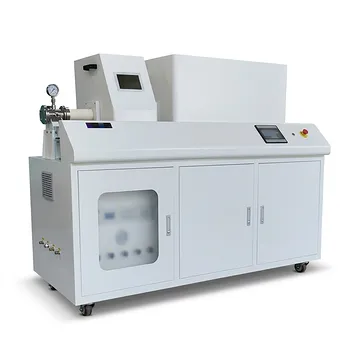
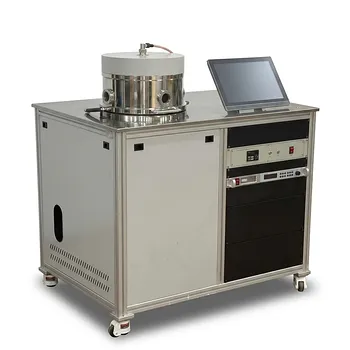
Unlike standard thermal processes, PECVD equipment uses Radio Frequency (RF) discharge to create a glow discharge plasma between electrodes.
This plasma generates a dense cloud of high-energy electrons, ions, and reactive radicals.
These high-energy electrons collide with the gas mixture, effectively breaking down (dissociating) the ruthenium precursors and carbon sources into reactive species.
Reduced Thermal Load
Because the energy required to break chemical bonds is supplied by the plasma, the reaction does not rely on heating the substrate.
This allows the substrate to remain at a significantly lower temperature during the deposition process.
Consequently, Ru-C films can be applied to polymers or other heat-sensitive substrates that would otherwise degrade under the high temperatures typical of standard CVD.
Engineering Material Properties
Controlling Nanoparticle Distribution
The quality of a nanocomposite depends heavily on how the metal is dispersed within the matrix.
PECVD allows for the precise manipulation of ruthenium nanoparticle distribution density within the carbon matrix.
By adjusting plasma parameters—such as RF power and gas flow rates—engineers can fine-tune the "loading" of ruthenium to meet specific design requirements.
Optimizing Interfacial Conductivity
The arrangement of ruthenium nanoparticles directly dictates the electronic performance of the film.
Proper distribution achieved through PECVD improves the interfacial conductivity of the composite material.
This ensures that the final Ru-C film functions efficiently in electronic or electrochemical applications.
Understanding the Trade-offs
Complexity of Process Parameters
While PECVD offers superior control, it introduces a complex set of variables that must be balanced.
Parameters such as chamber pressure, RF power, and gas ratios are interdependent; incorrect settings can lead to unstable plasma or poor film uniformity.
Potential for Surface Damage
The same high-energy ions that facilitate low-temperature deposition can sometimes be a double-edged sword.
If the plasma energy is too high, ion bombardment may damage the growing film or the underlying substrate surface, requiring careful calibration of the energy levels.
Making the Right Choice for Your Goal
To maximize the benefits of PECVD for ruthenium-carbon films, align your process settings with your specific objectives:
- If your primary focus is Substrate Preservation: Prioritize lower plasma power settings to maintain the lowest possible process temperature, protecting delicate underlying layers.
- If your primary focus is Electrical Performance: Focus on tuning the plasma density to maximize the uniformity and distribution density of ruthenium nanoparticles, ensuring peak interfacial conductivity.
PECVD transforms the challenge of depositing metal-carbon composites into a tunable, precision-engineered process.
Summary Table:
| Feature | Benefit for Ru-C Nanocomposites |
|---|---|
| Plasma Activation | Decouples reaction energy from heat, allowing low-temperature deposition. |
| RF Discharge | Efficiently dissociates ruthenium precursors and reactive gases. |
| Tunable Parameters | Enables precise control over Ru nanoparticle distribution and density. |
| Substrate Versatility | Compatible with heat-sensitive materials like polymers. |
| Enhanced Conductivity | Optimizes interfacial conductivity for superior electronic performance. |
Elevate Your Thin Film Research with KINTEK
Unlock the full potential of nanocomposite synthesis with KINTEK’s advanced PECVD and CVD systems. Whether you are developing ruthenium-carbon films for high-performance electrodes or engineering specialized coatings for heat-sensitive substrates, our precision-engineered high-temperature furnaces and vacuum systems provide the control you need.
From ruthenium precursors and ceramic crucibles to integrated battery research tools, KINTEK specializes in providing the comprehensive laboratory equipment and consumables required for cutting-edge material science.
Ready to optimize your thin film deposition? Contact us today to find the perfect equipment solution for your lab!
References
- Ruchi Gaur, Burak Atakan. Ruthenium complexes as precursors for chemical vapor-deposition (CVD). DOI: 10.1039/c4ra04701j
This article is also based on technical information from Kintek Solution Knowledge Base .
Related Products
- Inclined Rotary Plasma Enhanced Chemical Vapor Deposition PECVD Equipment Tube Furnace Machine
- Chemical Vapor Deposition CVD Equipment System Chamber Slide PECVD Tube Furnace with Liquid Gasifier PECVD Machine
- Inclined Rotary Plasma Enhanced Chemical Vapor Deposition PECVD Equipment Tube Furnace Machine
- RF PECVD System Radio Frequency Plasma-Enhanced Chemical Vapor Deposition RF PECVD
- Multi Heating Zones CVD Tube Furnace Machine Chemical Vapor Deposition Chamber System Equipment
People Also Ask
- What is plasma enhanced chemical vapor deposition PECVD equipment? A Guide to Low-Temperature Thin Film Deposition
- What are the core advantages of PE-CVD in OLED encapsulation? Protect Sensitive Layers with Low-Temp Film Deposition
- What is plasma enhanced chemical vapour deposition PECVD used for? Enable Low-Temp Thin Films for Electronics & Solar
- How does PECVD equipment facilitate the directional growth of carbon nanotubes? Achieve Precision Vertical Alignment
- What is the necessity of depositing a silicon nitride (SiNx) thin film using PECVD? Optimize QSSPC Lifetime Measurement