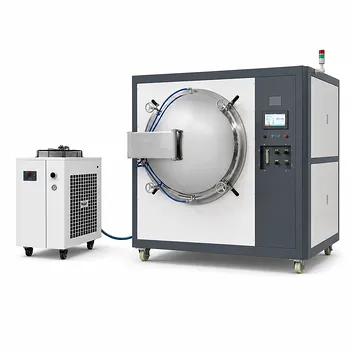
Post-treatment annealing acts as a critical stabilization mechanism for amorphous silicon carbide (a-SiC) thin films produced via Plasma-Enhanced Chemical Vapor Deposition (PECVD). By introducing controlled thermal energy, the furnace enables the rearrangement of the film's atomic structure and facilitates the escape of trapped hydrogen. This structural evolution significantly enhances the material's mechanical properties, making it suitable for rigorous long-term applications.
The annealing process fundamentally alters the film by converting internal compressive stress into tensile stress while simultaneously increasing hardness. This ensures the physical structure remains stable and durable, particularly for demanding use cases like long-term body implantation.
The Mechanism of Structural Enhancement
Thermal Energy and Atomic Rearrangement
The primary function of the annealing furnace is to provide controlled thermal energy to the deposited film.
This energy input allows the atoms within the amorphous structure to mobilize and reorganize. The result is a more stable, strictly ordered atomic configuration compared to the "as-deposited" state.
Hydrogen Desorption
PECVD processes often trap hydrogen within the film during deposition.
Annealing drives this hydrogen to escape from the a-SiC matrix. The removal of these hydrogen atoms is essential for densifying the material and locking in the desired physical properties.
Evolution of Mechanical Properties
Transforming Internal Stress
One of the most profound changes induced by annealing is the shift in mechanical stress.
As-deposited PECVD films typically exhibit compressive stress. Post-treatment annealing transforms this effectively into tensile stress, a state that the primary reference links to improved stability for specific applications.
Increasing Hardness and Elastic Modulus
The structural densification and hydrogen removal directly impact the film's strength.
Post-treatment results in a measurable increase in both hardness and elastic modulus. This makes the thin film more resistant to deformation and physical wear over time.
Understanding the Trade-offs
Balancing Stress States
While the primary goal of annealing is stability, the transition from compressive to tensile stress must be carefully managed.
PECVD films are prized for their initial low mechanical stress and uniformity, which prevents deformation. Introducing a post-treatment alters this equilibrium. One must ensure that the induced tensile stress does not exceed the material's limits, which could theoretically compromise the conformal step coverage or uniformity achieved during the initial deposition.
Making the Right Choice for Your Goal
To determine if annealing is the correct step for your specific a-SiC application, consider the following outcome requirements:
- If your primary focus is long-term physical stability (e.g., Implants): Prioritize annealing to increase hardness and lock in the atomic structure, ensuring the film survives strictly in biological environments.
- If your primary focus is initial electronic integration (e.g., IC Fabrication): Evaluate the "as-deposited" PECVD properties first, as the native low stress and good dielectric properties may be sufficient without thermal alteration.
By leveraging annealing, you trade the initial low-stress state of the film for a hardened, structurally evolved material capable of enduring harsh, long-term environments.
Summary Table:
| Property | As-Deposited (PECVD) | Post-Annealing (Furnace) |
|---|---|---|
| Atomic Structure | Amorphous / Less Stable | Rearranged / Stabilized |
| Hydrogen Content | High (Trapped) | Low (Desorbed) |
| Internal Stress | Compressive Stress | Tensile Stress |
| Hardness | Lower | Significantly Increased |
| Elastic Modulus | Lower | Increased (Denser) |
| Primary Benefit | Uniformity & Low Stress | Long-term Physical Durability |
Elevate Your Material Research with KINTEK Precision
Unlock the full potential of your thin-film applications with KINTEK’s advanced thermal processing solutions. Whether you are developing long-term medical implants or high-performance semiconductors, our comprehensive range of high-temperature tube, vacuum, and atmosphere furnaces provides the precise thermal control needed to stabilize a-SiC structures.
Beyond annealing, KINTEK specializes in the equipment essential for cutting-edge laboratory workflows—from PECVD and CVD systems for deposition to high-pressure reactors, hydraulic presses, and specialized ceramics. Our team is dedicated to providing high-quality consumables and machinery that ensure your research is both accurate and repeatable.
Ready to optimize your thin-film properties? Contact KINTEK today to find the perfect furnace or lab equipment for your specific application.
References
- Scott Greenhorn, Konstantinos Zekentes. Amorphous SiC Thin Films Deposited by Plasma-Enhanced Chemical Vapor Deposition for Passivation in Biomedical Devices. DOI: 10.3390/ma17051135
This article is also based on technical information from Kintek Solution Knowledge Base .
Related Products
- Controlled Nitrogen Inert Hydrogen Atmosphere Furnace
- Vacuum Heat Treat Furnace with Ceramic Fiber Liner
- High Temperature Muffle Oven Furnace for Laboratory Debinding and Pre Sintering
- Laboratory Muffle Oven Furnace Bottom Lifting Muffle Furnace
- Graphite Vacuum Furnace High Thermal Conductivity Film Graphitization Furnace
People Also Ask
- What is the role of a hydrogen atmosphere furnace in diamond/copper composites? Enhance Your Material Purity
- Why is hydrogen used in furnaces? Achieve Superior Purity and Bright Finishes
- What are the characteristics and risks of a hydrogen atmosphere in a furnace? Master the Balance of Power and Control
- What role does an atmosphere furnace utilizing hydrogen gas play in Cu-Cr-Nb alloy powder pretreatment? (Key Insights)
- What is the use of hydrogen in furnace? A Key to Oxygen-Free High-Temperature Processing