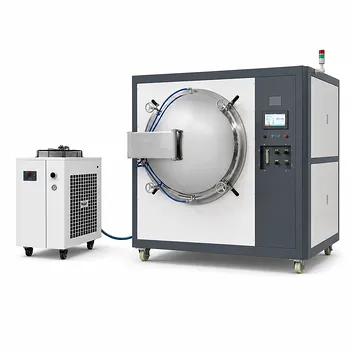
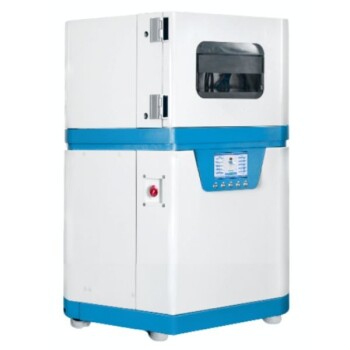
The application of high pressure is the critical factor in eliminating internal structural defects during the high-temperature annealing of Ti/Ti-Al composites. Specifically, applying substantial mechanical pressure (such as 40 MPa) physically forces the material to densify, closing microscopic voids created during the chemical reaction between titanium and aluminum.
Core Takeaway: The chemical reaction between titanium and aluminum naturally generates microscopic gaps known as Kirkendall voids due to uneven atomic movement. The vacuum hot pressing furnace counteracts this by applying high mechanical pressure to collapse these voids, resulting in a denser composite with significantly higher tensile and flexural strength.
The Challenge: The Formation of Kirkendall Voids
The Nature of Diffusion
When Titanium (Ti) and Aluminum (Al) react at high temperatures, their atoms diffuse into one another to form bonds. However, they do not move at the same speed.
Creating the Void
Because Al atoms typically diffuse faster than Ti atoms, "vacancies" or holes are left behind in the material structure.
The Structural Risk
These microscopic holes are called Kirkendall voids. If left unchecked, they act as stress concentration points, making the final composite porous and significantly weaker.
The Solution: Pressure-Driven Densification
Closing the Gaps
The primary function of the vacuum hot pressing furnace during annealing is to apply a continuous, high mechanical force—approximately 40 MPa.
Physical Compaction
This pressure acts as an external driving force that physically compresses the material. It forces the layers together, effectively collapsing and closing the Kirkendall voids generated during the reaction process.
Breaking Barriers
Beyond just closing holes, the high pressure helps rupture oxide films on the metal surfaces. This cleans the interface and allows for direct, metal-to-metal contact.
Shortening Diffusion Distances
By mechanically compressing the layers, the furnace reduces the distance atoms must travel to bond. This promotes more complete mutual diffusion between the Ti and Al layers.
The Result: Enhanced Material Properties
Increased Density
The direct outcome of eliminating voids and compressing the layers is a significant increase in the overall density of the Ti/Ti-Al composite.
Improved Tensile Strength
With a denser structure and fewer internal defects (voids), the material can withstand higher pulling forces before failing. The bonding interface is continuous rather than porous.
Higher Flexural Strength
The reduction in porosity also improves the material's ability to resist bending forces. A dense, void-free microstructure is essential for maintaining structural integrity under load.
Common Pitfalls to Avoid
Over-Reliance on Pressure
While pressure is vital for density, it cannot compensate for incorrect temperatures. Pressure ensures contact, but heat ensures the chemical bond.
The Brittle Phase Danger
Precise temperature control (e.g., maintaining 550°C) is just as critical as pressure. If the temperature is unregulated, the reaction may produce excessively thick, brittle intermetallic compounds (like Al3Ti).
Balancing Ductility
A composite that is highly pressurized but improperly heated may be dense but brittle. The goal is to balance pressure (for density) with controlled temperature (to limit brittle phase growth) to ensure the material retains ductility.
Making the Right Choice for Your Project
To optimize your Ti/Ti-Al composite processing, consider the following based on your specific performance requirements:
- If your primary focus is Maximum Mechanical Strength: Ensure your furnace maintains a consistent high pressure (approx. 40 MPa) throughout the annealing phase to fully eliminate Kirkendall voids.
- If your primary focus is Ductility and Bonding Quality: Prioritize precise temperature regulation alongside pressure to prevent the formation of thick, brittle intermetallic layers that compromise toughness.
Success lies in using pressure to eliminate defects while using temperature to control the chemistry.
Summary Table:
| Feature | Impact on Ti/Ti-Al Composites | Benefit |
|---|---|---|
| High Pressure (40 MPa) | Collapses Kirkendall voids and pores | Significant increase in material density |
| Mechanical Compaction | Ruptures oxide films at interfaces | Enhanced metal-to-metal bonding quality |
| Diffusion Control | Shortens atomic diffusion distances | Faster, more complete mutual bonding |
| Atmosphere Control | Prevents oxidation during annealing | Improved purity and interface integrity |
| Structural Integrity | Reduces stress concentration points | Higher tensile and flexural strength |
Elevate Your Material Research with KINTEK Precision Solutions
Unlock the full potential of your Ti/Ti-Al composites with KINTEK’s advanced thermal processing technology. Whether you are aiming to eliminate Kirkendall voids or optimize intermetallic phase growth, our high-performance vacuum hot pressing furnaces and isostatic presses provide the precise pressure and temperature control required for superior densification.
From high-temperature furnaces and crushing systems to high-pressure reactors and specialized lab consumables, KINTEK specializes in empowering researchers and manufacturers with reliable, industrial-grade equipment.
Ready to achieve void-free, high-strength results? Contact our laboratory experts today to find the perfect equipment configuration for your specific application.
Related Products
- Vacuum Hot Press Furnace Heated Vacuum Press Machine Tube Furnace
- 600T Vacuum Induction Hot Press Furnace for Heat Treat and Sintering
- Vacuum Hot Press Furnace Machine Heated Vacuum Press
- Vacuum Hot Press Furnace Machine for Lamination and Heating
- Vacuum Heat Treat and Pressure Sintering Furnace for High Temperature Applications
People Also Ask
- What advantages does a vacuum hot press furnace provide for LSLBO ceramic electrolytes? Achieve 94% Relative Density
- What role does a Vacuum Hot Press (VHP) furnace play in the densification of austenitic stainless steel 316 composites?
- What are the advantages of using a vacuum hot pressing furnace? Superior Densification for 2024Al/Gr/SiC Composites
- What are the advantages of a vacuum hot press furnace for LTPO solid electrolytes? Boost Density and Conductivity
- What core processing conditions does a vacuum hot press furnace provide? Achieve High-Density Cu-SiC/Diamond Composites