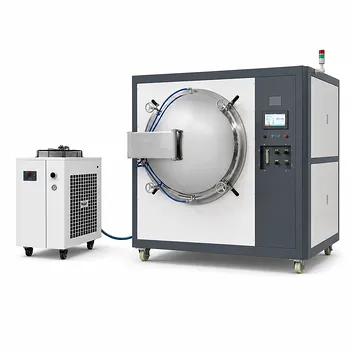
Mechanical pressure acts as a kinetic accelerant within a vacuum hot pressing furnace, fundamentally altering how Silicon Carbide (SiC) and Aluminum (Al) interact. Unlike traditional sintering, which relies primarily on thermal energy, the simultaneous application of mechanical force drives plastic deformation and forces powder particles into intimate contact. This physical compression accelerates the diffusion of Silicon atoms into the Aluminum matrix, creating a robust metallurgical bond that is difficult to achieve through heat alone.
Core Insight Mechanical pressure transforms the composite's weak point into a strong point. By forcing atomic inter-diffusion and maximizing contact area, vacuum hot pressing shifts the material's failure mode from peeling apart at the interface (interfacial separation) to breaking within the metal itself (matrix fracture), signaling a bond stronger than the matrix material.
The Mechanics of Pressure-Assisted Bonding
Forcing Plastic Deformation
In a traditional sintering environment, particles rely on gravity and thermal expansion to touch. Vacuum hot pressing changes this dynamic by applying active mechanical pressure while the aluminum is in a heated, plastic state.
This pressure forces the softer aluminum matrix to deform plastically, flowing around the harder Silicon Carbide particles. This eliminates the physical gaps that typically remain during pressureless sintering, ensuring maximum surface area contact between the reinforcement and the matrix.
Accelerating Atomic Diffusion
Physical contact is merely the prerequisite for the actual bonding mechanism: atomic diffusion. The primary driver for enhanced bonding in SiCp/Al composites is the accelerated diffusion of atoms across the interface.
The external pressure lowers the energy barrier required for this movement. Specifically, it promotes the diffusion of Silicon atoms into the Aluminum matrix. This "pressure-assisted diffusion" facilitates beneficial interfacial reactions that lock the particles together at an atomic level.
Shifting the Fracture Mechanism
The ultimate test of interfacial bonding is how the material breaks under stress. In loosely bonded composites (often result of traditional sintering), failure occurs via interfacial separation—the particle simply pulls away from the matrix.
Because vacuum hot pressing creates such a chemically and physically tight bond, the interface becomes stronger than the aluminum matrix itself. Consequently, when the material fails, it undergoes matrix fracture. The bond holds, and the metal tears, resulting in significantly superior mechanical performance.
Operational Advantages Over Traditional Sintering
Densification and Pore Elimination
Traditional pressureless sintering often leaves internal voids, particularly in metal-ceramic composites which are difficult to sinter.
Vacuum hot pressing mechanically forces the elimination of these internal pores. By driving particle rearrangement and plastic flow, the process fills voids that thermal energy alone cannot close. This allows for relative densities exceeding 90% to 98.5%, levels that are frequently unachievable with standard methods.
Lower Thermal Requirements
Applying pressure allows for a reduction in the thermal energy required to achieve densification.
Because mechanical force aids the bonding process, the furnace can often operate at lower sintering temperatures or with shorter holding times compared to traditional methods. This efficiency is critical because it inhibits excessive grain growth, preserving the material’s microstructure and maintaining chemical stability.
Understanding the Trade-offs
Process Complexity vs. Microstructural Integrity
While traditional sintering is simpler, it often demands higher temperatures to achieve acceptable density. This high heat risks excessive grain growth and the volatilization of volatile elements.
Vacuum hot pressing introduces equipment complexity but offers a distinct trade-off: it substitutes thermal intensity for mechanical force. This allows you to achieve high density without "overcooking" the microstructure, which is vital for maintaining the properties of nanocrystalline structures or preventing the loss of specific alloy components.
Making the Right Choice for Your Goal
- If your primary focus is Maximum Bonding Strength: Utilize vacuum hot pressing to ensure the interface is stronger than the matrix, forcing failure to occur via matrix fracture rather than separation.
- If your primary focus is Microstructural Control: Leverage the pressure-assisted mechanism to sinter at lower temperatures, inhibiting grain growth while still achieving near-perfect density.
- If your primary focus is Porosity Reduction: Rely on the mechanical rearrangement of particles to eliminate internal voids that pressureless sintering cannot resolve.
By adding mechanical pressure to the equation, you stop relying on chance for particle contact and start engineering the interface at an atomic level.
Summary Table:
| Feature | Traditional Sintering | Vacuum Hot Pressing (KINTEK) |
|---|---|---|
| Bonding Mechanism | Primarily Thermal Diffusion | Pressure-Assisted Diffusion |
| Interfacial Contact | Limited (Gravity/Thermal) | Maximum (Plastic Deformation) |
| Failure Mode | Interfacial Separation (Peeling) | Matrix Fracture (Strong Bond) |
| Relative Density | Lower (Often >10% Porosity) | Superior (90% to 98.5%+) |
| Microstructure | Risk of Grain Growth | Fine Grains (Lower Temp Possible) |
Elevate Your Material Performance with KINTEK Expertise
Unlock the full potential of your SiCp/Al composites and advanced materials with KINTEK’s industry-leading vacuum hot pressing furnaces. Whether you are looking to eliminate porosity, control microstructural grain growth, or achieve metallurgical bonding that surpasses the strength of the matrix itself, our specialized equipment delivers the precision and pressure your research demands.
Why partner with KINTEK?
- Comprehensive Range: From high-temperature vacuum and atmosphere furnaces to specialized hot hydraulic presses and isostatic presses.
- Total Lab Solutions: We provide everything from crushing and milling systems to essential ceramics and crucibles.
- Expert Support: Our team helps you transition from interfacial separation to superior matrix fracture performance.
Ready to transform your fabrication process? Contact KINTEK today to discuss your project requirements!
Related Products
- Vacuum Hot Press Furnace Heated Vacuum Press Machine Tube Furnace
- 600T Vacuum Induction Hot Press Furnace for Heat Treat and Sintering
- Vacuum Hot Press Furnace Machine Heated Vacuum Press
- Vacuum Hot Press Furnace Machine for Lamination and Heating
- Vacuum Heat Treat and Pressure Sintering Furnace for High Temperature Applications
People Also Ask
- What advantages does a vacuum hot press furnace provide for LSLBO ceramic electrolytes? Achieve 94% Relative Density
- What role does a Vacuum Hot Press (VHP) furnace play in the densification of austenitic stainless steel 316 composites?
- What are the advantages of using a vacuum hot pressing furnace? Superior Densification for 2024Al/Gr/SiC Composites
- What are the advantages of a vacuum hot press furnace for LTPO solid electrolytes? Boost Density and Conductivity
- What core processing conditions does a vacuum hot press furnace provide? Achieve High-Density Cu-SiC/Diamond Composites