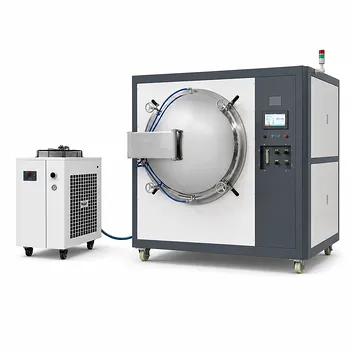
The precision of the temperature control system is the critical determinant between a high-performance brake pad and a structural failure. In a vacuum hot press furnace, precise thermal regulation ensures the metal matrix softens just enough to bond with ceramic reinforcements without melting excessively, directly dictating the final density, hardness, and durability of the material.
Core Takeaway Temperature precision is not merely about reaching a set point; it is about maintaining a delicate thermal window. This specific control enables the formation of a robust interface between dissimilar materials (like metal and ceramics), ensuring the component achieves its designed mechanical properties without deformation or structural weakness.
The Material Physics of Precision
Balancing Softening and Melting
The primary goal of the temperature control system is to maintain the sintering environment at an exact threshold, such as 1500°C.
At this specific temperature, the metal matrix must soften sufficiently to flow around reinforcement particles. However, the system must prevent the temperature from rising even slightly higher to avoid excessive melting or flow, which would destroy the component's shape.
Creating the Interface Bond
For composite materials like brake pads, the furnace must bond a metal matrix with a ceramic reinforcement phase, such as Al2O3 (Aluminum Oxide).
Precise thermal control, coordinated with applied pressure, ensures a robust interface bond forms between these two distinct materials. If the temperature fluctuates, this bond fails, leading to weak spots or eventual delamination under braking stress.
Achieving Designed Density
The ultimate output of this thermal precision is the attainment of the specific density and hardness requirements engineered for the part.
Without stable heat regulation, the material will suffer from porosity (if too cool) or deformation (if too hot), compromising the safety profile of the brake pad.
How Precision is Technically Achieved
Intelligent PID Control
Modern vacuum furnaces utilize PID intelligent program systems to manage these tight tolerances.
These systems allow for complex heating profiles, often offering 30 stages of programmable automatic control. This allows engineers to ramp temperatures up and down at specific rates to match the material's thermal properties.
Real-Time Monitoring and Data
Precision requires constant vigilance. The system communicates with a PLC and collects real-time temperature data every minute.
Operators can view dynamic heating curves on touch screens to visualize the process instantly. This allows for immediate verification that the actual temperature matches the programmed profile.
Common Pitfalls and Trade-offs
The Risk of Thermal Overshoot
If the control system is sluggish or poorly tuned, thermal overshoot can occur.
Even a momentary spike above the target temperature can cause the metal matrix to liquefy too much, leading to unwanted alloy segregation or dimension loss.
The Cost of Complexity
High-precision systems with paperless recording and multi-stage PID loops require skilled operators to program effectively.
Incorrectly set parameters on a complex 30-stage ramp can introduce defects just as easily as a hardware failure. The sophistication of the tool demands a sophisticated understanding of the sintering curve.
Making the Right Choice for Your Goal
To maximize the performance of your vacuum hot press furnace, align your control strategy with your specific material requirements.
- If your primary focus is High-Performance Composites (Brake Pads): Prioritize systems with multi-stage PID control to perfectly manage the softening-without-melting window of the metal matrix.
- If your primary focus is Quality Assurance and R&D: Ensure your system includes paperless recording and historical data querying to analyze the heating curve of every batch for consistency.
- If your primary focus is Process Efficiency: Look for touch-screen interfaces that allow intuitive start/stop control and real-time trend visualization to reduce operator error.
Precision in temperature control is the only way to transform raw powder into a safety-critical component capable of withstanding extreme forces.
Summary Table:
| Feature | Impact on Material Properties | Technical Implementation |
|---|---|---|
| Thermal Window | Prevents excessive melting while ensuring metal matrix softening | PID Intelligent Program Systems |
| Interface Bonding | Creates robust bonds between metal and ceramic (e.g., Al2O3) | Coordinated Heat & Pressure Control |
| Density Regulation | Eliminates porosity and prevents structural deformation | 30-Stage Programmable Profiles |
| Data Monitoring | Ensures consistency across batches and quality assurance | Real-time PLC Data & Dynamic Curves |
Elevate Your Material Performance with KINTEK
Precision is the difference between a high-performance component and a structural failure. At KINTEK, we specialize in providing advanced laboratory equipment designed to meet the most rigorous thermal requirements. Our comprehensive range of vacuum hot press furnaces, crushing and milling systems, and hydraulic presses (including isostatic and pellet models) ensures your research or production achieves peak density and hardness.
Whether you are developing safety-critical brake pads or advanced ceramics, our high-temperature furnaces and battery research tools offer the intelligent PID control and real-time monitoring you need for success.
Ready to optimize your sintering process? Contact our experts today to discover how KINTEK's precision solutions can transform your material science outcomes.
Related Products
- Vacuum Hot Press Furnace Heated Vacuum Press Machine Tube Furnace
- 600T Vacuum Induction Hot Press Furnace for Heat Treat and Sintering
- Vacuum Hot Press Furnace Machine for Lamination and Heating
- Vacuum Hot Press Furnace Machine Heated Vacuum Press
- Vacuum Heat Treat and Pressure Sintering Furnace for High Temperature Applications
People Also Ask
- What advantages does a vacuum hot press furnace provide for LSLBO ceramic electrolytes? Achieve 94% Relative Density
- What role does a Vacuum Hot Press (VHP) furnace play in the densification of austenitic stainless steel 316 composites?
- What are the advantages of using a vacuum hot pressing furnace? Superior Densification for 2024Al/Gr/SiC Composites
- What are the advantages of a vacuum hot press furnace for LTPO solid electrolytes? Boost Density and Conductivity
- What core processing conditions does a vacuum hot press furnace provide? Achieve High-Density Cu-SiC/Diamond Composites