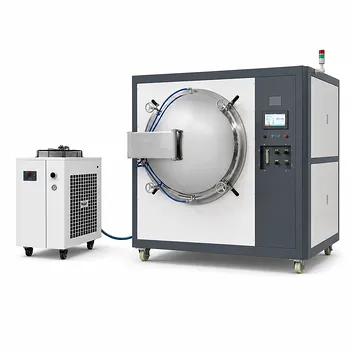
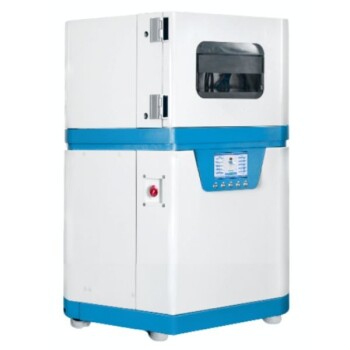
The pressure loading system acts as a critical mechanical catalyst that physically forces the composite material to densify when heat alone is insufficient. By applying continuous uniaxial pressure—typically around 30 MPa—the system overcomes the internal friction between powder particles, forcing the softer copper matrix to undergo plastic flow and rearrange itself around the rigid Ti3SiC2 particles. This mechanical compression effectively eliminates internal voids and pores, enabling the composite to achieve high density even at lower sintering temperatures.
The core function of the pressure system is to compensate for the "sintering resistance" introduced by the hard ceramic phase. It mechanically closes pores that thermal energy cannot eliminate on its own, ensuring structural integrity without requiring excessive heat that could degrade the material components.
The Mechanisms of Pressure-Assisted Densification
Overcoming Inter-Particle Friction
In a composite mixture, the hard Ti3SiC2 particles impede the natural movement of the softer copper particles. The pressure loading system provides a constant external force to overcome this frictional resistance. This ensures that the powder particles are brought into intimate contact, regardless of their inherent resistance to movement.
Inducing Plastic Flow in the Matrix
The applied pressure forces the copper matrix—which becomes semi-solid or highly ductile at sintering temperatures—to behave like a viscous fluid. This induces plastic flow, where the metal physically moves to fill the interstitial gaps between the harder ceramic particles. This rearrangement is the primary driver for achieving a dense structure.
Elimination of Internal Pores
As the copper matrix flows, it fills the voids created during the initial formation of sintering necks. The continuous mechanical pressure prevents the formation of isolated pores that typically occur in pressureless sintering. By actively closing these gaps, the system maximizes the relative density of the final composite.
The Synergy of Pressure and Vacuum
Enabling Lower Sintering Temperatures
Achieving high density usually requires very high temperatures, but Cu and Ti3SiC2 can react to form undesirable impurities (like TiSi2) if heated above 750°C. The pressure loading system allows for successful densification below this critical temperature threshold. The mechanical force substitutes for thermal energy, allowing the material to densify without triggering phase decomposition.
Preventing Gas Entrapment
While pressure collapses the pores, the vacuum environment is essential for removing the gas trapped within them. The vacuum system lowers the oxygen partial pressure and removes adsorbed gases from the powder interstices. This ensures that when the pressure system compresses the material, there are no gas pockets fighting back against the densification process.
Understanding the Trade-offs
Uniaxial Limitations
Most vacuum hot press systems apply uniaxial pressure (from one direction, usually top and bottom). While effective for simple shapes like discs or plates, this can sometimes lead to density gradients in complex geometries where the pressure is not distributed evenly throughout the volume.
The Risk of Over-Sintering
While pressure helps, it must be balanced carefully with temperature. If the temperature control is not precise (e.g., exceeding 750°C), the combination of high pressure and heat can accelerate unwanted chemical reactions between the Copper and Ti3SiC2. This leads to the formation of brittle impurity phases that degrade the composite's conductivity and strength.
Making the Right Choice for Your Goal
To maximize the effectiveness of the pressure loading system for your specific application, consider these focused recommendations:
- If your primary focus is Maximum Density: Prioritize maintaining a constant, high pressure (e.g., 30 MPa) throughout the entire dwell time to mechanically force the closure of all residual porosity.
- If your primary focus is Phase Purity: Utilize the pressure system to lower your required sintering temperature to 750°C or below, preventing the decomposition of Ti3SiC2 into unwanted silicides.
- If your primary focus is Electrical Conductivity: Ensure the vacuum system is fully engaged before applying maximum pressure to remove all adsorbed gases, which prevents micro-porosity that interrupts electron flow.
The pressure loading system is not just about squeezing the material; it is a tool that allows you to bypass the thermal limitations of the composite, trading heat for mechanical force to achieve a superior, dense structure.
Summary Table:
| Mechanism | Action of Pressure System | Impact on Cu-Ti3SiC2 Density |
|---|---|---|
| Particle Interaction | Overcomes inter-particle friction | Ensures intimate contact between ceramic & metal |
| Matrix Behavior | Induces plastic flow in Copper | Fills interstitial gaps around rigid Ti3SiC2 particles |
| Porosity Control | Mechanical closure of voids | Eliminates internal pores that heat alone cannot remove |
| Thermal Synergy | Substitutes mechanical force for heat | Achieves high density at <750°C to maintain phase purity |
Elevate Your Advanced Material Synthesis with KINTEK
Achieving the perfect balance between density and phase purity in Cu-Ti3SiC2 composites requires precision-engineered equipment. KINTEK specializes in high-performance laboratory solutions, offering state-of-the-art vacuum hot press furnaces and vacuum sintering systems designed for exacting material science applications.
Whether you are developing metal-matrix composites, advanced ceramics, or battery research tools, our portfolio includes:
- High-Temperature Furnaces: Muffle, tube, rotary, and CVD/PECVD systems.
- Precision Pressing: Hydraulic pellet presses, hot presses, and isostatic systems.
- Essential Lab Tools: Crushing systems, cooling solutions, and premium consumables (PTFE, ceramics, and crucibles).
Ready to optimize your densification process? Contact KINTEK today to consult with our experts and find the ideal high-pressure, high-temperature solution for your laboratory.
Related Products
- Vacuum Hot Press Furnace Heated Vacuum Press Machine Tube Furnace
- 600T Vacuum Induction Hot Press Furnace for Heat Treat and Sintering
- Vacuum Hot Press Furnace Machine Heated Vacuum Press
- Vacuum Hot Press Furnace Machine for Lamination and Heating
- Vacuum Heat Treat and Pressure Sintering Furnace for High Temperature Applications
People Also Ask
- What advantages does a vacuum hot press furnace provide for LSLBO ceramic electrolytes? Achieve 94% Relative Density
- What role does a Vacuum Hot Press (VHP) furnace play in the densification of austenitic stainless steel 316 composites?
- What are the advantages of using a vacuum hot pressing furnace? Superior Densification for 2024Al/Gr/SiC Composites
- What are the advantages of a vacuum hot press furnace for LTPO solid electrolytes? Boost Density and Conductivity
- What core processing conditions does a vacuum hot press furnace provide? Achieve High-Density Cu-SiC/Diamond Composites