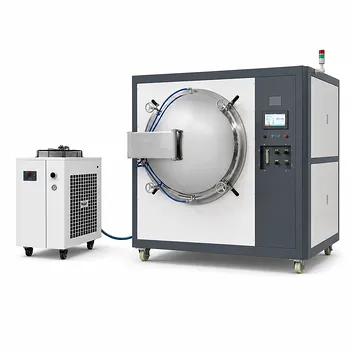
Temperature control precision in an annealing furnace directly dictates the size and distribution of metallic nanoparticles, such as copper, which are essential for the hydrogen spill-over effect. By maintaining a stable thermal environment, the furnace prevents irregular particle growth and ensures the carbon matrix develops the specific pore structure and graphitization levels required for maximum hydrogen storage.
High-precision temperature control is the critical variable that stabilizes catalyst particle size and carbon lattice morphology. Without this stability, thermal fluctuations trigger unpredictable diffusion and phase changes, leading to a significant loss in hydrogen adsorption efficiency.
The Mechanism of Particle Size Stabilization
Regulating the Spill-Over Effect
Precise control between 600°C and 700°C allows for the stabilization of copper nanoparticles within ideal size ranges, such as 20-30 nm or 30-40 nm. These specific dimensions are vital for the spill-over effect, where hydrogen molecules dissociate on the metal surface and migrate into the carbon pores.
Managing Arrhenius Diffusion Kinetics
Tracer atom diffusion is extremely sensitive to temperature, following an Arrhenius exponential relationship. Even minor fluctuations can cause the diffusion coefficient to spike, leading to depth profile distortions and uneven catalyst distribution across the nanomaterial.
Preventing Particle Coalescence
High thermal stability over long annealing periods (up to 90 hours) ensures that nanoparticles migrate according to the intended thermodynamic path. This prevents local overheating that would otherwise cause small particles to merge into larger, less active clusters.
Structural Optimization of the Carbon Matrix
Controlling Graphitization and Conductivity
Precision heating above 900°C allows for the systematic adjustment of the sp2-hybridized carbon ratio. This process, known as graphitization, optimizes the electronic conductivity and the distribution of catalytic active sites necessary for efficient hydrogen interaction.
Surface Chemistry and Functional Groups
Lower temperature stages (below 800°C) are used to precisely remove unstable oxygen-containing groups like carboxyl and ether groups. Removing these precursors in a controlled manner prevents aggressive outgassing that could damage the delicate carbon framework.
Atmospheric Interaction and Micro-Etching
In an atmosphere-controlled furnace, maintaining a stable CO2 concentration alongside precise temperature allows for a micro-etching effect. This process fine-tunes the pore size distribution, creating more "landing sites" for hydrogen atoms delivered by the metal catalysts.
Understanding the Trade-offs
Phase Stability vs. Volatility
Many materials used in carbon composites have a narrow phase stability window. Excessive heat can lead to the volatilization of critical components or the formation of impurity phases (such as iron-rich or bismuth-rich segregations), which act as dead weight and reduce the total hydrogen capacity.
Energy Consumption vs. Precision
While higher precision yields better material performance, it often requires box resistance furnaces with sophisticated PID controllers and high-grade insulation. Achieving a fluctuation range of ±1°C significantly increases operational costs compared to standard industrial furnaces.
Throughput and Cooling Rates
High-precision systems often require slower ramp-up and ramp-down phases to maintain thermal equilibrium. This can lead to longer processing cycles, creating a bottleneck in the production of carbon nanomaterials if the furnace capacity is not scaled accordingly.
How to Apply This to Your Project
Selecting the Right Control Strategy
To maximize the performance of your carbon nanomaterials, your furnace strategy must align with your specific material objectives.
- If your primary focus is Maximum Adsorption Capacity: Prioritize a furnace with high spatial uniformity to ensure copper nanoparticles stay within the 20-40 nm range across the entire batch.
- If your primary focus is Long-term Structural Stability: Use a furnace capable of maintaining precise temperatures for over 48 hours to ensure complete and uniform diffusion without lattice distortions.
- If your primary focus is Optimizing Pore Geometry: Select an atmosphere-integrated annealing furnace to leverage the CO2 micro-etching effect at a stable 600°C-700°C range.
Mastering temperature precision transforms an annealing furnace from a simple heating tool into a surgical instrument for molecular-level material engineering.
Summary Table:
| Impact Area | Influence of Temperature Precision | Hydrogen Storage Benefit |
|---|---|---|
| Catalyst Size | Stabilizes Cu nanoparticles (20-40 nm) | Enhances spill-over effect efficiency |
| Diffusion | Regulates Arrhenius diffusion kinetics | Prevents uneven catalyst distribution |
| Matrix Structure | Controls graphitization & conductivity | Optimizes sp2-hybridized carbon ratio |
| Pore Geometry | Enables controlled CO2 micro-etching | Increases hydrogen landing sites |
| Phase Stability | Prevents formation of impurity phases | Ensures maximum theoretical capacity |
Elevate Your Material Engineering with KINTEK Precision
Achieving the perfect balance of catalyst size and carbon morphology requires more than just heat—it requires surgical thermal control. KINTEK specializes in high-performance laboratory equipment designed for the most demanding research environments.
Our extensive portfolio of muffle, tube, vacuum, and atmosphere furnaces provides the ±1°C stability essential for stabilizing the spill-over effect and managing Arrhenius diffusion kinetics. For integrated workflows, we also offer:
- High-temperature high-pressure reactors and autoclaves for advanced material synthesis.
- CVD and PECVD systems for precise carbon nanomaterial growth.
- Crushing, milling, and pellet presses for consistent sample preparation.
- Crucibles and ceramics engineered to withstand long-duration annealing cycles.
Don't let thermal fluctuations compromise your hydrogen adsorption efficiency. Contact our technical experts today to discuss how KINTEK can optimize your laboratory’s heating and research capabilities.
References
- Bholanath T. Mukherjee. Role of Annealing Temperature on Improving the Hydrogen Storage Capacity of Copper Nano-Particles Decorated Carbon Nano Materials Synthesized from Sugarcane Bagasse. DOI: 10.22214/ijraset.2023.57710
This article is also based on technical information from Kintek Solution Knowledge Base .
Related Products
- Controlled Nitrogen Inert Hydrogen Atmosphere Furnace
- Vacuum Heat Treat Furnace with Ceramic Fiber Liner
- High Temperature Muffle Oven Furnace for Laboratory Debinding and Pre Sintering
- 1200℃ Controlled Atmosphere Furnace Nitrogen Inert Atmosphere Furnace
- 1700℃ Controlled Atmosphere Furnace Nitrogen Inert Atmosphere Furnace
People Also Ask
- Why is hydrogen used in furnaces? Achieve Superior Purity and Bright Finishes
- What is the role of a hydrogen atmosphere furnace in diamond/copper composites? Enhance Your Material Purity
- What are the characteristics and risks of a hydrogen atmosphere in a furnace? Master the Balance of Power and Control
- What is the use of hydrogen in furnace? A Key to Oxygen-Free High-Temperature Processing
- Can hydrogen be used in furnaces? Yes, for Oxide-Free Metal Processing & Rapid Heating