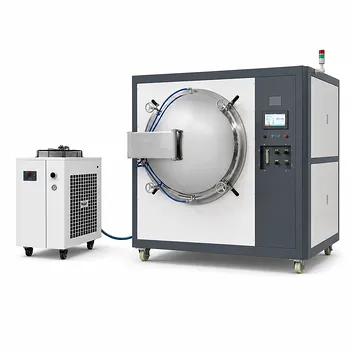
The use of a hot-press sintering furnace enhances LLZO solid-state electrolytes by applying mechanical pressure concurrently with high temperatures, rather than relying on heat alone. This dual-action process eliminates internal voids and promotes rapid particle bonding, resulting in a ceramic electrolyte with near-theoretical density.
The Core Takeaway Achieving high density is the single most critical factor for LLZO performance. Hot-press sintering overcomes the limitations of passive thermal diffusion by physically forcing particles together, significantly reducing resistance and increasing the material's mechanical durability.
The Mechanism of Densification
Simultaneous Heat and Pressure
Standard sintering relies on time and temperature to induce atomic diffusion. A hot-press sintering furnace accelerates this by adding mechanical pressure to the equation.
By compressing the powder while it is hot, the furnace ensures better physical contact between particles. This promotes diffusion at a much faster rate than heat alone can achieve.
Eliminating Internal Porosity
The primary enemy of solid-state electrolyte performance is porosity (air gaps). Air is an insulator for lithium ions.
Hot-press sintering effectively squeezes out these pores. While standard methods might achieve lower densities, this process creates ceramic bodies that reach near-theoretical density, often exceeding 95% relative density.
Impact on Electrochemical Performance
Reducing Grain Boundary Resistance
In polycrystalline ceramics like LLZO, the "grain boundaries" (the interfaces where crystals meet) often present a barrier to ion flow.
By achieving high density and tight particle packing, hot-press sintering minimizes the space and resistance at these boundaries. This directly leads to increased overall ionic conductivity, allowing lithium ions to move freely through the material.
Enhancing Mechanical Strength
A dense ceramic is a strong ceramic. The elimination of pores significantly improves the mechanical integrity of the electrolyte.
High mechanical strength is essential for solid-state batteries to withstand internal stresses and potentially suppress the growth of lithium dendrites, which can cause short circuits.
Understanding the Trade-offs
Process Intensity vs. Simplicity
While hot-press sintering yields superior density, it is a more intensive process than standard pressureless sintering (such as using a muffle furnace). Standard methods often require longer dwell times (e.g., 5 hours) and separate "green body" formation steps like Cold Isostatic Pressing (CIP) to achieve similar goals.
Isotropic vs. Uniaxial Pressure
It is important to distinguish between standard hot pressing (mechanical force) and Hot Isostatic Pressing (HIP).
HIP uses high-pressure gas to apply force from all directions (isotropically), which can further boost density from ~90.5% to 97.5%. While standard hot pressing is highly effective, complex shapes may benefit more from the isotropic pressure of HIP machines to ensure uniform densification.
Making the Right Choice for Your Goal
When selecting a synthesis method for LLZO electrolytes, consider your specific performance targets:
- If your primary focus is maximum ionic conductivity: Prioritize hot-press sintering or HIP. The reduction in grain boundary resistance caused by high density is non-negotiable for high-performance cells.
- If your primary focus is mechanical robustness: Utilize pressure-assisted sintering. The elimination of pores creates the structural integrity required to maintain battery safety and longevity.
Summary: Hot-press sintering transforms LLZO from a porous powder into a dense, conductive ceramic, serving as the foundational step for high-performance solid-state batteries.
Summary Table:
| Feature | Benefit | Impact on LLZO Performance |
|---|---|---|
| Simultaneous Heat & Pressure | Rapid particle bonding & diffusion | Reaches near-theoretical density (>95%) |
| Porosity Elimination | Removes air gaps (insulators) | Significantly higher ionic conductivity |
| Grain Boundary Control | Minimizes interface resistance | Faster and more efficient lithium-ion flow |
| Mechanical Compression | Enhanced structural integrity | Improved durability and dendrite suppression |
Elevate Your Solid-State Battery Research with KINTEK
Achieving peak electrochemical performance in LLZO electrolytes requires precision and the right equipment. KINTEK specializes in high-performance laboratory solutions designed for advanced materials science. Whether you need hot-press sintering systems, hydraulic presses (pellet, hot, isostatic), or high-temperature furnaces (muffle, vacuum, tube), we provide the tools necessary to achieve superior material density and conductivity.
Our comprehensive portfolio also includes battery research tools, consumables like PTFE products and crucibles, and advanced cooling solutions to support every stage of your workflow. Let our expertise help you streamline your synthesis process and ensure consistent, high-quality results.
Ready to optimize your electrolyte production? Contact us today to find the perfect equipment for your lab!
Related Products
- 600T Vacuum Induction Hot Press Furnace for Heat Treat and Sintering
- Vacuum Heat Treat and Pressure Sintering Furnace for High Temperature Applications
- Vacuum Heat Treat and Sintering Furnace with 9MPa Air Pressure
- Vacuum Hot Press Furnace Heated Vacuum Press Machine Tube Furnace
- Vacuum Hot Press Furnace Machine Heated Vacuum Press
People Also Ask
- What role does an induction vacuum hot pressing furnace play in sintering? Achieve 98% Density in Carbide Blocks
- What advantages does a vacuum hot press furnace provide for LSLBO ceramic electrolytes? Achieve 94% Relative Density
- What role does a Vacuum Hot Press (VHP) furnace play in the densification of austenitic stainless steel 316 composites?
- What role does mechanical pressure play during the vacuum diffusion bonding of tungsten and copper? Keys to Solid Bonding
- What are the advantages of a vacuum hot press furnace for W-50%Cu? Achieve 99.6% Density at Lower Temperatures