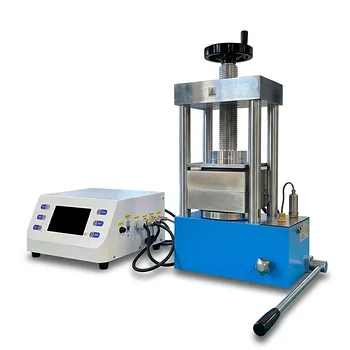
Precision hydraulic pressing is the definitive method for ensuring structural integrity and electrochemical efficiency in hydrogen electrode fabrication. By applying rigorously controlled pressure and specific holding times, these presses uniformly bond catalysts, binders, and conductive fillers onto membrane electrode assemblies (MEAs) or gas diffusion layers. This mechanical precision is essential for maximizing the active surface area and establishing the physical pathways required for high-performance hydrogen production.
The core advantage of using a precision hydraulic press is its ability to balance two competing needs: creating a tight electrical contact to minimize resistance while maintaining an open pore structure for optimal gas and ion transport.
Optimizing Electrical Connectivity
Reducing Interface Resistance
The primary function of the hydraulic press is to force active materials into intimate contact with the current collector.
By eliminating microscopic gaps between layers, the press significantly reduces interface resistance. Lower resistance means less energy is wasted as heat, ensuring that more electrical energy is converted directly into chemical potential for hydrogen production.
Ensuring Uniform Material Distribution
A precision press applies force evenly across the entire surface area of the electrode.
This uniformity is critical when compressing catalysts, binders, and conductive fillers. It prevents the formation of "hot spots" or areas of poor conductivity, which can lead to uneven reaction rates and premature component failure.
Enhancing Mass and Ion Transport
Optimizing Internal Pore Structure
Beyond simple bonding, the pressing process dictates the microscopic architecture of the electrode.
The reference highlights that precise pressing optimizes the internal pore structure. This structure is vital because it creates the physical channels required for reactants to reach the catalyst sites.
Facilitating Gas Diffusion
For hydrogen production to occur efficiently, gases must be able to move freely into and out of the electrode layers.
A controlled press ensures the material is compacted enough to conduct electricity, but not so dense that it seals off gas pathways. This balance directly enhances the rate of gas diffusion.
Improving Ion Transport rates
Similar to gas diffusion, ions must move through the electrode assembly to complete the electrochemical reaction.
The optimized structure created by the press reduces the tortuosity (path length) for ion movement. This allows for faster ion transport, which correlates directly to higher current densities and overall system efficiency.
The Role of Process Variables
Controlling Pressure
The specific amount of force applied determines the density of the final electrode.
Precision presses allow operators to dial in the exact pressure required for specific material chemistries. This repeatability ensures that every batch meets the same performance standards.
Managing Holding Time
It is not enough to simply apply pressure; the duration of the compression is equally important.
Controlling the holding time ensures that binders have sufficient time to set and that the materials mechanically lock together. This stabilizes the electrode, preventing delamination during operation.
Understanding the Trade-offs
The Danger of Over-Compression
While tight contact is necessary for conductivity, applying too much pressure can be detrimental.
Over-compression can crush the internal pores, effectively sealing the electrode. This creates a bottleneck for gas diffusion and ion transport, choking the reaction despite having excellent electrical conductivity.
The Risk of Under-Compression
Conversely, insufficient pressure fails to bond the layers adequately.
This results in high interface resistance and weak structural integrity. An under-compressed electrode may suffer from poor performance and physical degradation, such as peeling or cracking, under operating conditions.
Making the Right Choice for Your Goal
To maximize the utility of a precision hydraulic press, you must tune your parameters based on the specific limiting factors of your cell design.
- If your primary focus is maximizing electrical efficiency: Prioritize higher pressure settings to maximize contact area and minimize interface resistance, ensuring the binders are fully engaged.
- If your primary focus is maximizing reaction rates (mass transport): Use a slightly lower pressure or distinct holding times to preserve porosity, ensuring that gas diffusion and ion transport channels remain open.
The ultimate goal of precision pressing is to achieve the perfect equilibrium where electrical resistance is minimized without compromising the intricate porous network required for chemical activity.
Summary Table:
| Feature | Impact on Electrode Performance | Benefit for Hydrogen Production |
|---|---|---|
| Pressure Control | Reduces interface resistance and eliminates microscopic gaps | Minimizes energy waste; increases electrical efficiency |
| Uniform Distribution | Prevents "hot spots" and uneven reaction rates | Extends component lifespan and ensures stable output |
| Pore Optimization | Balances density with open gas/ion pathways | Enhances mass transport and maximizes reaction rates |
| Holding Time | Stabilizes binders and prevents delamination | Ensures structural integrity and long-term durability |
Elevate Your Hydrogen Research with KINTEK Precision
Precision is the difference between a functional electrode and a high-performance one. KINTEK specializes in advanced laboratory equipment designed to meet the rigorous demands of green energy R&D. Our comprehensive range of hydraulic presses (pellet, hot, and isostatic) provides the exact pressure control and repeatability required to optimize your MEAs and gas diffusion layers.
Beyond pressing, KINTEK supports your entire workflow with:
- High-temperature furnaces and reactors for catalyst synthesis.
- Electrolytic cells and electrodes for performance testing.
- Crushing, milling, and sieving systems for material preparation.
Don't let interface resistance or poor mass transport hinder your results. Partner with KINTEK to access the tools that bridge the gap between material science and electrochemical efficiency.
Contact our technical experts today to find the perfect pressing solution for your lab!
References
- Julio José Caparrós Mancera, Fernando Isorna. Sun, heat and electricity. A comprehensive study of non‐pollutant alternatives to produce green hydrogen. DOI: 10.1002/er.8505
This article is also based on technical information from Kintek Solution Knowledge Base .
Related Products
- Laboratory Hydraulic Press Split Electric Lab Pellet Press
- Automatic Laboratory Hydraulic Press for XRF & KBR Pellet Press
- Laboratory Hydraulic Pellet Press for XRF KBR FTIR Lab Applications
- Electric Heated Hydraulic Vacuum Heat Press for Lab
- Laboratory Manual Hydraulic Pellet Press for Lab Use
People Also Ask
- What role does a laboratory hydraulic press play in platinum recovery research? Enhancing Sample Precision
- What are the specific applications of a lab hydraulic press in biochar evaluation? Optimize density and data accuracy.
- What are the roles of a laboratory hydraulic press and stainless steel molds in the preparation of graphite samples?
- What is the role of a laboratory hydraulic press in electrode prep? Maximize Energy Density & Sealing Precision
- Why must a laboratory hydraulic press equipped with cylindrical molds be used when preparing BZY green bodies? High Density