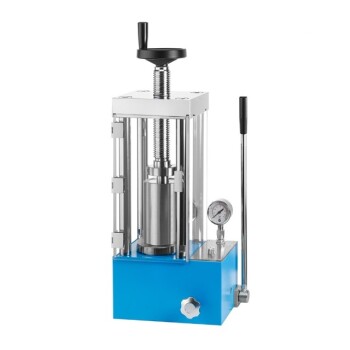
In the infrared spectroscopy characterization of Pennisetum alopecuroides, a laboratory hydraulic manual pellet press serves as the critical sample preparation tool. It functions by compressing a mixture of ground biomass and potassium bromide (KBr) powder into a solid, transparent pellet of uniform thickness. This physical transformation is necessary to allow the infrared light beam to penetrate the dense lignocellulosic structure effectively.
By converting loose biomass powder into a transparent optical medium, the hydraulic press enables the detection of clear functional group information. This precision is required to analyze subtle chemical bond changes in lignin and hemicellulose that occur during the pretreatment of Pennisetum alopecuroides.
The Challenge of Lignocellulosic Analysis
Overcoming Sample Opacity
Raw biomass samples, such as Pennisetum alopecuroides, are naturally opaque and scatter light.
If analyzed directly, the infrared beam cannot pass through the material effectively.
The primary role of the hydraulic press is to eliminate this opacity by creating a dense, transparent matrix.
The Role of the KBr Matrix
To achieve transparency, the ground fiber powder is mixed with potassium bromide (KBr).
KBr is optically transparent to infrared light.
The press fuses this mixture, ensuring the biomass is suspended evenly within a clear medium rather than clumped together.
Mechanism of Action
High-Pressure Compression
The manual hydraulic press applies significant force to the sample mixture.
By building up pressure using the hand lever, the press forces the KBr to flow around the biomass particles (cold flow).
This creates a solid disc where the sample is encapsulated and immobilized.
Ensuring Uniformity
For accurate spectroscopy, the path length of the light must be consistent.
The hydraulic press ensures the resulting pellet has a uniform thickness and a smooth, homogeneous surface.
This uniformity prevents distortions in the spectral data caused by variations in sample density.
Analytical Outcomes for Pennisetum alopecuroides
Clear Spectral Baselines
A well-pressed pellet reduces light scattering interference.
According to technical references, this results in infrared absorption spectra with stable baselines.
Stability is crucial for distinguishing real data from background noise.
Tracking Structural Changes
The ultimate goal of using the press is to facilitate the analysis of chemical bonds.
Researchers use the resulting clear characteristic peaks to monitor lignin and hemicellulose.
This allows for a direct comparison of the biomass structure before and after pretreatment, revealing how the chemical bonds have shifted.
Understanding the Trade-offs
The Risk of Inadequate Pressure
If the hydraulic press does not apply sufficient pressure, the pellet will remain opaque.
This leads to significant light scattering, which obscures the characteristic peaks needed for analysis.
Uniformity vs. Speed
While the press is capable of rapid sample preparation, rushing the process can lead to structural flaws in the pellet.
A pellet that is not homogeneous will yield inconsistent absorption data, making quantitative analysis impossible.
Ensuring Data Integrity in Spectroscopy
If your primary focus is Structural Analysis:
- Ensure the pellet is pressed to full transparency to accurately visualize changes in lignin and hemicellulose bonds.
If your primary focus is Comparative Study:
- Maintain consistent pressure settings across all samples to ensure valid comparisons between pre- and post-treatment biomass.
If your primary focus is Baseline Stability:
- Prioritize a smooth, defect-free surface finish to minimize light scattering and noise in your spectral data.
Precision in the physical pressing stage is the prerequisite for accuracy in the chemical analysis stage.
Summary Table:
| Feature | Role in Pennisetum alopecuroides Characterization |
|---|---|
| Pressure Application | Forces KBr cold flow to encapsulate biomass into a solid matrix. |
| Optical Clarity | Eliminates sample opacity and light scattering for clear light penetration. |
| Uniformity | Ensures consistent path length for stable baselines and reproducible data. |
| Analytical Goal | Enables tracking of chemical bond shifts in lignin and hemicellulose. |
Elevate Your Material Analysis with KINTEK Precision
High-quality infrared spectroscopy begins with flawless sample preparation. At KINTEK, we specialize in providing researchers with the robust laboratory hydraulic manual pellet presses, KBr dies, and pellet-making consumables necessary to transform complex biomass like Pennisetum alopecuroides into clear, analytical-grade discs.
Beyond spectroscopy, KINTEK offers a comprehensive range of laboratory solutions, including:
- Sample Preparation: Crushing and milling systems, sieving equipment, and advanced hydraulic presses (pellet, hot, isostatic).
- Thermal Processing: High-temperature muffle, tube, vacuum, and CVD furnaces.
- Specialized Reactors: High-temperature high-pressure reactors and autoclaves.
- Lab Essentials: ULT freezers, cold traps, homogenizers, and precision ceramics.
Achieve stable baselines and superior spectral data today. Contact our specialists to find the perfect equipment for your lab!
References
- Shangyuan Tang, Xiyu Cheng. Enhanced Enzymatic Hydrolysis of Pennisetum alopecuroides by Dilute Acid, Alkaline and Ferric Chloride Pretreatments. DOI: 10.3390/molecules24091715
This article is also based on technical information from Kintek Solution Knowledge Base .
Related Products
- Laboratory Manual Hydraulic Pellet Press for Lab Use
- Laboratory Manual Hydraulic Pellet Press for Lab Use
- Automatic Laboratory Hydraulic Press for XRF & KBR Pellet Press
- Automatic Laboratory Hydraulic Pellet Press Machine for Lab Use
- Laboratory Hydraulic Pellet Press for XRF KBR FTIR Lab Applications
People Also Ask
- What is the role of a laboratory hydraulic pellet press and stainless steel molds in the fabrication of RuO2/NbC anodes?
- What is the necessity of using a laboratory hydraulic pellet press in the preparation of biomass fuel pellets? Guide
- What is the significance of applying 200 MPa of pressure with a laboratory hydraulic pellet press for composite ceramics?
- How does a laboratory hydraulic pellet press contribute to SiCw/2024 aluminum composite preforms? Optimize Densification
- Why use laboratory manual hydraulic presses for semiconductor pellets? Optimize Annealing & Crystalline Quality