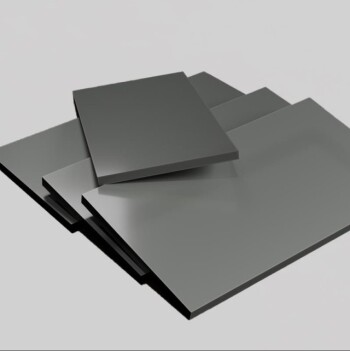
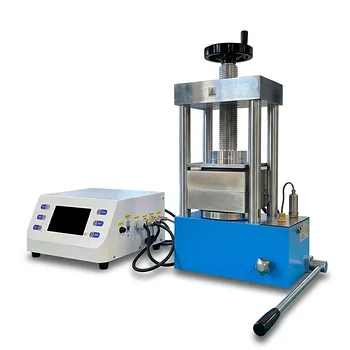
A laboratory hydraulic press serves as the definitive tool for consolidating loose raw materials into functional electrode structures. In the fabrication of graphite-cement composite electrodes, the press is used to compress a uniformly mixed powder of graphite and cement into solid blocks. This process transforms the raw mixture into a cohesive unit with specific density and mechanical strength characteristics required for experimentation and application.
The hydraulic press is not merely a shaping tool; it is a tuning instrument. By precisely controlling the applied pressure, researchers manipulate the internal pore distribution of the composite, directly balancing mechanical stability with the mass transfer efficiency required for microbial fuel cells.
Transforming Powder into Functional Structure
Consolidation of Raw Materials
The primary function of the press is to convert the uniformly mixed powder of graphite and cement into a singular, solid form. Without this compression, the loose particles would lack the physical cohesion necessary to act as a stable electrode.
Establishing Particle Contact
The force applied by the press drives the graphite and cement particles into close proximity. This physical compaction ensures solid-solid interface contact, which is essential for creating a continuous conductive network within the cement matrix.
Creating Defined Geometry
The press allows researchers to produce electrodes with consistent shapes and dimensions. By compressing the material into solid blocks, the resulting electrode achieves a geometric stability that allows it to hold its shape during handling and operation.
The Critical Role of Pressure Control
Adjusting Pore Distribution
The most sophisticated use of the hydraulic press in this context is the modulation of porosity. Researchers use specific pressure settings to adjust the pore distribution within the composite material.
Regulating Mass Transfer
The pores created (or retained) during pressing are not defects; they are functional pathways. Proper pressure ensures the electrode structure supports efficient mass transfer, allowing reactants to move through the material during the operation of a microbial fuel cell.
Ensuring Mechanical Stability
Pressure determines the structural integrity of the final block. The press must apply enough force to bind the cement and graphite into a structure capable of maintaining mechanical stability over time, preventing the electrode from crumbling in a liquid environment.
Understanding the Trade-offs
The Density vs. Permeability Conflict
There is an inherent trade-off when selecting the pressure setting on the hydraulic press. Applying excessive pressure will maximize mechanical strength and electrical contact but may eliminate the critical pores needed for mass transfer, rendering the electrode inefficient.
The Risk of Under-Compression
Conversely, applying insufficient pressure preserves high porosity but may result in a structurally weak electrode. A block that is too porous may lack the necessary mechanical strength to survive the operational environment or fail to establish a reliable conductive network.
Making the Right Choice for Your Goal
To optimize your graphite-cement composite electrode, you must tune the hydraulic press settings to your specific performance requirements.
- If your primary focus is mechanical longevity: Prioritize higher compression pressures to maximize density and ensure the electrode maintains stability in harsh fluid environments.
- If your primary focus is electrochemical efficiency: Utilize moderate controlled pressure to preserve the pore distribution necessary for effective mass transfer within the microbial fuel cell.
The hydraulic press is the gatekeeper that determines whether your composite powder becomes a conductive stone or a breathable, functional electrode.
Summary Table:
| Process Objective | Role of Hydraulic Press | Key Outcome |
|---|---|---|
| Material Consolidation | Compresses loose powder into solid blocks | Geometric stability and structural cohesion |
| Conductivity | Forces particle-to-particle contact | Continuous electrical network formation |
| Pore Distribution | Modulates internal void spaces | Controlled mass transfer for fuel cells |
| Mechanical Integrity | Optimizes density via pressure control | Durability in liquid environments |
Elevate Your Electrode Fabrication with KINTEK
Precision is paramount when balancing mechanical stability with mass transfer efficiency. KINTEK specializes in advanced laboratory hydraulic presses (pellet, hot, and isostatic) designed to provide the exact pressure control required for your graphite-cement composite research.
Our extensive portfolio supports every stage of your material science workflow, including:
- Crushing and Milling Systems for uniform powder preparation.
- High-Temperature Furnaces for specialized curing and sintering.
- PTFE Products & Ceramics for high-purity material handling.
Whether you are developing microbial fuel cells or advanced battery technologies, KINTEK provides the high-performance tools and consumables needed to turn your research into results. Contact our technical experts today to find the perfect pressing solution for your lab.
References
- Luis Alberto Estudillo‐Wong, Nicolás Alonso‐Vante. Revisiting Current Trends in Electrode Assembly and Characterization Methodologies for Biofilm Applications. DOI: 10.3390/surfaces6010002
This article is also based on technical information from Kintek Solution Knowledge Base .
Related Products
- Graphite Disc Rod and Sheet Electrode Electrochemical Graphite Electrode
- Automatic Laboratory Hydraulic Press for XRF & KBR Pellet Press
- Laboratory Hydraulic Press Split Electric Lab Pellet Press
- Carbon Graphite Plate Manufactured by Isostatic Pressing Method
- kbr pellet press 2t
People Also Ask
- Why is a graphite electrode used as a counter electrode? Achieve Pure Electrochemical Reduction with KINTEK
- What is the correct procedure for installing and connecting a graphite electrode during an experiment? Ensure Accurate Electrochemical Results
- What are the potential risks when using a graphite electrode in electrochemical tests? Avoid Decomposition and Contamination
- What are the key precautions for handling graphite electrodes? Ensure Safety & Maximize Performance
- Why are Dimensionally Stable Anodes (DSA) preferred for indium electrowinning? Ensure High-Purity Results.