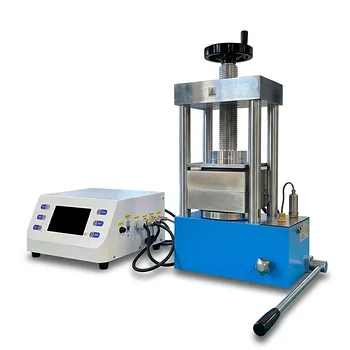
The laboratory uniaxial hydraulic press is a critical tool for densifying electrode materials and ensuring low interface resistance. It applies precise, uniform mechanical pressure (typically ranging from 10 to 30 MPa) to active material slurries coated onto current collectors like nickel foam or nickel foil. This process creates the robust mechanical bond and continuous electrical path necessary for high-performance symmetric supercapacitors.
Using a hydraulic press transforms a loose slurry into a dense, high-conductivity electrode by minimizing contact resistance and maximizing particle-to-particle contact. This step is essential for achieving both high rate performance and long-term cycling stability in energy storage devices.
Enhancing Charge Transfer and Structural Integrity
Reducing Ohmic Contact Resistance
Pressing forces active material particles into intimate contact with the current collector substrate. This minimizes the interface resistance, which is vital for efficient electron transport and reducing heat generation during high-current operation.
Eliminating Internal Voids
The uniaxial force collapses air pockets and voids within the slurry layer. This compaction significantly increases the volumetric energy density, allowing the electrode to store more energy within the same physical footprint.
Ensuring Mechanical Stability
By physically embedding the active material into the pores of nickel foam or mesh, the press prevents the material from shedding or delaminating. This ensures the electrode maintains its structural integrity during electrolyte immersion and repeated charge-discharge cycles.
Controlling Electrode Geometry and Density
Precise Thickness Control
Equipping the hydraulic press with precision molds allows researchers to achieve a fixed electrode shape and thickness (e.g., 30 μm). This level of control is necessary for reproducibility in experimental testing and ensures consistent performance across multiple cells.
Optimizing Particle Contact
High-pressure physical compression ensures that the conductive agents, binders, and active materials are tightly packed. This proximity facilitates faster charge transfer rates and improves the overall rate performance of the supercapacitor.
Managing Compaction Parameters
Standard protocols often involve applying a specific load, such as 0.5 tons or 10-30 MPa, and maintaining that pressure for a set duration (dwell time). Maintaining constant pressure for approximately one minute ensures the material reaches a stable, equilibrium density.
Understanding the Trade-offs
The Porosity-Conductivity Paradox
While high pressure increases conductivity, excessive compaction can reduce the porosity of the electrode. If pores become too compressed, electrolyte ions cannot easily access the internal surface area, which can hinder the supercapacitor’s high-frequency performance.
Risk of Substrate Damage
Applying pressure beyond the mechanical limits of the current collector (e.g., very thin nickel foil) can cause warping or micro-fractures. These structural defects may lead to uneven current distribution or internal short circuits within the coin cell assembly.
How to Apply This to Your Project
Properly calibrating your pressing process is essential for balancing energy density with ion accessibility.
- If your primary focus is high power density: Prioritize a higher compaction pressure (25–30 MPa) to minimize internal resistance and maximize electron flow across the electrode.
- If your primary focus is electrolyte accessibility: Use a moderate pressure (10 MPa) and a longer dwell time to ensure mechanical stability without sacrificing the porous network needed for rapid ion transport.
Mastering the balance of pressure and time is the definitive path to producing supercapacitor electrodes that offer both high energy storage and rapid power delivery.
Summary Table:
| Feature | Function in Electrode Assembly | Impact on Performance |
|---|---|---|
| Compaction Pressure | 10–30 MPa application | Increases volumetric energy density |
| Interface Resistance | Minimizes Ohmic contact resistance | Enhances high-current charge transfer |
| Structural Integrity | Prevents material delamination | Improves long-term cycling stability |
| Thickness Control | Ensures uniform slurry layers | Guarantees experimental reproducibility |
| Dwell Time | Maintains pressure for ~1 minute | Achieves stable equilibrium density |
Elevate Your Energy Storage Research with KINTEK
Achieving the perfect balance between porosity and conductivity requires precision equipment you can trust. KINTEK specializes in high-performance laboratory solutions, offering a robust range of manual, automatic, and isostatic hydraulic presses designed specifically for pelletizing and electrode densification.
Beyond pressing, our comprehensive portfolio supports your entire workflow—from high-temperature muffle and vacuum furnaces for material synthesis to battery research tools, electrolytic cells, and essential consumables like PTFE and ceramics.
Ready to optimize your supercapacitor fabrication? Contact KINTEK today to discover how our high-precision systems can enhance your lab's efficiency and ensure reproducible, high-quality results for your next breakthrough.
References
- Nantikron Ngamjumrus, Chesta Ruttanapun. Two Steps for Improving Reduced Graphene Oxide/Activated Durian Shell Carbon Composite by Hydrothermal and 3-D Ball Milling Process for Symmetry Supercapacitor Device. DOI: 10.3390/en16196962
This article is also based on technical information from Kintek Solution Knowledge Base .
Related Products
- Laboratory Hydraulic Press Split Electric Lab Pellet Press
- Automatic Laboratory Hydraulic Press for XRF & KBR Pellet Press
- Laboratory Hydraulic Pellet Press for XRF KBR FTIR Lab Applications
- 24T 30T 60T Heated Hydraulic Press Machine with Heated Plates for Laboratory Hot Press
- Laboratory Manual Hydraulic Pellet Press for Lab Use
People Also Ask
- What role does a laboratory hydraulic press play in platinum recovery research? Enhancing Sample Precision
- What are the specific applications of a lab hydraulic press in biochar evaluation? Optimize density and data accuracy.
- What are the roles of a laboratory hydraulic press and stainless steel molds in the preparation of graphite samples?
- What is the role of a laboratory hydraulic press in electrode prep? Maximize Energy Density & Sealing Precision
- Why must a laboratory hydraulic press equipped with cylindrical molds be used when preparing BZY green bodies? High Density