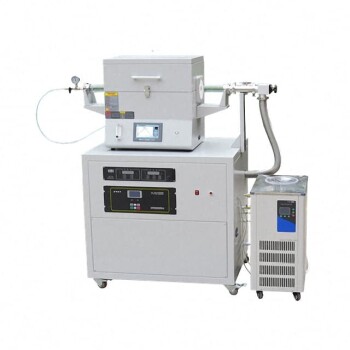
Thermal stability evaluation in a vacuum tube furnace is the standard method for determining the operational limits of TiO2/Ag/AZO multilayer films. By subjecting these transparent conductors to controlled annealing cycles under high vacuum, researchers can observe how the critical silver nanolayer responds to heat without the interference of atmospheric oxygen. This process allows for the precise measurement of electrical resistance changes and microstructural degradation, effectively mapping the material's performance boundaries.
The vacuum tube furnace serves as a controlled "stress test" environment that isolates thermal effects from chemical oxidation. By maintaining a high vacuum while precisely modulating temperature, the furnace reveals the temperature thresholds where the conductive silver layer begins to degrade or agglomerate.
The Role of Atmosphere Control in Thermal Testing
Preventing Silver Oxidation
The silver (Ag) nanolayer is the primary conductive component in the TiO2/Ag/AZO stack, but it is highly susceptible to oxidation at elevated temperatures. A vacuum tube furnace removes oxygen from the environment, ensuring that any changes in electrical performance are due to thermal morphology shifts rather than chemical corrosion.
Maintaining Interface Integrity
Multilayer conductors rely on the precise thickness of the TiO2 and AZO layers to protect the silver and manage light transmission. The furnace provides a stable thermal environment that allows researchers to study how these layers interact at the interfaces without external atmospheric contaminants affecting the results.
Simulating Service Conditions and Material Limits
Precision Annealing Between 200°C and 400°C
Most thermal stability tests for these conductors occur within the 200°C to 400°C range, simulating potential manufacturing or high-stress service environments. The furnace’s ability to maintain precise heating and cooling rates is critical for identifying the exact "tipping point" where the material’s resistance begins to spike.
Assessing Grain Growth and Agglomeration
At high temperatures, thin silver films tend to undergo grain growth or dewetting, where the continuous film breaks into isolated islands. The vacuum tube furnace enables researchers to monitor these microstructural transformations and determine how elements might segregate at grain boundaries to resist or promote coarsening.
Understanding the Trade-offs and Pitfalls
Vacuum Level vs. Residual Oxygen
Even in a high-vacuum environment, trace amounts of oxygen can remain, potentially leading to minor oxidation that skews results. It is vital to ensure the vacuum system is fully purged and stabilized before the heating cycle begins to maintain the objectivity of the test.
Thermal Lag and Sensor Accuracy
In a tube furnace, the temperature of the heating element may differ slightly from the actual sample temperature. Users must account for this thermal lag by placing thermocouples as close to the TiO2/Ag/AZO sample as possible to ensure the data reflects the material's true thermal threshold.
Substrate Compatibility
The thermal expansion coefficients of the glass or polymer substrate must be considered alongside the conductor layers. Rapid cooling rates in the furnace can induce mechanical stress or cracking, which might be mistaken for a failure of the TiO2/Ag/AZO layers themselves.
Applying Furnace Data to Material Development
Making the Right Choice for Your Goal
To get the most value from vacuum furnace testing, the parameters must align with the specific performance requirements of the end application.
- If your primary focus is maximizing electrical conductivity: Use the furnace to identify the maximum temperature before silver agglomeration occurs, as this represents the absolute upper limit for processing.
- If your primary focus is long-term environmental durability: Utilize the furnace for extended steady-state heating (e.g., 400°C for 2 hours) to simulate accelerated aging and verify the protective quality of the TiO2/AZO capping layers.
- If your primary focus is optical transparency: Monitor the furnace-treated samples for phase structure transformations that might increase light scattering or change the refractive index of the dielectric layers.
By utilizing a vacuum tube furnace to isolate thermal variables, researchers can confidently engineer TiO2/Ag/AZO conductors that remain stable under the most demanding operational conditions.
Summary Table:
| Testing Parameter | Role in Stability Evaluation | Benefit for Researchers |
|---|---|---|
| High Vacuum | Eliminates oxygen interference | Prevents silver oxidation; isolates thermal morphology shifts |
| Precise Heating | 200°C - 400°C controlled cycles | Identifies exact temperature thresholds for resistance spikes |
| Atmosphere Control | Prevents atmospheric contaminants | Ensures interface integrity between TiO2 and AZO layers |
| Cooling Control | Regulated thermal ramp-down | Minimizes mechanical stress and substrate cracking |
Elevate Your Material Stability Research with KINTEK
Precision is the foundation of innovation. Whether you are mapping the limits of TiO2/Ag/AZO conductors or developing the next generation of thin-film materials, KINTEK provides the high-performance thermal equipment you need to succeed.
We specialize in advanced laboratory solutions, including high-precision vacuum tube furnaces, muffle furnaces, and CVD/PECVD systems designed for oxidation-free processing. Our extensive portfolio also features high-temperature high-pressure reactors, autoclaves, electrolytic cells, and high-performance hydraulic presses for pellet preparation.
Ready to achieve superior thermal control? Contact us today to discuss your application. Our experts will help you select the ideal furnace or laboratory system to ensure your research results are accurate, repeatable, and reliable.
References
- Ertao Hu, Wei Wei. Design and Fabrication of an Ag Ultrathin Layer-Based Transparent Band Tunable Conductor and Its Thermal Stability. DOI: 10.3390/nano13142108
This article is also based on technical information from Kintek Solution Knowledge Base .
Related Products
- Vacuum Sealed Continuous Working Rotary Tube Furnace Rotating Tube Furnace
- Laboratory High Pressure Vacuum Tube Furnace
- Laboratory Vacuum Tilt Rotary Tube Furnace Rotating Tube Furnace
- Split Chamber CVD Tube Furnace with Vacuum Station Chemical Vapor Deposition System Equipment Machine
- 1200℃ Controlled Atmosphere Furnace Nitrogen Inert Atmosphere Furnace
People Also Ask
- What are the advantages of using a rotary tube furnace for MoVOx catalysts? Elevate Uniformity and Crystallinity
- What are the process advantages of using a rotary tube furnace for WS2 powder? Achieve Superior Material Crystallinity
- Why is a vacuum tube furnace with argon protection required for RGO/Cu? Ensure Conductivity and Material Purity
- Why is a rotary tube furnace preferred over a fixed tube furnace for the carbonization of asphaltenes? Superior Quality
- What is a rotary tube furnace? Achieve Superior Uniformity for Powders and Granules