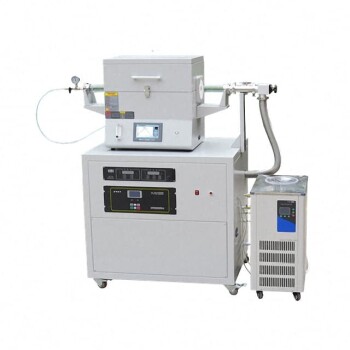
A vacuum tube furnace is a critical requirement for synthesizing nanocomposite powders because it provides the strictly controlled environment necessary for high-temperature heat treatment. Its primary function is to prevent the oxidation of these powders—specifically those that have been mechanically ball-milled—by isolating them from oxygen using a vacuum or inert gas atmosphere. This isolation ensures that materials, such as (NbTi)C/Fe, maintain the high purity and chemical stability needed before they proceed to melting and casting.
Nanocomposite powders become highly reactive after mechanical processing. The vacuum tube furnace creates a protective barrier against oxidation, preserving the material's chemical integrity during the vulnerable high-temperature synthesis phase.
The Critical Role of Atmosphere Control
Preventing Oxidation of Nanopowders
The most significant threat to nanocomposite powders during heat treatment is exposure to oxygen. When these materials are heated in a standard environment, they are prone to rapid oxidation, which degrades their properties.
A vacuum tube furnace eliminates this risk by replacing the air with a vacuum or an inert gas atmosphere. This ensures the synthesis occurs in a pristine environment where oxygen cannot react with the developing composite.
Preserving Chemical Stability
Maintaining chemical stability is essential for the performance of the final composite material.
By controlling the atmosphere, the furnace prevents unwanted chemical reactions that would otherwise alter the composition of the powder. This is particularly crucial for complex composites like (NbTi)C/Fe, where precise stoichiometry is required.
Integration into the Manufacturing Workflow
Processing After Ball Milling
The need for this specific furnace arises directly from the preceding step: mechanical ball milling.
Ball milling is used to break down materials into fine nanocomposite powders, but this process often leaves them in a highly energetic and reactive state. The vacuum tube furnace provides a safe transition environment to treat these reactive powders without degrading them.
Preparation for Melting and Casting
The synthesis in the vacuum tube furnace acts as a bridge between raw powder production and the final formation of the material.
It ensures that the composite powders reach high purity levels before they enter the final melting and casting stages. Without this step, impurities introduced during heating would compromise the quality of the cast product.
Operational Constraints and Considerations
Strict Requirement for Controlled Environments
The primary limitation of this process is that it cannot be performed in open-air furnaces. The operator is strictly bound to using equipment capable of maintaining a robust vacuum or inert gas seal.
Complexity of Synthesis
Achieving the correct environment adds a layer of complexity compared to standard heat treatment. Failures in the vacuum seal or impurities in the inert gas supply will directly result in oxidized, unusable powder.
Making the Right Choice for Your Goal
To ensure the successful synthesis of nanocomposite powders, consider the following specific requirements of your workflow:
- If your primary focus is Material Purity: Ensure your furnace is capable of maintaining a deep vacuum or high-purity inert gas atmosphere to completely prevent oxidation.
- If your primary focus is Process Continuity: Verify that the furnace capacity aligns with your ball milling output to maintain a seamless transition to the melting and casting stages.
The vacuum tube furnace is not just a heating element; it is a protective chamber essential for translating raw, milled powders into high-performance composite materials.
Summary Table:
| Feature | Importance in Nanocomposite Synthesis |
|---|---|
| Atmosphere Control | Prevents rapid oxidation of reactive nanopowders post-milling. |
| Chemical Stability | Maintains precise stoichiometry for complex composites like (NbTi)C/Fe. |
| Vacuum/Inert Gas | Eliminates oxygen exposure during high-temperature heat treatment. |
| Workflow Bridge | Prepares ball-milled powders for high-purity melting and casting. |
Elevate Your Material Research with KINTEK Precision
Don't let oxidation compromise your innovation. KINTEK specializes in advanced laboratory solutions designed for the most demanding synthesis workflows. From high-performance vacuum tube, muffle, and CVD furnaces to precision crushing and milling systems, we provide the tools necessary to maintain the integrity of your nanocomposite powders.
Whether you are performing high-temperature synthesis or preparing samples with our hydraulic presses and planetary ball mills, our expert-grade equipment ensures superior purity and process repeatability.
Ready to optimize your lab's performance? Contact KINTEK today to find the perfect furnace or laboratory consumable for your specific research goals.
References
- Feng Qiu, Qi‐Chuan Jiang. Application of nanoparticles in cast steel: An overview. DOI: 10.1007/s41230-020-0037-z
This article is also based on technical information from Kintek Solution Knowledge Base .
Related Products
- Vacuum Sealed Continuous Working Rotary Tube Furnace Rotating Tube Furnace
- Laboratory High Pressure Vacuum Tube Furnace
- Laboratory Vacuum Tilt Rotary Tube Furnace Rotating Tube Furnace
- Split Chamber CVD Tube Furnace with Vacuum Station Chemical Vapor Deposition System Equipment Machine
- 1200℃ Controlled Atmosphere Furnace Nitrogen Inert Atmosphere Furnace
People Also Ask
- What are the process advantages of using a rotary tube furnace for WS2 powder? Achieve Superior Material Crystallinity
- What are the advantages of using a rotary tube furnace for MoVOx catalysts? Elevate Uniformity and Crystallinity
- Why is a vacuum tube furnace with argon protection required for RGO/Cu? Ensure Conductivity and Material Purity
- Why is a rotary tube furnace preferred over a fixed tube furnace for the carbonization of asphaltenes? Superior Quality
- What is a rotary tube furnace? Achieve Superior Uniformity for Powders and Granules