Knowledge How is carbon nanotubes structured? From Graphene Sheets to 1D Cylinders
Author avatar

Tech Team · Kintek Solution

Updated 6 days ago

How is carbon nanotubes structured? From Graphene Sheets to 1D Cylinders


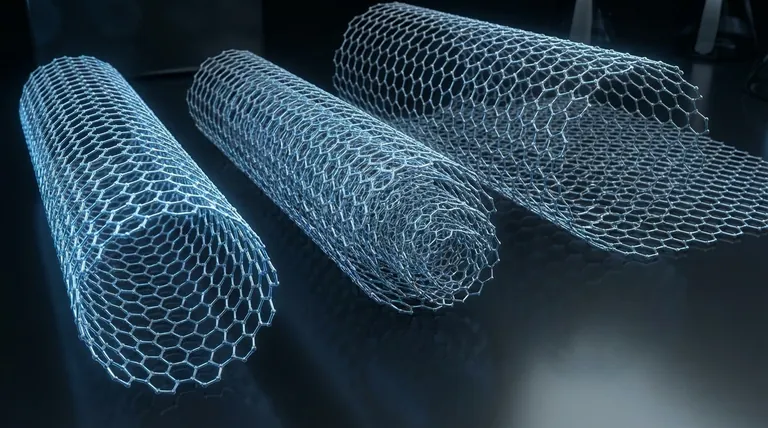
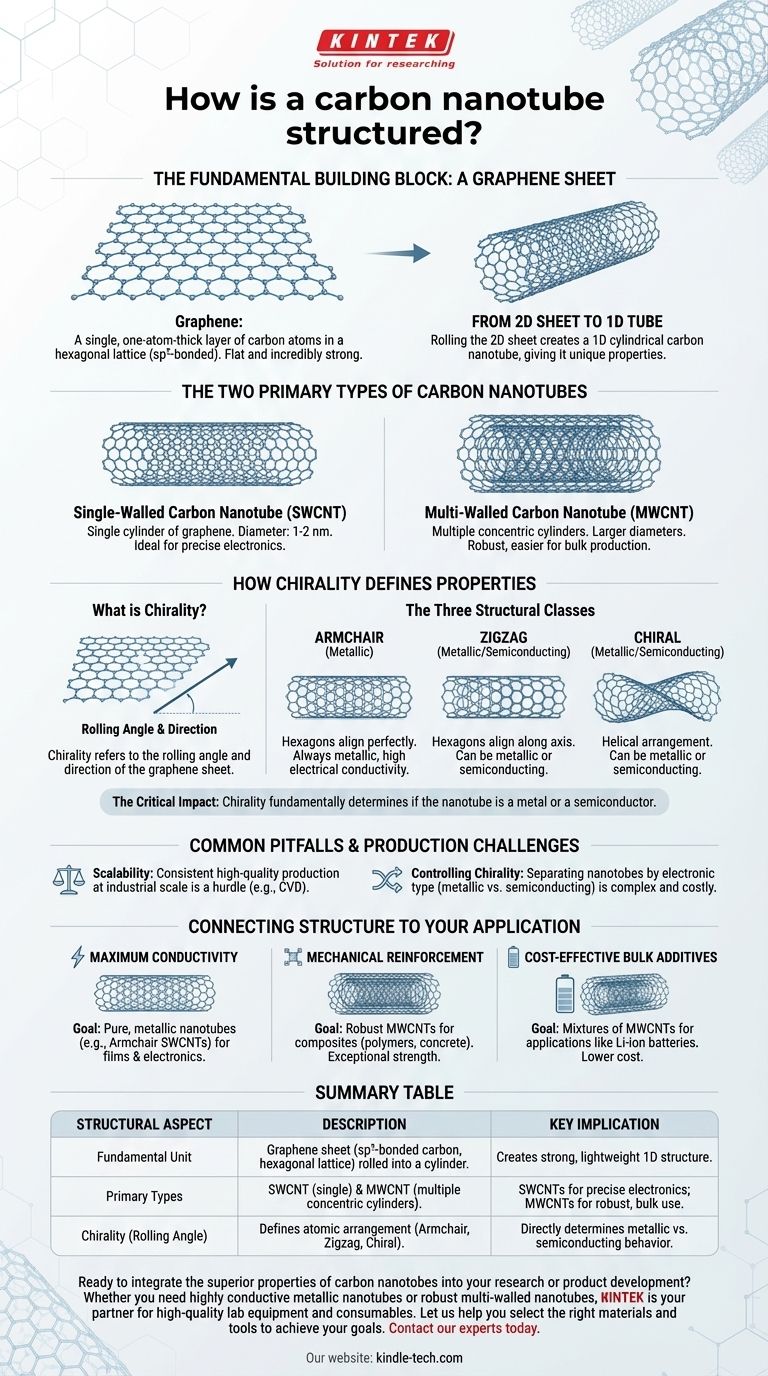
At its most fundamental level, a carbon nanotube is a sheet of graphene rolled into a seamless, hollow cylinder. Graphene itself is a single, one-atom-thick layer of carbon atoms arranged in a hexagonal honeycomb lattice. This unique, one-dimensional cylindrical structure is what gives carbon nanotubes their extraordinary and highly sought-after properties.

The specific way a carbon nanotube is "rolled" from a flat graphene sheet—its diameter and twist angle, known as chirality—fundamentally determines its properties, dictating whether it behaves as a metal or a semiconductor.

The Fundamental Building Block: A Graphene Sheet

The Hexagonal Lattice

The foundation of a carbon nanotube is the sp²-hybridized bonds between carbon atoms. These strong covalent bonds form a repeating hexagonal pattern, exactly like chicken wire, creating a flat and incredibly strong sheet called graphene.

From 2D Sheet to 1D Tube

Imagine taking this flat graphene sheet and rolling it up to connect one edge to the other seamlessly. The result is a carbon nanotube—a cylindrical fullerene. This transformation from a two-dimensional sheet to a one-dimensional tube is the source of its unique characteristics.

The Two Primary Types of Carbon Nanotubes

Single-Walled Carbon Nanotubes (SWCNTs)

A single-walled carbon nanotube (SWCNT) consists of a single cylinder of graphene. Their diameters are typically in the range of 1-2 nanometers, making them ideal for applications in electronics where precise properties are required.

Multi-Walled Carbon Nanotubes (MWCNTs)

A multi-walled carbon nanotube (MWCNT) is composed of multiple concentric cylinders of graphene nested inside one another, much like Russian nesting dolls. MWCNTs have larger outer diameters and are generally more robust and easier to produce in bulk than SWCNTs.

How Chirality Defines a Nanotube's Properties

What is Chirality?

Chirality refers to the angle and direction in which the graphene sheet is rolled to form the tube. It is described by a vector that defines how to "cut" the strip from the graphene lattice before rolling it up.

The Three Structural Classes

Based on this vector, nanotubes are classified into three types:

  1. Armchair: The hexagonal pattern aligns perfectly along the circumference of the tube.
  2. Zigzag: The hexagonal pattern aligns along the axis of the tube.
  3. Chiral: All other nanotubes, which have a helical or twisted arrangement of hexagons around the tube.

The Critical Impact: Metallic vs. Semiconducting

This structural difference has a profound impact on a nanotube's electrical behavior.

Armchair nanotubes are always metallic and exhibit extremely high electrical conductivity. In contrast, zigzag and chiral nanotubes can be either metallic or semiconducting, depending on their specific atomic arrangement.

Common Pitfalls and Production Challenges

The Challenge of Scalability

A prime challenge in realizing the full potential of carbon nanotubes is scaling up production. While methods like Chemical Vapor Deposition (CVD) are dominant, producing high-quality nanotubes consistently at an industrial scale remains a significant hurdle.

Controlling Chirality

For advanced electronics, separating nanotubes by their electronic type (metallic vs. semiconducting) is critical. Most synthesis methods produce a mixture of all chiralities, and separating them is a complex and costly process that limits their widespread use in applications like transistors.

Connecting Structure to Your Application

The specific structure of a carbon nanotube directly relates to its suitability for a given task.

  • If your primary focus is maximum electrical conductivity: The goal is to use pure, metallic nanotubes, with armchair SWCNTs being the theoretical ideal for applications in films and electronics.
  • If your primary focus is mechanical reinforcement: MWCNTs are often preferred for composites, such as in advanced polymers or concrete, as their structure provides exceptional strength and they are more cost-effective to produce in bulk.
  • If your primary focus is cost-effective bulk additives: For applications like improving conductivity in lithium-ion batteries, mixtures of MWCNTs are the standard choice due to their lower production cost and sufficient performance.

Understanding this link between atomic structure and real-world function is the key to unlocking the potential of these materials.
How is carbon nanotubes structured? From Graphene Sheets to 1D Cylinders

Summary Table:

Structural Aspect Description Key Implication
Fundamental Unit A single sheet of graphene (sp²-bonded carbon in a hexagonal lattice) rolled into a cylinder. Creates an incredibly strong and lightweight one-dimensional structure.
Primary Types SWCNT: Single graphene cylinder. MWCNT: Multiple concentric graphene cylinders. SWCNTs for precise electronics; MWCNTs for robust, bulk applications.
Chirality (Rolling Angle) Defines the atomic arrangement (Armchair, Zigzag, Chiral). Directly determines if the nanotube is a metal or a semiconductor.

Ready to integrate the superior properties of carbon nanotubes into your research or product development?

The precise structure of CNTs is the key to their performance. Whether you need highly conductive metallic nanotubes for electronics or robust multi-walled nanotubes for composite materials, KINTEK is your partner. We specialize in providing high-quality lab equipment and consumables for nanotechnology research and development.

Let us help you select the right materials and tools to achieve your goals. Contact our experts today to discuss your specific application needs.

Visual Guide
How is carbon nanotubes structured? From Graphene Sheets to 1D Cylinders Visual Guide

Related Products

People Also Ask

Related Products

HFCVD Machine System Equipment for Drawing Die Nano-Diamond Coating

HFCVD Machine System Equipment for Drawing Die Nano-Diamond Coating

The nano-diamond composite coating drawing die uses cemented carbide (WC-Co) as the substrate, and uses the chemical vapor phase method ( CVD method for short ) to coat the conventional diamond and nano-diamond composite coating on the surface of the inner hole of the mold.

915MHz MPCVD Diamond Machine Microwave Plasma Chemical Vapor Deposition System Reactor

915MHz MPCVD Diamond Machine Microwave Plasma Chemical Vapor Deposition System Reactor

915MHz MPCVD Diamond Machine and its multi-crystal effective growth, the maximum area can reach 8 inches, the maximum effective growth area of single crystal can reach 5 inches. This equipment is mainly used for the production of large-size polycrystalline diamond films, the growth of long single crystal diamonds, the low-temperature growth of high-quality graphene, and other materials that require energy provided by microwave plasma for growth.

Ultra-High Temperature Graphite Vacuum Graphitization Furnace

Ultra-High Temperature Graphite Vacuum Graphitization Furnace

The ultra-high temperature graphitization furnace utilizes medium frequency induction heating in a vacuum or inert gas environment. The induction coil generates an alternating magnetic field, inducing eddy currents in the graphite crucible, which heats up and radiates heat to the workpiece, bringing it to the desired temperature. This furnace is primarily used for graphitization and sintering of carbon materials, carbon fiber materials, and other composite materials.

1200℃ Split Tube Furnace with Quartz Tube Laboratory Tubular Furnace

1200℃ Split Tube Furnace with Quartz Tube Laboratory Tubular Furnace

KT-TF12 split tube furnace: high-purity insulation, embedded heating wire coils, and max. 1200C. Widely used for new materials and chemical vapour deposition.

Graphite Vacuum Furnace High Thermal Conductivity Film Graphitization Furnace

Graphite Vacuum Furnace High Thermal Conductivity Film Graphitization Furnace

The high thermal conductivity film graphitization furnace has uniform temperature, low energy consumption and can operate continuously.

Small Vacuum Heat Treat and Tungsten Wire Sintering Furnace

Small Vacuum Heat Treat and Tungsten Wire Sintering Furnace

The small vacuum tungsten wire sintering furnace is a compact experimental vacuum furnace specially designed for universities and scientific research institutes. The furnace features a CNC welded shell and vacuum piping to ensure leak-free operation. Quick-connect electrical connections facilitate relocation and debugging, and the standard electrical control cabinet is safe and convenient to operate.

Molybdenum Vacuum Heat Treat Furnace

Molybdenum Vacuum Heat Treat Furnace

Discover the benefits of a high-configuration molybdenum vacuum furnace with heat shield insulation. Ideal for high-purity, vacuum environments like sapphire crystal growth and heat treatment.

High Temperature Muffle Oven Furnace for Laboratory Debinding and Pre Sintering

High Temperature Muffle Oven Furnace for Laboratory Debinding and Pre Sintering

KT-MD High temperature debinding and pre-sintering furnace for ceramic materials with various molding processes. Ideal for electronic components such as MLCC and NFC.

1700℃ Laboratory Quartz Tube Furnace with Alumina Tube Tubular Furnace

1700℃ Laboratory Quartz Tube Furnace with Alumina Tube Tubular Furnace

Looking for a high-temperature tube furnace? Check out our 1700℃ Tube Furnace with Alumina Tube. Perfect for research and industrial applications up to 1700C.

Graphite Vacuum Furnace IGBT Experimental Graphitization Furnace

Graphite Vacuum Furnace IGBT Experimental Graphitization Furnace

IGBT experimental graphitization furnace, a tailored solution for universities and research institutions, with high heating efficiency, user-friendliness, and precise temperature control.

Vacuum Heat Treat and Molybdenum Wire Sintering Furnace for Vacuum Sintering

Vacuum Heat Treat and Molybdenum Wire Sintering Furnace for Vacuum Sintering

A vacuum molybdenum wire sintering furnace is a vertical or bedroom structure, which is suitable for withdrawal, brazing, sintering and degassing of metal materials under high vacuum and high temperature conditions. It is also suitable for dehydroxylation treatment of quartz materials.

Vacuum Dental Porcelain Sintering Furnace

Vacuum Dental Porcelain Sintering Furnace

Get precise and reliable results with KinTek's Vacuum Porcelain Furnace. Suitable for all porcelain powders, it features hyperbolic ceramic furnace function, voice prompt, and automatic temperature calibration.

Vacuum Sealed Continuous Working Rotary Tube Furnace Rotating Tube Furnace

Vacuum Sealed Continuous Working Rotary Tube Furnace Rotating Tube Furnace

Experience efficient material processing with our vacuum-sealed rotary tube furnace. Perfect for experiments or industrial production, equipped with optional features for controlled feeding and optimized results. Order now.

1700℃ Muffle Oven Furnace for Laboratory

1700℃ Muffle Oven Furnace for Laboratory

Get superior heat control with our 1700℃ Muffle Furnace. Equipped with intelligent temperature microprocessor, TFT touch screen controller & advanced insulation materials for precise heating up to 1700C. Order now!

Laboratory Sterilizer Lab Autoclave Pulse Vacuum Lifting Sterilizer

Laboratory Sterilizer Lab Autoclave Pulse Vacuum Lifting Sterilizer

The pulse vacuum lifting sterilizer is a state-of-the-art equipment for efficient and precise sterilization. It uses pulsating vacuum technology, customizable cycles, and a user-friendly design for easy operation and safety.

Vacuum Hot Press Furnace Machine for Lamination and Heating

Vacuum Hot Press Furnace Machine for Lamination and Heating

Experience clean and precise lamination with Vacuum Lamination Press. Perfect for wafer bonding, thin-film transformations, and LCP lamination. Order now!

Laboratory Sterilizer Lab Autoclave Vertical Pressure Steam Sterilizer for Liquid Crystal Display Automatic Type

Laboratory Sterilizer Lab Autoclave Vertical Pressure Steam Sterilizer for Liquid Crystal Display Automatic Type

Liquid crystal display automatic vertical sterilizer is a safe, reliable and automatic control sterilization equipment, which is composed of heating system, microcomputer control system and overheating and overvoltage protection system.

Benchtop Laboratory Vacuum Freeze Dryer

Benchtop Laboratory Vacuum Freeze Dryer

Benchtop laboratory freeze dryer for efficient lyophilization of biological, pharmaceutical, and food samples. Features intuitive touchscreen, high-performance refrigeration, and durable design. Preserve sample integrity—consult now!

Laboratory Test Sieves and Sieving Machines

Laboratory Test Sieves and Sieving Machines

Precision lab test sieves & sieving machines for accurate particle analysis. Stainless steel, ISO-compliant, 20μm-125mm range. Request specs now!

Benchtop Laboratory Freeze Dryer for Lab Use

Benchtop Laboratory Freeze Dryer for Lab Use

Premium benchtop laboratory freeze dryer for lyophilization, preserving samples with ≤ -60°C cooling. Ideal for pharmaceuticals & research.


Leave Your Message