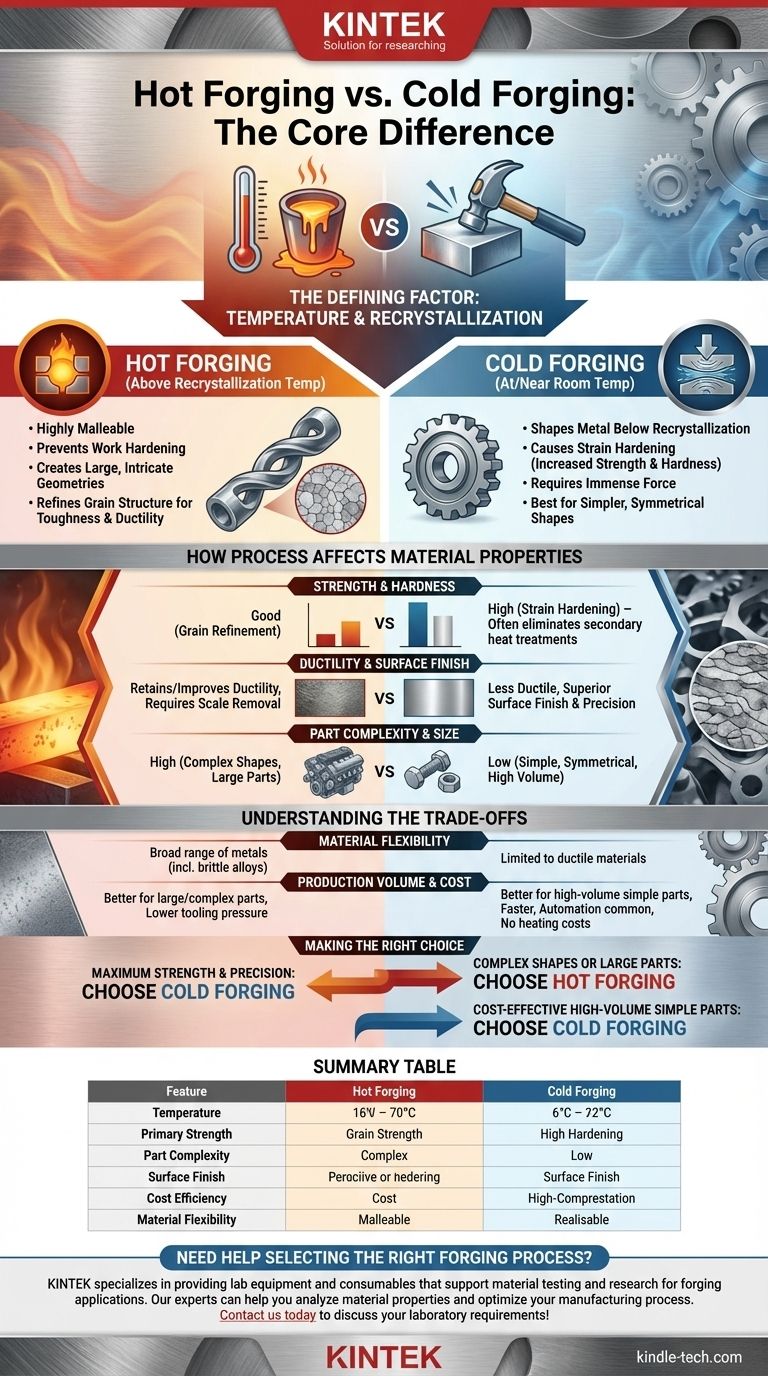
At its core, the difference between hot and cold forging is temperature. Hot forging shapes metal above its recrystallization temperature, making it highly malleable, while cold forging shapes metal at or near room temperature, which increases its strength through a process called strain hardening. This single difference in temperature creates a cascade of trade-offs affecting part complexity, final strength, surface finish, and overall cost.
The decision between hot and cold forging is a fundamental engineering trade-off. You are choosing between the superior formability and material flexibility of hot forging versus the enhanced strength, precision, and cost-efficiency (at high volumes) of cold forging.
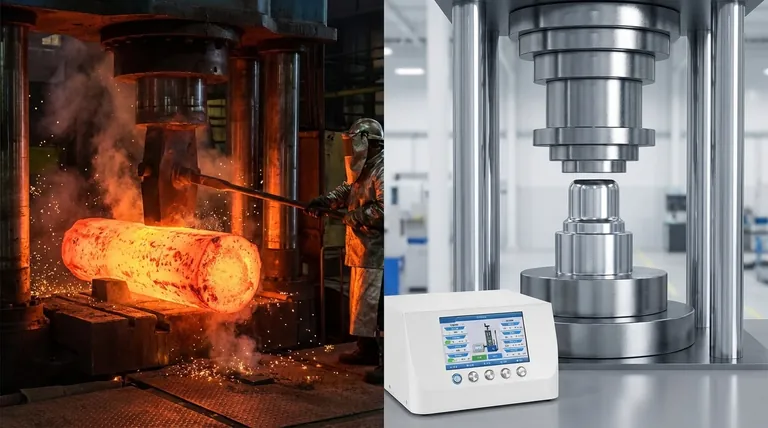
The Defining Factor: Temperature and Recrystallization
The temperature at which metal is worked fundamentally alters its internal structure and resulting properties. This is the most important concept to grasp when comparing these two processes.
Hot Forging: Shaping Above Recrystallization Temperature
Hot forging involves heating a metal workpiece (such as steel, aluminum, or titanium alloys) to a temperature above where its distorted grains can reform, a point known as the recrystallization temperature.
Working the metal in this heated, plastic-like state prevents it from hardening. The primary benefit is a significant reduction in the force required to shape the part, allowing for the creation of very large and intricate geometries that would be impossible to achieve cold.
Cold Forging: Shaping Below Recrystallization Temperature
Cold forging, also called cold forming, is performed at or near room temperature. Because the metal is below its recrystallization temperature, the process deforms its crystalline grain structure.
This deformation, known as strain hardening (or work hardening), makes the material significantly stronger and harder but also less ductile. This process requires immense force, limiting it to more ductile materials and generally simpler shapes.
How Process Affects Material Properties
The choice of forging temperature directly impacts the mechanical characteristics of the finished component.
Strength and Hardness
Cold forging produces a stronger and harder part than hot forging due to the strain hardening effect. This can often eliminate the need for secondary heat treatments, saving time and money.
Hot forging does not add strength through work hardening. However, the process refines the grain structure, which can improve the material's toughness and ductility.
Ductility and Surface Finish
The increase in strength from cold forging comes at the cost of ductility, making the final part more brittle. Hot-forged parts, by contrast, retain or even improve their ductility.
Cold forging offers a superior surface finish and higher dimensional accuracy. Because the part isn't heated, there is no oxidation scale to remove and no thermal contraction to account for during cooling.
Understanding the Trade-offs
Choosing a forging method requires balancing design complexity, material requirements, and production economics.
Part Complexity and Size
Hot forging is the clear choice for large and geometrically complex parts. The high malleability of the heated metal allows it to fill intricate die cavities with less force.
Cold forging is best suited for simpler, often symmetrical shapes with high production volumes. The high pressures required and the material's reduced ductility limit the complexity that can be achieved without causing fractures.
Material Requirements
Cold forging demands materials with high initial ductility and low sensitivity to strain hardening to avoid cracking during the process. This can limit material selection or require higher-grade, more expensive starting stock.
Hot forging is compatible with a much broader range of metals, including alloys that are too brittle to be worked cold.
Production Volume and Cost
For high-volume production runs, cold forging is typically more cost-effective. The process is faster, automation is common, and there are no energy costs associated with heating the workpiece.
Hot forging involves significant energy costs for furnaces and has longer cycle times, making it more expensive on a per-part basis for very high volumes. However, its lower tooling pressure requirements can sometimes offset costs for lower-volume runs.
Making the Right Choice for Your Application
Selecting the correct process requires a clear understanding of your project's primary goal. Use these guidelines to make an informed decision.
- If your primary focus is maximum strength and dimensional precision: Choose cold forging for its strain hardening benefits and excellent tolerances, but be prepared for simpler part geometries.
- If your primary focus is creating complex shapes or very large parts: Choose hot forging for its unmatched formability and flexibility with a wider range of materials.
- If your primary focus is cost-effective, high-volume production of simple parts: Choose cold forging for its speed, lack of heating costs, and superior as-forged surface finish.
Ultimately, your choice is dictated by balancing the need for geometric complexity against the desired final material properties and production cost.
Summary Table:
| Feature | Hot Forging | Cold Forging |
|---|---|---|
| Temperature | Above recrystallization temp | At/near room temperature |
| Primary Strength | Good (grain refinement) | High (strain hardening) |
| Part Complexity | High (complex shapes) | Low (simple, symmetrical) |
| Surface Finish | Requires scale removal | Superior, precise |
| Cost Efficiency | Better for large/complex parts | Better for high-volume simple parts |
| Material Flexibility | Broad range of metals | Limited to ductile materials |
Need help selecting the right forging process for your lab or production needs? KINTEK specializes in providing lab equipment and consumables that support material testing and research for forging applications. Our experts can help you choose the right tools to analyze material properties and optimize your manufacturing process. Contact us today to discuss how we can support your laboratory requirements with precision equipment and consumables!
Visual Guide
Related Products
- Double Plate Heating Press Mold for Lab
- Metallographic Specimen Mounting Machine for Laboratory Materials and Analysis
- Laboratory Hydraulic Press Lab Pellet Press for Button Battery
- Vacuum Hot Press Furnace Machine for Lamination and Heating
- Automatic Laboratory Hydraulic Pellet Press Machine for Lab Use
People Also Ask
- How is conventional heating different from induction heating? Direct vs. Indirect Heat Explained
- What does a hot press machine do? Permanently Bond, Form, or Transfer Materials with Precision
- What is a hot hydraulic press? Harness Heat and Pressure for Advanced Manufacturing
- What are heated hydraulic presses used for? Molding Composites, Vulcanizing Rubber, and More
- Does a hydraulic press have heat? How Heated Platens Unlock Advanced Molding and Curing