Knowledge How long does PVD coating process take? A Detailed Breakdown of the Multi-Stage Workflow
Author avatar

Tech Team · Kintek Solution

Updated 5 days ago

How long does PVD coating process take? A Detailed Breakdown of the Multi-Stage Workflow


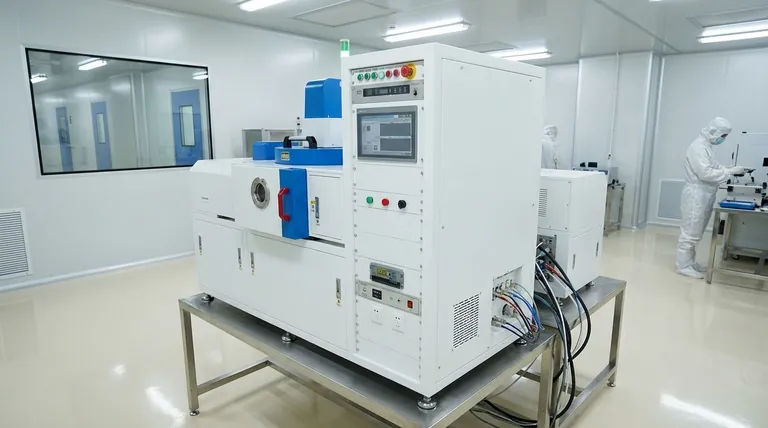
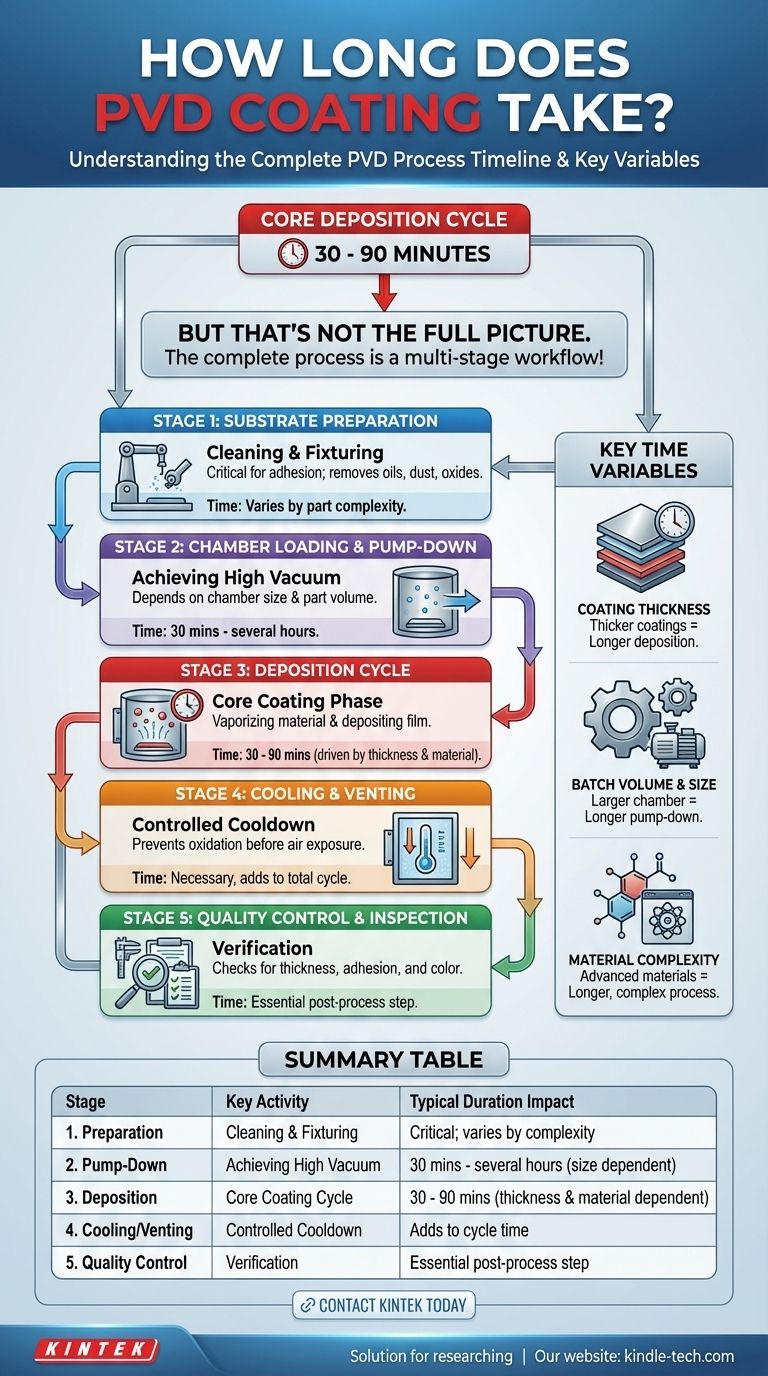
For a standard batch, the core PVD coating process that occurs inside the vacuum chamber typically takes between 30 and 90 minutes. However, this deposition time is only a fraction of the total lead time. The complete cycle, from initial part preparation to final quality inspection, is a multi-stage workflow where factors outside the chamber often dictate the overall duration.

While the vacuum deposition cycle itself is relatively short, the total process time is primarily driven by substrate preparation, chamber pump-down, desired coating thickness, and post-process quality control. Focusing only on the in-chamber time is a common oversimplification.
How long does PVD coating process take? A Detailed Breakdown of the Multi-Stage Workflow

Deconstructing the Total PVD Timeline

To accurately estimate time, you must understand that PVD is not a single action but a sequence of critical stages. Each stage contributes to the total time required to produce a finished, coated component.

Stage 1: Substrate Preparation and Cleaning

Before any coating can begin, the part to be coated (the substrate) must be perfectly clean. This is non-negotiable for ensuring proper coating adhesion.

This stage involves removing any oils, grease, dust, or oxides from the surface through various chemical and mechanical cleaning methods. Inadequate preparation is a primary cause of coating failure.

Stage 2: Chamber Loading and Pump-Down

Once cleaned, parts are loaded into fixtures and placed inside the PVD chamber. The chamber is then sealed, and a powerful vacuum system begins evacuating the air.

Achieving the necessary high-vacuum environment does not happen instantly. The time required for this "pump-down" phase depends on the size of the chamber and the cleanliness of the parts and internal fixtures. This step alone can take a significant amount of time.

Stage 3: The Deposition Cycle

This is the core "coating" phase and what is typically measured in the 30-90 minute timeframe. It involves heating the substrates and then using a high-energy source to vaporize a solid source material (the target).

These vaporized atoms travel through the vacuum and condense on the substrates, forming a thin, dense, and highly adherent film, atom by atom. The precise duration of this step is determined by the specific coating material and the required final thickness.

Stage 4: Cooling and Venting

After the deposition is complete, the parts must cool down within the vacuum chamber. Attempting to expose hot components to air can cause oxidation and compromise the coating's surface.

Once cooled to a safe temperature, the chamber is slowly vented with an inert gas before being brought back to atmospheric pressure, allowing the doors to be opened and the parts removed.

Stage 5: Quality Control and Inspection

The process does not end when the parts leave the chamber. Each batch typically undergoes quality control (QC) to ensure it meets specifications.

This may involve using advanced equipment like an X-ray fluorescent (XRF) machine to verify coating thickness and composition or a spectrophotometer to confirm color consistency.

Understanding the Key Time Variables

The duration of the PVD process is not fixed. It is a dynamic outcome based on several trade-offs between speed, cost, and final coating quality.

Coating Thickness vs. Deposition Time

This is the most direct relationship. A thicker coating requires more material to be vaporized and deposited onto the substrate, which directly extends the time of the deposition cycle.

Substrate Size and Batch Volume

Larger individual parts or a larger volume of parts require a bigger vacuum chamber. A larger chamber has more atmospheric gas to remove, leading to a longer pump-down time. It also requires more time to achieve uniform heating.

Coating Material and Complexity

Depositing a simple, single-element metal is often faster than creating a complex compound. Some advanced coatings require reacting the vaporized metal with specific gases (like nitrogen or oxygen) inside the chamber, which adds complexity and time to the process control steps.

Estimating Your PVD Process Time

To get a realistic estimate for your project, you must consider your primary objective. The answer changes based on whether you are optimizing for speed, quality, or production throughput.

  • If your primary focus is rapid turnaround: Use standard, thinner coatings on smaller parts to minimize both pump-down and deposition cycle times.
  • If your primary focus is performance and quality: Expect longer lead times to accommodate thicker coatings, complex materials, and the extensive quality control necessary to validate results.
  • If your primary focus is large-scale production: The key to improving throughput is optimizing the workflow around the chamber, including pre-cleaning and batch loading strategies, as these are often bigger bottlenecks than the deposition cycle itself.

Understanding these individual stages and variables allows you to move beyond a simple time estimate and strategically plan your manufacturing process for optimal results.

Summary Table:

Stage Key Activity Typical Duration Impact
1. Preparation Substrate Cleaning & Fixturing Critical for adhesion; varies by part complexity
2. Pump-Down Achieving High Vacuum 30 mins - several hours (chamber size dependent)
3. Deposition Core Coating Cycle 30 - 90 mins (coating thickness & material dependent)
4. Cooling/Venting Controlled Cooldown Necessary to prevent oxidation; adds to cycle time
5. Quality Control Thickness & Color Verification Essential for quality assurance; post-process step

Need a precise PVD coating timeline for your specific components?

At KINTEK, we specialize in providing lab equipment and consumables for advanced coating processes. Our expertise ensures you get accurate estimates and optimal results, whether you're prioritizing speed, quality, or high-volume production.

Contact us today to discuss your project requirements and discover how KINTEK can streamline your PVD coating workflow.

Visual Guide
How long does PVD coating process take? A Detailed Breakdown of the Multi-Stage Workflow Visual Guide

Related Products

People Also Ask

Related Products

RF PECVD System Radio Frequency Plasma-Enhanced Chemical Vapor Deposition RF PECVD

RF PECVD System Radio Frequency Plasma-Enhanced Chemical Vapor Deposition RF PECVD

RF-PECVD is an acronym for "Radio Frequency Plasma-Enhanced Chemical Vapor Deposition." It deposits DLC (Diamond-like carbon film) on germanium and silicon substrates. It is utilized in the 3-12um infrared wavelength range.

Chemical Vapor Deposition CVD Equipment System Chamber Slide PECVD Tube Furnace with Liquid Gasifier PECVD Machine

Chemical Vapor Deposition CVD Equipment System Chamber Slide PECVD Tube Furnace with Liquid Gasifier PECVD Machine

KT-PE12 Slide PECVD System: Wide power range, programmable temp control, fast heating/cooling with sliding system, MFC mass flow control & vacuum pump.

Split Chamber CVD Tube Furnace with Vacuum Station Chemical Vapor Deposition System Equipment Machine

Split Chamber CVD Tube Furnace with Vacuum Station Chemical Vapor Deposition System Equipment Machine

Efficient split chamber CVD furnace with vacuum station for intuitive sample checking and quick cooling. Up to 1200℃ max temperature with accurate MFC mass flowmeter control.

VHP Sterilization Equipment Hydrogen Peroxide H2O2 Space Sterilizer

VHP Sterilization Equipment Hydrogen Peroxide H2O2 Space Sterilizer

A hydrogen peroxide space sterilizer is a device that uses vaporized hydrogen peroxide to decontaminate enclosed spaces. It kills microorganisms by damaging their cellular components and genetic material.

Molybdenum Tungsten Tantalum Special Shape Evaporation Boat

Molybdenum Tungsten Tantalum Special Shape Evaporation Boat

Tungsten Evaporation Boat is ideal for vacuum coating industry and sintering furnace or vacuum annealing. we offers tungsten evaporation boats that are designed to be durable and robust, with long operating lifetimes and to ensure consistent smooth and even spreading of the molten metals.

1400℃ Controlled Atmosphere Furnace with Nitrogen and Inert Atmosphere

1400℃ Controlled Atmosphere Furnace with Nitrogen and Inert Atmosphere

Achieve precise heat treatment with KT-14A controlled atmosphere furnace. Vacuum sealed with a smart controller, it's ideal for lab and industrial use up to 1400℃.

600T Vacuum Induction Hot Press Furnace for Heat Treat and Sintering

600T Vacuum Induction Hot Press Furnace for Heat Treat and Sintering

Discover the 600T Vacuum Induction Hot Press Furnace, designed for high-temperature sintering experiments in vacuum or protected atmospheres. Its precise temperature and pressure control, adjustable working pressure, and advanced safety features make it ideal for nonmetal materials, carbon composites, ceramics, and metal powders.

30T 40T Split Automatic Heated Hydraulic Press Machine with Heated Plates for Laboratory Hot Press

30T 40T Split Automatic Heated Hydraulic Press Machine with Heated Plates for Laboratory Hot Press

Discover our split automatic heated lab press 30T/40T for precise sample preparation in material research, pharmacy, ceramics, and electronics industries. With a small footprint and heating up to 300°C, it's perfect for processing under vacuum environment.

Molybdenum Vacuum Heat Treat Furnace

Molybdenum Vacuum Heat Treat Furnace

Discover the benefits of a high-configuration molybdenum vacuum furnace with heat shield insulation. Ideal for high-purity, vacuum environments like sapphire crystal growth and heat treatment.

Vacuum Dental Porcelain Sintering Furnace

Vacuum Dental Porcelain Sintering Furnace

Get precise and reliable results with KinTek's Vacuum Porcelain Furnace. Suitable for all porcelain powders, it features hyperbolic ceramic furnace function, voice prompt, and automatic temperature calibration.

Oil Free Diaphragm Vacuum Pump for Laboratory and Industrial Use

Oil Free Diaphragm Vacuum Pump for Laboratory and Industrial Use

Oil-free diaphragm vacuum pump for labs: clean, reliable, chemical-resistant. Ideal for filtration, SPE, and rotary evaporation. Maintenance-free operation.

Vacuum Heat Treat Furnace with Ceramic Fiber Liner

Vacuum Heat Treat Furnace with Ceramic Fiber Liner

Vacuum furnace with polycrystalline ceramic fiber insulation liner for excellent heat insulation and uniform temperature field. Choose from 1200℃ or 1700℃ max. working temperature with high vacuum performance and precise temperature control.

1200℃ Controlled Atmosphere Furnace Nitrogen Inert Atmosphere Furnace

1200℃ Controlled Atmosphere Furnace Nitrogen Inert Atmosphere Furnace

Discover our KT-12A Pro Controlled atmosphere furnace - high precision, heavy duty vacuum chamber, versatile smart touch screen controller, and excellent temperature uniformity up to 1200C. Ideal for both laboratory and industrial application.

Small Vacuum Heat Treat and Tungsten Wire Sintering Furnace

Small Vacuum Heat Treat and Tungsten Wire Sintering Furnace

The small vacuum tungsten wire sintering furnace is a compact experimental vacuum furnace specially designed for universities and scientific research institutes. The furnace features a CNC welded shell and vacuum piping to ensure leak-free operation. Quick-connect electrical connections facilitate relocation and debugging, and the standard electrical control cabinet is safe and convenient to operate.

Graphite Vacuum Furnace High Thermal Conductivity Film Graphitization Furnace

Graphite Vacuum Furnace High Thermal Conductivity Film Graphitization Furnace

The high thermal conductivity film graphitization furnace has uniform temperature, low energy consumption and can operate continuously.

Circulating Water Vacuum Pump for Laboratory and Industrial Use

Circulating Water Vacuum Pump for Laboratory and Industrial Use

Efficient circulating water vacuum pump for labs - oil-free, corrosion-resistant, quiet operation. Multiple models available. Get yours now!

2200 ℃ Graphite Vacuum Heat Treat Furnace

2200 ℃ Graphite Vacuum Heat Treat Furnace

Discover the power of the KT-VG Graphite Vacuum Furnace - with a maximum working temperature of 2200℃, it's perfect for vacuum sintering of various materials. Learn more now.

2200 ℃ Tungsten Vacuum Heat Treat and Sintering Furnace

2200 ℃ Tungsten Vacuum Heat Treat and Sintering Furnace

Experience the ultimate refractory metal furnace with our Tungsten vacuum furnace. Capable of reaching 2200℃, perfect for sintering advanced ceramics and refractory metals. Order now for high-quality results.

Ultra-High Temperature Graphite Vacuum Graphitization Furnace

Ultra-High Temperature Graphite Vacuum Graphitization Furnace

The ultra-high temperature graphitization furnace utilizes medium frequency induction heating in a vacuum or inert gas environment. The induction coil generates an alternating magnetic field, inducing eddy currents in the graphite crucible, which heats up and radiates heat to the workpiece, bringing it to the desired temperature. This furnace is primarily used for graphitization and sintering of carbon materials, carbon fiber materials, and other composite materials.

Vacuum Heat Treat and Molybdenum Wire Sintering Furnace for Vacuum Sintering

Vacuum Heat Treat and Molybdenum Wire Sintering Furnace for Vacuum Sintering

A vacuum molybdenum wire sintering furnace is a vertical or bedroom structure, which is suitable for withdrawal, brazing, sintering and degassing of metal materials under high vacuum and high temperature conditions. It is also suitable for dehydroxylation treatment of quartz materials.


Leave Your Message