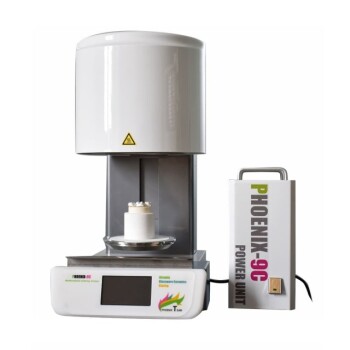
The total duration of the sintering process is divided into two distinct timeframes. The initial forming stage, where the part is pressed or molded, is extremely rapid and typically takes only seconds to complete. In contrast, the subsequent heat treatment stage—where the actual bonding occurs—is a much slower process that generally lasts for several hours.
Sintering is not a uniform event but a multi-stage process where mechanical speed meets thermal patience. While the shape is defined in seconds, the structural integrity of the material is forged over hours of controlled heating.
Breaking Down the Timeline
To understand the schedule of a sintering project, you must distinguish between the physical shaping of the material and the thermal processing that solidifies it.
Phase 1: Rapid Forming
The first step involves compressing powder into a solid mass, often referred to as a "green body." This is a mechanical process utilizing high pressure. Because it relies on force rather than temperature changes, this stage is completed in a matter of seconds.
Phase 2: Extended Heat Treatment
Once the part is formed, it undergoes thermal processing. This is the longest portion of the workflow. The "green body" must be subjected to heat for several hours to transition into a finished, dense component.
The Mechanics Behind the Duration
The heat treatment phase requires hours because it relies on atomic physics rather than mechanical force. You cannot rush these reactions without compromising the material.
Atomic Diffusion
During the heating phase, the material is raised to a temperature just below its melting point. At this stage, atoms diffuse across the boundaries of the powder particles. This migration takes time to occur uniformly throughout the part.
Densification and Bonding
As atoms move, the particles fuse together into a single solid piece. This leads to the exclusion of pores and a reduction in volume (shrinkage). This gradual densification creates the final strength of the material, which necessitates a slow, steady heat application.
Understanding the Trade-offs
While it is tempting to accelerate manufacturing processes, sintering presents specific limitations regarding speed.
Speed vs. Structural Integrity
Attempting to shorten the heat treatment cycle is a common pitfall. If the "soak time" (the time spent at high temperature) is insufficient, atomic diffusion remains incomplete. This results in a weak part with internal pores and low density.
Thermal Shock Risks
Rapidly heating or cooling the part to save time can induce internal stresses. Because the material is not fully bonded during the ramp-up, aggressive temperature changes can cause cracking or distortion before the sintering is complete.
Making the Right Choice for Your Goal
When planning a sintering workflow, your approach to timing depends on your specific manufacturing priorities.
- If your primary focus is High Throughput: Invest in high-speed pressing equipment to maximize the speed of the forming stage, as this is the only variable part of the process you can significantly accelerate.
- If your primary focus is Material Strength: Prioritize a longer, controlled heat treatment cycle to ensure maximum atomic diffusion and pore elimination.
Quality in sintering is strictly a function of time and temperature; patience in the heating phase yields durability in the final product.
Summary Table:
| Process Stage | Duration | Primary Action | Key Objective |
|---|---|---|---|
| Phase 1: Forming | Seconds | Mechanical Compression | Creating the 'Green Body' shape |
| Phase 2: Heating | Hours | Atomic Diffusion | Bonding, densification, and pore removal |
| Cooling/Ramping | Variable | Controlled Temperature Drop | Preventing thermal shock and cracking |
Elevate Your Sintering Precision with KINTEK
Don't compromise on structural integrity by rushing your thermal cycles. KINTEK specializes in advanced laboratory equipment designed to provide the precise temperature control and uniform heating required for successful atomic diffusion.
Whether you are developing new materials or scaling production, our comprehensive range of high-temperature muffle, tube, and vacuum furnaces, along with our hydraulic pellet presses, ensures your sintering process is both efficient and reliable.
Ready to optimize your material density and strength? Contact our experts today to find the perfect sintering solution for your laboratory or industrial application.
Related Products
- Vacuum Heat Treat and Sintering Furnace with 9MPa Air Pressure
- Spark Plasma Sintering Furnace SPS Furnace
- Vacuum Heat Treat and Molybdenum Wire Sintering Furnace for Vacuum Sintering
- Small Vacuum Heat Treat and Tungsten Wire Sintering Furnace
- Dental Porcelain Zirconia Sintering Ceramic Vacuum Press Furnace
People Also Ask
- What is the process of pressure sintering? Achieve Superior Density and Strength for High-Performance Parts
- What is the effect of pressure during sintering? Achieve Higher Density and Finer Microstructures Faster
- Why must green bodies produced via binder jetting undergo treatment in a vacuum sintering furnace?
- What is a vacuum sintering furnace? Unlock Purity and Performance in Advanced Materials
- How does the vacuum environment impact sintering of diamond-copper composites? Protect Against Thermal Damage