To ensure high-quality spectral data, Potassium Bromide (KBr) powder must be pulverized to a maximum particle size of 200 mesh and subsequently dried at approximately 110 °C for two to three hours. Following this thermal treatment, the powder must be stored in a desiccator to prevent the re-absorption of environmental moisture.
Proper pre-treatment of KBr is essential to remove interfering moisture and ensure optical transparency in the final pellet. Neglecting these steps can result in cloudy pellets, spectral artifacts, or discoloration caused by chemical oxidation.
Achieving the Right Physical Consistency
Pulverization Standards
Before heating, the KBr must be mechanically refined. The powder should be pulverized until it passes through a 200 mesh screen.
This fine particle size is critical for creating a homogeneous mixture with your sample. Coarse powder leads to light scattering, which reduces the baseline quality of your spectrum.
Removing Moisture and Preventing Oxidation
The Drying Protocol
Once pulverized, the KBr powder must be dried to remove hygroscopic water. Place the powder in an oven set to approximately 110 °C and let it dry for two to three hours.
Removing this moisture is vital because water molecules have strong infrared absorption bands that can mask important regions of your sample's spectrum.
The Danger of Rapid Heating
You must exercise caution regarding how heat is applied. Do not heat the powder rapidly.
Rapid temperature increases can cause the KBr to oxidize into Potassium Bromate (KBrO3). This chemical change typically manifests as a brown discoloration in the powder, rendering it unsuitable for high-quality optical measurements.
Maintaining Sample Integrity
Storage Requirements
After the drying process is complete, the KBr must not be left exposed to ambient air. Immediately transfer the dried powder to a desiccator.
KBr is highly hygroscopic, meaning it acts like a sponge for atmospheric moisture. Proper storage ensures the powder remains dry until the moment it is mixed with your sample.
Equipment Hygiene
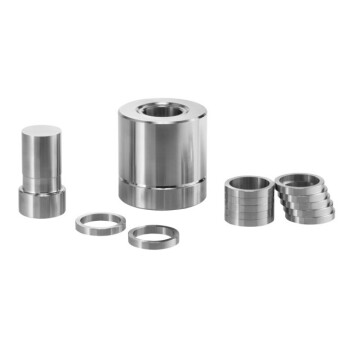
Before the KBr contacts your tools, ensure all equipment is contaminant-free. The die set, mortar, and pestle should be thoroughly cleaned with solvent and deionized (DI) water.
After cleaning, these tools must be completely dried in a warm oven. Even trace amounts of moisture on the tools can rehydrate the dried KBr powder.
Common Pitfalls and Quality Control
The "Vacuum" Variable
Even with perfectly dried powder, the pellet formation process introduces risks. When pressing the mixture (usually at 8 tons), you must apply a vacuum of several mm Hg.
Inadequate vacuum fails to degas the mixture. This traps air and residual moisture within the matrix, resulting in brittle pellets that scatter light rather than transmitting it transparently.
Balancing Sample Ratios
To maintain transparency, the ratio of sample to KBr must be precise. A typical 13 mm pellet requires 200 to 250 mg of KBr mixed with only 0.1% to 1.0% of the sample.
Exceeding this sample concentration often results in pellets that are too opaque for the instrument to read effectively.
Making the Right Choice for Your Goal
To achieve the best possible infrared spectrum, align your preparation steps with your specific analytical needs:
- If your primary focus is spectral purity: Ensure you heat the KBr slowly to avoid oxidation (brown discoloration) that introduces chemical impurities.
- If your primary focus is optical clarity: Prioritize fine pulverization (<200 mesh) and the use of a vacuum during pressing to prevent light scattering.
- If your primary focus is baseline stability: Strictly store the KBr in a desiccator and dry all cleaning equipment to eliminate water bands from your background.
Meticulous pre-treatment of your KBr matrix is the invisible foundation of a distinct and reliable infrared spectrum.
Summary Table:
| Step | Requirement | Purpose |
|---|---|---|
| Pulverization | < 200 mesh particle size | Ensures homogeneity & reduces light scattering |
| Drying | 110 °C for 2-3 hours | Removes hygroscopic water & avoids water bands |
| Heating Rate | Slow/Gradual increase | Prevents oxidation and brown discoloration |
| Storage | Desiccator cabinet | Maintains dryness by preventing air moisture absorption |
| Cleaning | Solvent + DI Water + Oven Dry | Eliminates cross-contamination and tool moisture |
Achieve flawless optical clarity in your spectroscopy samples with Kintek’s precision lab equipment. From professional-grade crushing and milling systems to achieve the perfect 200 mesh consistency, to our high-performance hydraulic pellet presses and vacuum pumps, we provide the tools researchers need for high-quality IR analysis. Contact KINTEK today to equip your laboratory with the finest furnaces, presses, and consumables designed for scientific excellence.
Related Products
- Laboratory Hydraulic Pellet Press for XRF KBR FTIR Lab Applications
- Automatic Laboratory Hydraulic Press for XRF & KBR Pellet Press
- kbr pellet press 2t
- XRF & KBR steel ring lab Powder Pellet Pressing Mold for FTIR
- XRF & KBR plastic ring lab Powder Pellet Pressing Mold for FTIR
People Also Ask
- What is the role of a laboratory hydraulic pellet press and stainless steel molds in the fabrication of RuO2/NbC anodes?
- How does a laboratory hydraulic pellet press contribute to SiCw/2024 aluminum composite preforms? Optimize Densification
- What is the necessity of using a laboratory hydraulic pellet press in the preparation of biomass fuel pellets? Guide
- What is the significance of applying 200 MPa of pressure with a laboratory hydraulic pellet press for composite ceramics?
- What key role does a laboratory pellet press play in FTIR analysis? Master KBr Sample Preparation Excellence