Knowledge How to measure PVD coating thickness? A Guide to Accurate Ball Crater Testing
Author avatar

Tech Team · Kintek Solution

Updated 1 week ago

How to measure PVD coating thickness? A Guide to Accurate Ball Crater Testing


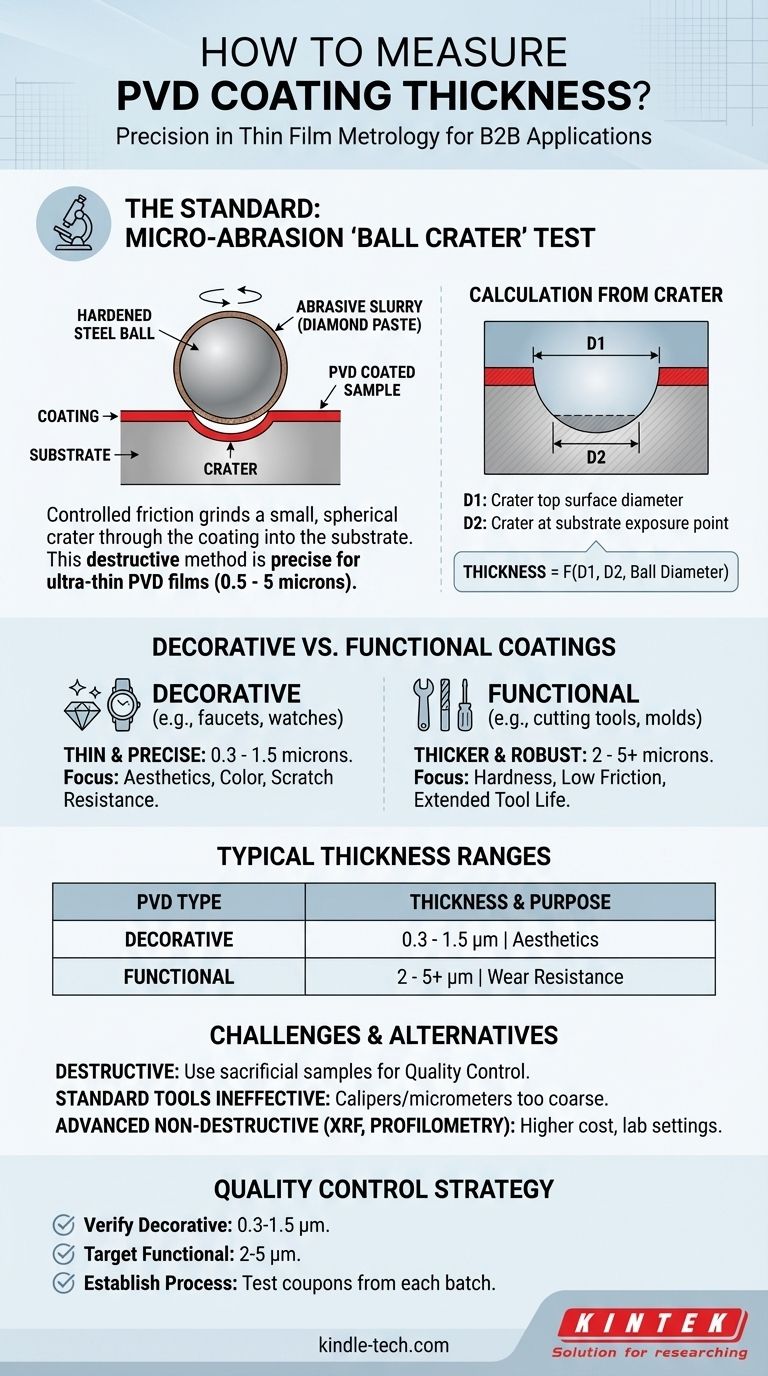
To measure the thickness of a PVD coating, the most common and accessible industry method is the micro-abrasion wear test, also known as the "ball crater" or "dimple-grinder" test. This technique is specifically designed to accurately measure the ultra-thin films created by Physical Vapor Deposition (PVD), which typically range from 0.5 to 5 microns.

While direct measurement is achieved with a destructive micro-abrasion test, a true assessment of quality requires understanding the expected thickness based on the coating's intended function—whether it is for decorative appearance or for functional performance.

The Standard Measurement Technique: Micro-Abrasion

The ball crater test is a destructive method, meaning it leaves a permanent mark on the tested surface. Because of this, it is often performed on sample coupons coated alongside a production batch or on a non-critical area of the part itself.

How the 'Ball Crater' Test Works

The process is straightforward but precise. A hardened steel ball of a known diameter is coated with a fine abrasive slurry (typically diamond paste) and rotated against the surface of the coated part.

This controlled friction grinds a small, spherical crater that passes through the PVD coating and into the underlying substrate material.

Calculating Thickness from the Crater

Once the grinding is complete, the crater is viewed under a microscope. The test relies on simple geometry.

By measuring the diameter of the crater at the top surface and the diameter of the crater at the point where it exposes the substrate, the coating's thickness can be calculated with high accuracy.

Why PVD Thickness Matters: Decorative vs. Functional

The required thickness of a PVD coating is dictated entirely by its application. Understanding this distinction is key to knowing what measurement value to expect. PVD coatings are not one-size-fits-all.

Decorative Coatings: Thin and Precise

For products where aesthetics are the primary goal, such as faucets, watches, or colored stainless steel sheets, the PVD coating is extremely thin.

These decorative films often measure between 0.3 and 1.5 microns. Their purpose is to provide a specific color, a durable finish, and basic resistance to scratches and tarnishing, without adding significant dimensionality.

Functional Coatings: Thicker and More Robust

For industrial applications like cutting tools, molds, and high-wear components, the PVD coating serves a functional purpose. These coatings are engineered for extreme hardness, low friction (lubricity), and thermal stability.

To achieve these properties, functional coatings are significantly thicker, typically ranging from 2 to 5 microns. In some highly demanding cases, they can be even thicker. This added material is essential for extending the operational life of the tool.

Understanding the Trade-offs and Challenges

Measuring PVD coatings requires specialized knowledge and equipment because you are dealing with layers thinner than a human blood cell.

The Test is Destructive

The primary drawback of the standard ball crater test is that it damages the part. You cannot test a finished, customer-ready product and then ship it. This necessitates a quality control strategy based on statistical process control and the testing of sacrificial samples.

Standard Tools are Ineffective

Mechanical measurement tools like calipers or micrometers are completely useless for this task. The thickness of a PVD film is far below their resolution and can't be measured by contact.

Advanced Non-Destructive Methods

Other, more advanced techniques like X-Ray Fluorescence (XRF) and profilometry can measure coating thickness non-destructively. However, these methods require more expensive equipment and are typically used in laboratory or high-volume production settings. For most shops, the ball crater test remains the practical standard.

Making the Right Choice for Your Goal

Your measurement strategy should align directly with the coating's purpose. Use the expected thickness range as your benchmark for quality control.

  • If your primary focus is a decorative finish: Expect and verify measurements in the 0.3 to 1.5-micron range, ensuring color and finish are consistent across the batch.
  • If your primary focus is a functional tool coating: Your target is a thickness between 2 and 5 microns, as this range is directly correlated to the tool's performance and wear life.
  • If you are establishing a quality process: Use the micro-abrasion test on designated test coupons from each PVD batch to validate thickness without destroying valuable parts.

By combining the right measurement technique with an understanding of the coating's purpose, you can confidently validate the quality and performance of your PVD-coated components.

How to measure PVD coating thickness? A Guide to Accurate Ball Crater Testing

Summary Table:

PVD Coating Type Typical Thickness Range Primary Purpose
Decorative (e.g., watches, faucets) 0.3 - 1.5 microns Aesthetics, scratch resistance
Functional (e.g., cutting tools, molds) 2 - 5+ microns Hardness, wear resistance, extended tool life

Ensure your PVD coatings meet exact specifications with KINTEK's precision lab equipment. Whether you're performing ball crater tests or need advanced non-destructive measurement solutions, our expertise in laboratory equipment and consumables helps you maintain quality control for both decorative and functional coatings. Contact our specialists today to discuss the right tools for your PVD coating validation needs.

Visual Guide
How to measure PVD coating thickness? A Guide to Accurate Ball Crater Testing Visual Guide

Related Products

People Also Ask

Related Products

Laboratory Test Sieves and Sieving Machines

Laboratory Test Sieves and Sieving Machines

Precision lab test sieves & sieving machines for accurate particle analysis. Stainless steel, ISO-compliant, 20μm-125mm range. Request specs now!

HFCVD Machine System Equipment for Drawing Die Nano-Diamond Coating

HFCVD Machine System Equipment for Drawing Die Nano-Diamond Coating

The nano-diamond composite coating drawing die uses cemented carbide (WC-Co) as the substrate, and uses the chemical vapor phase method ( CVD method for short ) to coat the conventional diamond and nano-diamond composite coating on the surface of the inner hole of the mold.

Anti-Cracking Press Mold for Lab Use

Anti-Cracking Press Mold for Lab Use

The anti-cracking press mold is a specialized equipment designed for molding various shapes and sizes of film using high pressure and electric heating.

Vacuum Hot Press Furnace Machine for Lamination and Heating

Vacuum Hot Press Furnace Machine for Lamination and Heating

Experience clean and precise lamination with Vacuum Lamination Press. Perfect for wafer bonding, thin-film transformations, and LCP lamination. Order now!

915MHz MPCVD Diamond Machine Microwave Plasma Chemical Vapor Deposition System Reactor

915MHz MPCVD Diamond Machine Microwave Plasma Chemical Vapor Deposition System Reactor

915MHz MPCVD Diamond Machine and its multi-crystal effective growth, the maximum area can reach 8 inches, the maximum effective growth area of single crystal can reach 5 inches. This equipment is mainly used for the production of large-size polycrystalline diamond films, the growth of long single crystal diamonds, the low-temperature growth of high-quality graphene, and other materials that require energy provided by microwave plasma for growth.

Benchtop Laboratory Vacuum Freeze Dryer

Benchtop Laboratory Vacuum Freeze Dryer

Benchtop laboratory freeze dryer for efficient lyophilization of biological, pharmaceutical, and food samples. Features intuitive touchscreen, high-performance refrigeration, and durable design. Preserve sample integrity—consult now!

Laboratory Sterilizer Lab Autoclave Vertical Pressure Steam Sterilizer for Liquid Crystal Display Automatic Type

Laboratory Sterilizer Lab Autoclave Vertical Pressure Steam Sterilizer for Liquid Crystal Display Automatic Type

Liquid crystal display automatic vertical sterilizer is a safe, reliable and automatic control sterilization equipment, which is composed of heating system, microcomputer control system and overheating and overvoltage protection system.

CVD Diamond Cutting Tool Blanks for Precision Machining

CVD Diamond Cutting Tool Blanks for Precision Machining

CVD Diamond Cutting Tools: Superior Wear Resistance, Low Friction, High Thermal Conductivity for Non-Ferrous Materials, Ceramics, Composites Machining

Custom PTFE Teflon Parts Manufacturer for Centrifuge Tube Racks

Custom PTFE Teflon Parts Manufacturer for Centrifuge Tube Racks

The precision-made PTFE test tube racks are completely inert and, due to the high temperature properties of PTFE, these test tube racks can be sterilized (autoclaved) without any problems.

Benchtop Laboratory Freeze Dryer for Lab Use

Benchtop Laboratory Freeze Dryer for Lab Use

Premium benchtop laboratory freeze dryer for lyophilization, preserving samples with ≤ -60°C cooling. Ideal for pharmaceuticals & research.

Laboratory Sterilizer Lab Autoclave Pulse Vacuum Lifting Sterilizer

Laboratory Sterilizer Lab Autoclave Pulse Vacuum Lifting Sterilizer

The pulse vacuum lifting sterilizer is a state-of-the-art equipment for efficient and precise sterilization. It uses pulsating vacuum technology, customizable cycles, and a user-friendly design for easy operation and safety.

RRDE rotating disk (ring disk) electrode / compatible with PINE, Japanese ALS, Swiss Metrohm glassy carbon platinum

RRDE rotating disk (ring disk) electrode / compatible with PINE, Japanese ALS, Swiss Metrohm glassy carbon platinum

Elevate your electrochemical research with our Rotating Disk and Ring Electrodes. Corrosion resistant and customizable to your specific needs, with complete specifications.

Laboratory Vibratory Sieve Shaker Machine Slap Vibrating Sieve

Laboratory Vibratory Sieve Shaker Machine Slap Vibrating Sieve

KT-T200TAP is a slapping and oscillating sieving instrument for laboratory desktop use, with 300 rpm horizontal circular motion and 300 vertical slapping motions to simulate manual sieving to help sample particles pass through better.

Graphite Vacuum Furnace IGBT Experimental Graphitization Furnace

Graphite Vacuum Furnace IGBT Experimental Graphitization Furnace

IGBT experimental graphitization furnace, a tailored solution for universities and research institutions, with high heating efficiency, user-friendliness, and precise temperature control.

Vacuum Heat Treat and Molybdenum Wire Sintering Furnace for Vacuum Sintering

Vacuum Heat Treat and Molybdenum Wire Sintering Furnace for Vacuum Sintering

A vacuum molybdenum wire sintering furnace is a vertical or bedroom structure, which is suitable for withdrawal, brazing, sintering and degassing of metal materials under high vacuum and high temperature conditions. It is also suitable for dehydroxylation treatment of quartz materials.

Vacuum Dental Porcelain Sintering Furnace

Vacuum Dental Porcelain Sintering Furnace

Get precise and reliable results with KinTek's Vacuum Porcelain Furnace. Suitable for all porcelain powders, it features hyperbolic ceramic furnace function, voice prompt, and automatic temperature calibration.

Precision Machined Zirconia Ceramic Ball for Engineering Advanced Fine Ceramics

Precision Machined Zirconia Ceramic Ball for Engineering Advanced Fine Ceramics

zirconia ceramic ball have the characteristics of high strength, high hardness, PPM wear level, high fracture toughness, good wear resistance, and high specific gravity.

Small Vacuum Heat Treat and Tungsten Wire Sintering Furnace

Small Vacuum Heat Treat and Tungsten Wire Sintering Furnace

The small vacuum tungsten wire sintering furnace is a compact experimental vacuum furnace specially designed for universities and scientific research institutes. The furnace features a CNC welded shell and vacuum piping to ensure leak-free operation. Quick-connect electrical connections facilitate relocation and debugging, and the standard electrical control cabinet is safe and convenient to operate.

Silicon Carbide SiC Thermal Heating Elements for Electric Furnace

Silicon Carbide SiC Thermal Heating Elements for Electric Furnace

Experience the advantages of Silicon Carbide (SiC) Heating Element: Long service life, high corrosion and oxidation resistance, fast heating speed, and easy maintenance. Learn more now!

Custom PTFE Teflon Parts Manufacturer Corrosion Resistant Cleaning Rack Flower Basket

Custom PTFE Teflon Parts Manufacturer Corrosion Resistant Cleaning Rack Flower Basket

The PTFE cleaning rack, also known as the PTFE flower basket cleaning flower basket, is a specialized laboratory tool designed for the efficient cleaning of PTFE materials. This cleaning rack ensures thorough and safe cleaning of PTFE items, maintaining their integrity and performance in laboratory settings.


Leave Your Message