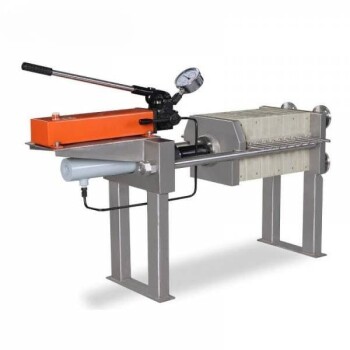
Laboratory hydraulic presses play a pivotal role in two distinct stages of the experimental process for 9-12 wt% Cr steel: material synthesis and preliminary mechanical characterization. Specifically, they are utilized to mold alloy powders into high-density forms during sample preparation and to conduct initial compression or bending tests prior to more complex long-term evaluations.
The laboratory hydraulic press acts as a foundational tool in high-chromium steel research, bridging the gap between raw powder consolidation and the rigorous screening required before advanced creep testing.
Material Preparation and Synthesis
In the early stages of creating 9-12 wt% Cr steel samples, the hydraulic press is essential for transforming raw materials into workable solids.
Alloy Powder Molding
For workflows involving powder metallurgy, the hydraulic press is the primary tool for molding alloy powder. It applies uniform, high pressure to loose powder particles to create a cohesive shape.
Achieving High Density
The pressure exerted by the press ensures the dense packing of powder particles. This process results in "green bodies" with sufficient density and structural integrity to withstand subsequent processing steps, such as sintering or forging.
Mechanical Performance Screening
Once the material is formed, the hydraulic press serves as a testing instrument to establish baseline mechanical properties.
Specimen Pre-deformation
Researchers use hydraulic presses to apply controlled force for specimen pre-deformation. This step prepares the sample material structurally for specific experimental conditions.
Room-Temperature Evaluation
Before moving to expensive or time-consuming tests, the press is used to evaluate basic mechanical limits. It tests the room-temperature compression or bending strength of the steel.
Serving as a Preliminary Reference
Data gathered from the hydraulic press serves as a preliminary performance reference. This screening allows researchers to validate the basic quality of the steel before committing samples to long-term creep testing.
Understanding the Limitations
While versatile, the laboratory hydraulic press is generally used for static or quasi-static applications in this context.
Screening vs. Final Validation
It is critical to note that the hydraulic press provides preliminary data. It assesses room-temperature strength but is not a substitute for the specialized equipment required for high-temperature creep testing or fatigue analysis.
Making the Right Choice for Your Goal
To maximize the utility of a hydraulic press in your 9-12 wt% Cr steel experiments, align its use with your specific stage of research.
- If your primary focus is Sample Fabrication: Prioritize the press for generating high pressure to ensure dense, void-free green bodies during powder metallurgy.
- If your primary focus is Mechanical Screening: Use the press to establish rapid room-temperature baselines for compression and bending strength before proceeding to creep analysis.
By strictly separating fabrication from preliminary testing, you ensure the integrity of your high-chromium steel samples throughout the experimental lifecycle.
Summary Table:
| Experimental Stage | Application Method | Key Purpose/Benefit |
|---|---|---|
| Material Preparation | Alloy Powder Molding | Creating high-density 'green bodies' for sintering. |
| Material Preparation | Powder Consolidation | Ensuring structural integrity of raw alloy powders. |
| Mechanical Screening | Room-Temp Evaluation | Testing compression and bending strength baselines. |
| Mechanical Screening | Specimen Pre-deformation | Structurally preparing samples for complex testing. |
| Process Validation | Quality Screening | Validating material quality before long-term creep tests. |
Elevate Your Material Research with KINTEK Precision
Precision in the initial stages of 9-12 wt% Cr steel development is the foundation of long-term experimental success. KINTEK provides industry-leading laboratory hydraulic presses, including pellet, hot, and isostatic models, designed to deliver the exact pressure needed for high-density powder molding and rigorous mechanical screening.
Our extensive portfolio supports every phase of your lab work:
- Advanced Sample Prep: High-performance crushing, milling, and hydraulic pressing systems.
- Thermal Processing: A comprehensive range of muffle, tube, vacuum, and atmosphere furnaces.
- Specialized Research Tools: From high-pressure reactors and autoclaves to battery research consumables and cooling solutions.
Don't compromise on the integrity of your alloy samples. Partner with KINTEK for reliable equipment that transforms raw materials into high-performance data. Contact us today to find the perfect hydraulic press for your lab!
References
- Osman Mamun, Ram Devanathan. Uncertainty quantification for Bayesian active learning in rupture life prediction of ferritic steels. DOI: 10.1038/s41598-022-06051-8
This article is also based on technical information from Kintek Solution Knowledge Base .
Related Products
- Laboratory Hydraulic Press Lab Pellet Press Machine for Glove Box
- Laboratory Hydraulic Press Split Electric Lab Pellet Press
- Laboratory Hydraulic Press Lab Pellet Press for Button Battery
- Automatic Laboratory Hydraulic Press for XRF & KBR Pellet Press
- Automatic Laboratory Hydraulic Pellet Press Machine for Lab Use
People Also Ask
- What is the function of a laboratory hydraulic press in W-Cu composites? Control Porosity and Material Ratio
- What is the role of a laboratory hydraulic press in the initial stages of Li6PS5Cl preparation? Key to Green Pellets
- What role does a laboratory hydraulic press play in triboelectric testing? Achieve Precision Alloy Sample Prep
- How can a laboratory hydraulic press be applied to chitosan for wastewater treatment? Optimize Pores & Strength
- How do a precision laboratory hydraulic press and specialized molds contribute to the fabrication of spherical ceramic samples? Achieving High-Density Material Precision