Knowledge Laboratory electrodes Is a graphite melting point high or low? Discover Its Extreme Thermal Resilience
Author avatar

Tech Team · Kintek Solution

Updated 2 months ago

Is a graphite melting point high or low? Discover Its Extreme Thermal Resilience


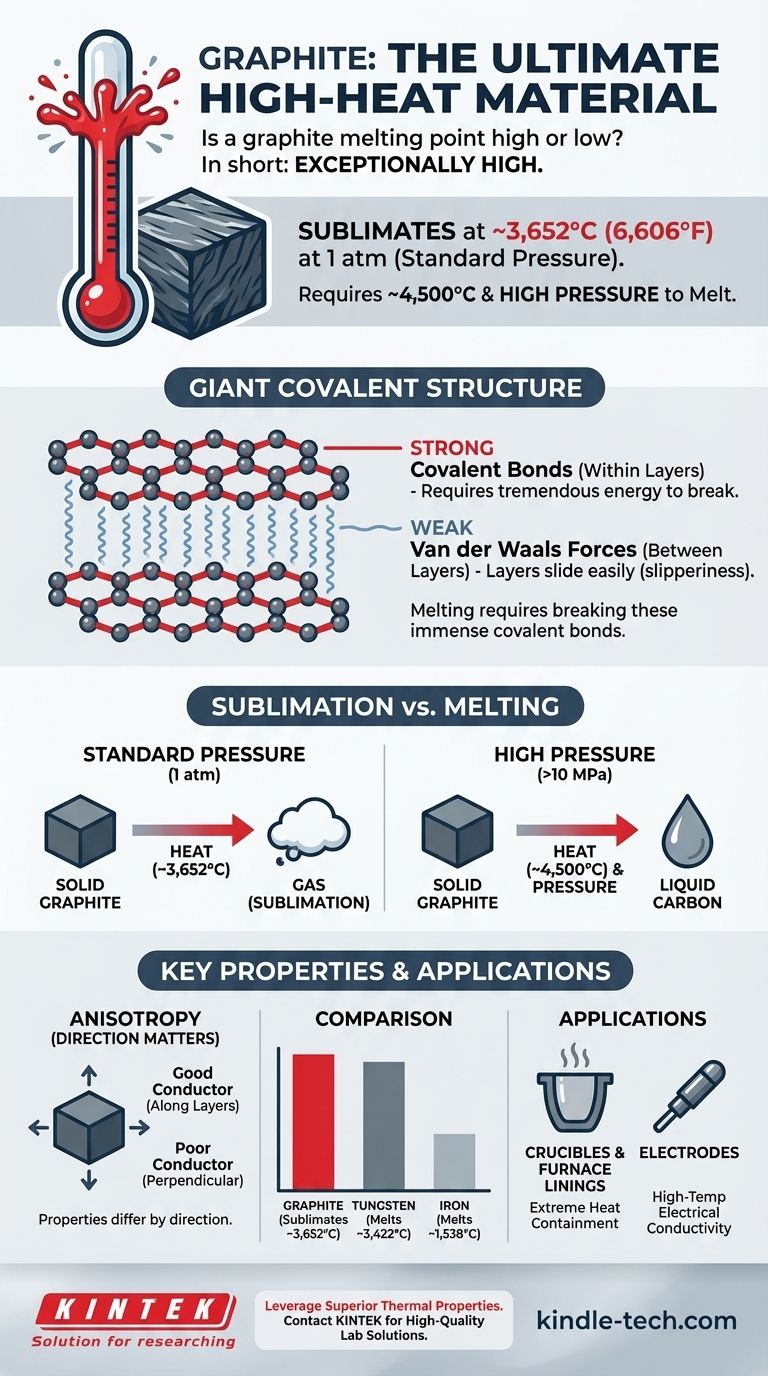
In short, graphite has an exceptionally high melting point. More accurately, at standard atmospheric pressure, it sublimates—turning directly from a solid to a gas—at an extreme temperature of around 3,652°C (6,606°F). To achieve true melting into a liquid state, both very high temperatures (~4,500°C) and high pressures are required.

The core reason for graphite's thermal resilience is its atomic structure. Melting graphite is not a matter of simply separating its layers, but of breaking the immensely strong covalent bonds that form the material itself, which requires a tremendous amount of energy.
Is a graphite melting point high or low? Discover Its Extreme Thermal Resilience

The Giant Covalent Structure of Graphite

To understand graphite's high melting point, you must first understand its structure. It is not a simple collection of molecules, but a giant covalent structure.

Strong Covalent Bonds Within Layers

Each carbon atom in graphite is bonded to three other carbon atoms through strong covalent bonds. These atoms form a hexagonal lattice, creating vast, two-dimensional sheets or layers.

These covalent bonds are the same type of bond found in diamonds and are incredibly strong, requiring a massive amount of thermal energy to break.

Weak Forces Between Layers

While the atoms within a layer are strongly bonded, the layers themselves are held together by much weaker intermolecular forces known as van der Waals forces.

These weak forces are easily overcome, which is why graphite feels soft and slippery. This property allows layers to slide off, making graphite an excellent material for pencil lead and as a solid lubricant.

What 'Melting' Actually Means for Graphite

This distinction between the two force types is critical. The slipperiness of graphite is due to the weak forces between layers, but its melting point is dictated by the strong covalent bonds within the layers.

To transition graphite from a solid to a liquid, you must provide enough energy to break the strong covalent bonds and allow the carbon atoms to move freely. This is why it has one of the highest melting/sublimation points of any known material.

Understanding the Trade-offs and Nuances

Graphite's properties are not uniform, and its behavior under heat comes with specific conditions and limitations that are crucial for practical applications.

Sublimation vs. Melting

At normal atmospheric pressure, graphite does not melt. When heated, it reaches its sublimation point and turns directly into a gas.

A true liquid carbon phase only exists at very high pressures, starting around 10 megapascals (MPa), or about 100 times standard atmospheric pressure.

Anisotropy: Direction Matters

Graphite is an anisotropic material, meaning its properties differ depending on the direction of measurement.

It conducts heat and electricity very well along its layers but is a poor conductor perpendicular to them. This must be considered in thermal management applications.

Comparison to Diamond and Metals

Graphite's sublimation point is comparable to, and under some conditions surpasses, that of diamond—another carbon allotrope. Both are high for the same reason: breaking strong covalent bonds.

Compared to metals, graphite stands apart. For instance, iron melts at 1,538°C and tungsten, one of the highest melting point metals, melts at 3,422°C—still below graphite's sublimation point.

Making the Right Choice for Your Application

Understanding these principles allows you to select and use graphite effectively based on your specific goal.

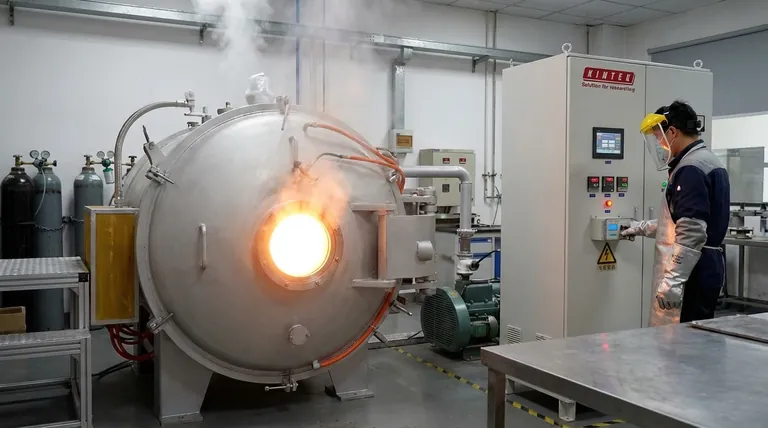
  • If your primary focus is extreme heat containment: Graphite is a premier choice for crucibles, furnace linings, and rocket nozzles due to its incredibly high sublimation point and structural stability at temperatures where most metals would be liquid or vapor.
  • If your primary focus is high-temperature electrical conductivity: Graphite is ideal for electrodes in electric arc furnaces, as it can withstand the immense heat generated while efficiently conducting massive electrical currents.
  • If your primary focus is understanding material science: Remember that a material's melting point is fundamentally linked to the strength of the bonds holding its atoms together, and graphite is a classic example of a giant covalent structure.

Ultimately, graphite's high melting point is a direct consequence of its robust atomic structure, making it one of the most thermally resilient materials known.

Summary Table:

Property Value / Description
Sublimation Point ~3,652°C (6,606°F) at 1 atm
Melting Point ~4,500°C (requires high pressure)
Key Structural Feature Giant covalent structure with strong bonds within layers
Primary Thermal Limitation Oxidation in air at temperatures above ~400°C

Leverage Graphite's Superior Thermal Properties in Your Lab

Graphite's exceptional heat resistance makes it indispensable for high-temperature applications like furnace linings, crucibles, and electrodes.

At KINTEK, we specialize in providing high-quality lab equipment and consumables, including premium graphite products tailored for demanding laboratory environments. Our materials ensure reliability, performance, and safety at extreme temperatures.

Ready to enhance your high-temperature processes? Contact our experts today to find the perfect graphite solution for your specific needs!

Visual Guide
Is a graphite melting point high or low? Discover Its Extreme Thermal Resilience Visual Guide

Related Products

People Also Ask

Related Products

Ultra-High Temperature Graphite Vacuum Graphitization Furnace

Ultra-High Temperature Graphite Vacuum Graphitization Furnace

The ultra-high temperature graphitization furnace utilizes medium frequency induction heating in a vacuum or inert gas environment. The induction coil generates an alternating magnetic field, inducing eddy currents in the graphite crucible, which heats up and radiates heat to the workpiece, bringing it to the desired temperature. This furnace is primarily used for graphitization and sintering of carbon materials, carbon fiber materials, and other composite materials.

2200 ℃ Graphite Vacuum Heat Treat Furnace

2200 ℃ Graphite Vacuum Heat Treat Furnace

Discover the power of the KT-VG Graphite Vacuum Furnace - with a maximum working temperature of 2200℃, it's perfect for vacuum sintering of various materials. Learn more now.

Horizontal High Temperature Graphite Vacuum Graphitization Furnace

Horizontal High Temperature Graphite Vacuum Graphitization Furnace

Horizontal Graphitization Furnace: This type of furnace is designed with the heating elements placed horizontally, allowing for uniform heating of the sample. It's well-suited for graphitizing large or bulky samples that require precise temperature control and uniformity.

Vertical High Temperature Graphite Vacuum Graphitization Furnace

Vertical High Temperature Graphite Vacuum Graphitization Furnace

Vertical high temperature graphitization furnace for carbonization and graphitization of carbon materials up to 3100℃.Suitable for shaped graphitization of carbon fiber filaments and other materials sintered in a carbon environment.Applications in metallurgy, electronics, and aerospace for producing high-quality graphite products like electrodes and crucibles.

Large Vertical Graphite Vacuum Graphitization Furnace

Large Vertical Graphite Vacuum Graphitization Furnace

A large vertical high-temperature graphitization furnace is a type of industrial furnace used for the graphitization of carbon materials, such as carbon fiber and carbon black. It is a high-temperature furnace that can reach temperatures of up to 3100°C.

Graphite Vacuum Continuous Graphitization Furnace

Graphite Vacuum Continuous Graphitization Furnace

High-temperature graphitization furnace is a professional equipment for graphitization treatment of carbon materials. It is a key equipment for the production of high-quality graphite products. It has high temperature, high efficiency and uniform heating. It is suitable for various high-temperature treatments and graphitization treatments. It is widely used in metallurgy, electronics, aerospace, etc. industry.

Graphite Vacuum Furnace Bottom Discharge Graphitization Furnace for Carbon Materials

Graphite Vacuum Furnace Bottom Discharge Graphitization Furnace for Carbon Materials

Bottom-out graphitization furnace for carbon materials, ultra-high temperature furnace up to 3100°C, suitable for graphitization and sintering of carbon rods and carbon blocks. Vertical design, bottom discharging, convenient feeding and discharging, high temperature uniformity, low energy consumption, good stability, hydraulic lifting system, convenient loading and unloading.

Graphite Vacuum Furnace High Thermal Conductivity Film Graphitization Furnace

Graphite Vacuum Furnace High Thermal Conductivity Film Graphitization Furnace

The high thermal conductivity film graphitization furnace has uniform temperature, low energy consumption and can operate continuously.

Carbon Graphite Boat -Laboratory Tube Furnace with Cover

Carbon Graphite Boat -Laboratory Tube Furnace with Cover

Covered Carbon Graphite Boat Laboratory Tube Furnaces are specialized vessels or vessels made of graphite material designed to withstand extreme high temperatures and chemically aggressive environments.

High Purity Pure Graphite Crucible for Evaporation

High Purity Pure Graphite Crucible for Evaporation

Vessels for high temperature applications, where materials are kept at extremely high temperatures to evaporate, allowing thin films to be deposited on substrates.

1700℃ Laboratory High Temperature Tube Furnace with Alumina Tube

1700℃ Laboratory High Temperature Tube Furnace with Alumina Tube

Looking for a high-temperature tube furnace? Check out our 1700℃ Tube Furnace with Alumina Tube. Perfect for research and industrial applications up to 1700C.

1400℃ Laboratory High Temperature Tube Furnace with Alumina Tube

1400℃ Laboratory High Temperature Tube Furnace with Alumina Tube

Looking for a tube furnace for high-temperature applications? Our 1400℃ Tube Furnace with Alumina Tube is perfect for research and industrial use.

High Temperature Muffle Oven Furnace for Laboratory Debinding and Pre Sintering

High Temperature Muffle Oven Furnace for Laboratory Debinding and Pre Sintering

KT-MD High temperature debinding and pre-sintering furnace for ceramic materials with various molding processes. Ideal for electronic components such as MLCC and NFC.

1700℃ Muffle Oven Furnace for Laboratory

1700℃ Muffle Oven Furnace for Laboratory

Get superior heat control with our 1700℃ Muffle Furnace. Equipped with intelligent temperature microprocessor, TFT touch screen controller & advanced insulation materials for precise heating up to 1700C. Order now!

Graphite Vacuum Furnace IGBT Experimental Graphitization Furnace

Graphite Vacuum Furnace IGBT Experimental Graphitization Furnace

IGBT experimental graphitization furnace, a tailored solution for universities and research institutions, with high heating efficiency, user-friendliness, and precise temperature control.

1200℃ Muffle Furnace Oven for Laboratory

1200℃ Muffle Furnace Oven for Laboratory

Upgrade your lab with our 1200℃ Muffle Furnace. Achieve fast, precise heating with Japan alumina fibers and Molybdenum coils. Features TFT touch screen controller for easy programming and data analysis. Order now!

1400℃ Muffle Oven Furnace for Laboratory

1400℃ Muffle Oven Furnace for Laboratory

Get precise high-temperature control up to 1500℃ with KT-14M Muffle furnace. Equipped with a smart touch screen controller and advanced insulation materials.

Graphite Vacuum Furnace Negative Material Graphitization Furnace

Graphite Vacuum Furnace Negative Material Graphitization Furnace

Graphitization furnace for battery production has uniform temperature and low energy consumption. Graphitization furnace for negative electrode materials: an efficient graphitization solution for battery production and advanced functions to enhance battery performance.

1800℃ Muffle Oven Furnace for Laboratory

1800℃ Muffle Oven Furnace for Laboratory

KT-18 muffle furnace with Japan Al2O3 polycrystalline fibe and Silicon Molybdenum heating element, up to 1900℃, PID temperature control and 7" smart touch screen. Compact design, low heat loss, and high energy efficiency. Safety interlock system and versatile functions.

1200℃ Split Tube Furnace with Quartz Tube Laboratory Tubular Furnace

1200℃ Split Tube Furnace with Quartz Tube Laboratory Tubular Furnace

KT-TF12 split tube furnace: high-purity insulation, embedded heating wire coils, and max. 1200C. Widely used for new materials and chemical vapour deposition.


Leave Your Message