Knowledge cvd machine Is graphene production bad for the environment? The Truth About Manufacturing Methods
Author avatar

Tech Team · Kintek Solution

Updated 2 months ago

Is graphene production bad for the environment? The Truth About Manufacturing Methods


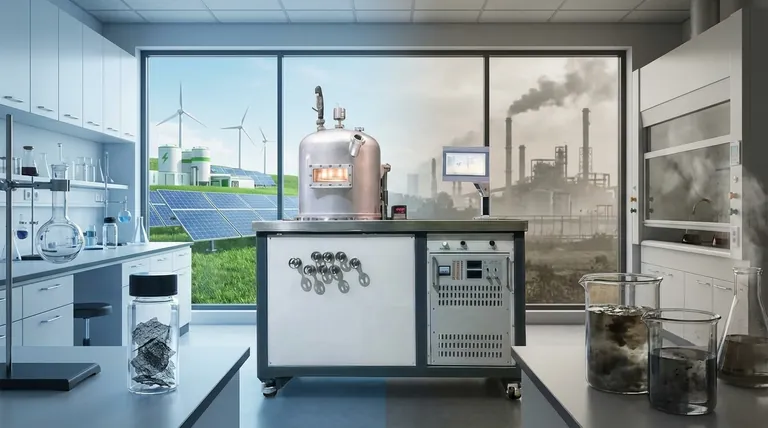
The environmental friendliness of graphene production is a complex issue with no simple yes or no answer. The impact is not inherent to graphene itself, but is entirely dependent on the specific manufacturing method used. Some common, scalable methods rely on harsh chemicals and significant energy consumption, while newer, emerging techniques show promise for a much cleaner footprint.

The core issue is that the graphene industry has not yet standardized a single, scalable, and environmentally benign production method. Therefore, evaluating the environmental impact of graphene requires looking past the material and scrutinizing the specific process used to create it.
Is graphene production bad for the environment? The Truth About Manufacturing Methods

The Production Method Dictates the Impact

To understand the environmental cost, you must first understand the fundamental divide in how graphene is made. The two primary approaches, "top-down" and "bottom-up," come with vastly different environmental considerations.

The "Top-Down" Chemical Route

This approach starts with bulk graphite and exfoliates it down into single layers. The most common industrial method is a chemical process known as the Hummers' method.

This process involves using powerful oxidizing agents and strong acids (like sulfuric and nitric acid) to separate the graphite layers. This creates significant challenges, including the generation of toxic wastewater and the need for extensive purification, which itself consumes energy and resources.

The "Bottom-Up" Deposition Route

This approach builds graphene atom-by-atom on a substrate. The benchmark for high-quality graphene is Chemical Vapor Deposition (CVD).

In CVD, a hydrocarbon gas (like methane) is heated to extreme temperatures, often around 1000°C. At this heat, the gas decomposes, and carbon atoms deposit onto a metal catalyst (like copper) to form a pristine graphene sheet. The primary environmental drawbacks here are the high energy consumption and the use of greenhouse gas precursors.

Emerging "Green" Alternatives

Recognizing these challenges, researchers are actively developing more sustainable methods. These include electrochemical exfoliation, which uses electricity and milder chemicals, and even processes that use bio-waste as a carbon source.

While promising, these methods are less mature and often struggle to produce graphene at the quality or scale required for many commercial applications, a challenge noted in most industry analyses.

Understanding the Trade-offs

Choosing a graphene source involves navigating a complex landscape of cost, quality, and environmental impact. There is currently no perfect solution.

Purity vs. Environmental Cost

The highest-purity, defect-free graphene is typically produced via CVD. This quality is essential for advanced electronics but comes at a high energy cost. Conversely, the bulk graphene used for composites is often made via chemical exfoliation, which is cheaper but carries a heavy burden of chemical waste.

The Challenge of Scale

A process that seems clean in a laboratory setting can become an environmental problem when scaled up for mass production. The sheer volume of raw materials, energy inputs, and waste outputs is amplified, making efficient and clean processing paramount. The current lack of scalable and clean techniques is a primary bottleneck for the industry.

The Full Lifecycle Perspective

It's also crucial to consider the potential for graphene to create a net environmental benefit. Its use in creating stronger, lighter materials can reduce fuel consumption in vehicles. Its application in advanced batteries could be critical for the transition to renewable energy. These downstream benefits may ultimately outweigh the initial production impact.

How to Evaluate Graphene's Environmental Claims

When assessing graphene for your project, your primary task is to investigate the supplier's production method. Treat claims of "green graphene" with healthy skepticism and ask for specifics.

  • If your primary focus is high-performance electronics: Inquire about the energy source and efficiency of the CVD process your supplier uses.
  • If your primary focus is bulk industrial use (e.g., composites): Demand information on the chemical waste streams and water treatment processes associated with their exfoliation method.
  • If your primary focus is sustainability: Look for suppliers pioneering newer methods like electrochemical exfoliation, but be prepared to rigorously test the material's quality and consistency.

By focusing on the production method rather than the material itself, you can make an informed and responsible decision.

Summary Table:

Production Method Key Environmental Impact Typical Use Case
Chemical Exfoliation (e.g., Hummers' Method) Toxic wastewater, harsh chemicals Bulk composites, industrial materials
Chemical Vapor Deposition (CVD) High energy consumption, greenhouse gases High-performance electronics
Emerging Green Methods (e.g., Electrochemical) Lower chemical/energy use (but less mature) Sustainable applications (R&D focus)

Choosing the right lab equipment is critical for developing sustainable materials like graphene. KINTEK specializes in providing the precise, reliable lab equipment and consumables needed for materials research and development. Whether you are optimizing a CVD process for high-quality graphene or exploring new, eco-friendly synthesis methods, our expertise can help you achieve your research goals efficiently and safely. Contact us today to discuss how we can support your laboratory's specific needs and contribute to your next breakthrough. Get in touch with our experts

Visual Guide

Is graphene production bad for the environment? The Truth About Manufacturing Methods Visual Guide

Related Products

People Also Ask

Related Products

Vertical High Temperature Graphite Vacuum Graphitization Furnace

Vertical High Temperature Graphite Vacuum Graphitization Furnace

Vertical high temperature graphitization furnace for carbonization and graphitization of carbon materials up to 3100℃.Suitable for shaped graphitization of carbon fiber filaments and other materials sintered in a carbon environment.Applications in metallurgy, electronics, and aerospace for producing high-quality graphite products like electrodes and crucibles.

Customer Made Versatile CVD Tube Furnace Chemical Vapor Deposition Chamber System Equipment

Customer Made Versatile CVD Tube Furnace Chemical Vapor Deposition Chamber System Equipment

Get your exclusive CVD furnace with KT-CTF16 Customer Made Versatile Furnace. Customizable sliding, rotating, and tilting functions for precise reactions. Order now!

Large Vertical Graphite Vacuum Graphitization Furnace

Large Vertical Graphite Vacuum Graphitization Furnace

A large vertical high-temperature graphitization furnace is a type of industrial furnace used for the graphitization of carbon materials, such as carbon fiber and carbon black. It is a high-temperature furnace that can reach temperatures of up to 3100°C.

Horizontal High Temperature Graphite Vacuum Graphitization Furnace

Horizontal High Temperature Graphite Vacuum Graphitization Furnace

Horizontal Graphitization Furnace: This type of furnace is designed with the heating elements placed horizontally, allowing for uniform heating of the sample. It's well-suited for graphitizing large or bulky samples that require precise temperature control and uniformity.

Graphite Vacuum Continuous Graphitization Furnace

Graphite Vacuum Continuous Graphitization Furnace

High-temperature graphitization furnace is a professional equipment for graphitization treatment of carbon materials. It is a key equipment for the production of high-quality graphite products. It has high temperature, high efficiency and uniform heating. It is suitable for various high-temperature treatments and graphitization treatments. It is widely used in metallurgy, electronics, aerospace, etc. industry.

HFCVD Machine System Equipment for Drawing Die Nano-Diamond Coating

HFCVD Machine System Equipment for Drawing Die Nano-Diamond Coating

The nano-diamond composite coating drawing die uses cemented carbide (WC-Co) as the substrate, and uses the chemical vapor phase method ( CVD method for short ) to coat the conventional diamond and nano-diamond composite coating on the surface of the inner hole of the mold.

Custom CVD Diamond Coating for Lab Applications

Custom CVD Diamond Coating for Lab Applications

CVD Diamond Coating: Superior Thermal Conductivity, Crystal Quality, and Adhesion for Cutting Tools, Friction, and Acoustic Applications

Laboratory CVD Boron Doped Diamond Materials

Laboratory CVD Boron Doped Diamond Materials

CVD boron-doped diamond: A versatile material enabling tailored electrical conductivity, optical transparency, and exceptional thermal properties for applications in electronics, optics, sensing, and quantum technologies.

Graphite Vacuum Furnace High Thermal Conductivity Film Graphitization Furnace

Graphite Vacuum Furnace High Thermal Conductivity Film Graphitization Furnace

The high thermal conductivity film graphitization furnace has uniform temperature, low energy consumption and can operate continuously.

CVD Diamond for Thermal Management Applications

CVD Diamond for Thermal Management Applications

CVD diamond for thermal management: High-quality diamond with thermal conductivity up to 2000 W/mK, ideal for heat spreaders, laser diodes, and GaN on Diamond (GOD) applications.

CVD Diamond Dressing Tools for Precision Applications

CVD Diamond Dressing Tools for Precision Applications

Experience the Unbeatable Performance of CVD Diamond Dresser Blanks: High Thermal Conductivity, Exceptional Wear Resistance, and Orientation Independence.

Chemical Vapor Deposition CVD Equipment System Chamber Slide PECVD Tube Furnace with Liquid Gasifier PECVD Machine

Chemical Vapor Deposition CVD Equipment System Chamber Slide PECVD Tube Furnace with Liquid Gasifier PECVD Machine

KT-PE12 Slide PECVD System: Wide power range, programmable temp control, fast heating/cooling with sliding system, MFC mass flow control & vacuum pump.

CVD Diamond Cutting Tool Blanks for Precision Machining

CVD Diamond Cutting Tool Blanks for Precision Machining

CVD Diamond Cutting Tools: Superior Wear Resistance, Low Friction, High Thermal Conductivity for Non-Ferrous Materials, Ceramics, Composites Machining

CVD Diamond Wire Drawing Die Blanks for Precision Applications

CVD Diamond Wire Drawing Die Blanks for Precision Applications

CVD diamond wire drawing die blanks: superior hardness, abrasion resistance, and applicability in wire drawing various materials. Ideal for abrasive wear machining applications like graphite processing.

Microwave Plasma Chemical Vapor Deposition MPCVD Machine System Reactor for Lab and Diamond Growth

Microwave Plasma Chemical Vapor Deposition MPCVD Machine System Reactor for Lab and Diamond Growth

Get high-quality diamond films with our Bell-jar Resonator MPCVD machine designed for lab and diamond growth. Discover how Microwave Plasma Chemical Vapor Deposition works for growing diamonds using carbon gas and plasma.

915MHz MPCVD Diamond Machine Microwave Plasma Chemical Vapor Deposition System Reactor

915MHz MPCVD Diamond Machine Microwave Plasma Chemical Vapor Deposition System Reactor

915MHz MPCVD Diamond Machine and its multi-crystal effective growth, the maximum area can reach 8 inches, the maximum effective growth area of single crystal can reach 5 inches. This equipment is mainly used for the production of large-size polycrystalline diamond films, the growth of long single crystal diamonds, the low-temperature growth of high-quality graphene, and other materials that require energy provided by microwave plasma for growth.

CVD Diamond Optical Windows for Lab Applications

CVD Diamond Optical Windows for Lab Applications

Diamond optical windows: exceptional broad band infrared transparency, excellent thermal conductivity & low scattering in infrared, for high-power IR laser & microwave windows applications.

Graphite Vacuum Furnace Bottom Discharge Graphitization Furnace for Carbon Materials

Graphite Vacuum Furnace Bottom Discharge Graphitization Furnace for Carbon Materials

Bottom-out graphitization furnace for carbon materials, ultra-high temperature furnace up to 3100°C, suitable for graphitization and sintering of carbon rods and carbon blocks. Vertical design, bottom discharging, convenient feeding and discharging, high temperature uniformity, low energy consumption, good stability, hydraulic lifting system, convenient loading and unloading.

RF PECVD System Radio Frequency Plasma-Enhanced Chemical Vapor Deposition RF PECVD

RF PECVD System Radio Frequency Plasma-Enhanced Chemical Vapor Deposition RF PECVD

RF-PECVD is an acronym for "Radio Frequency Plasma-Enhanced Chemical Vapor Deposition." It deposits DLC (Diamond-like carbon film) on germanium and silicon substrates. It is utilized in the 3-12um infrared wavelength range.


Leave Your Message