Knowledge Vacuum Furnace Is it possible to braze stainless steel? A Guide to Overcoming the Oxide Barrier
Author avatar

Tech Team · Kintek Solution

Updated 3 months ago

Is it possible to braze stainless steel? A Guide to Overcoming the Oxide Barrier


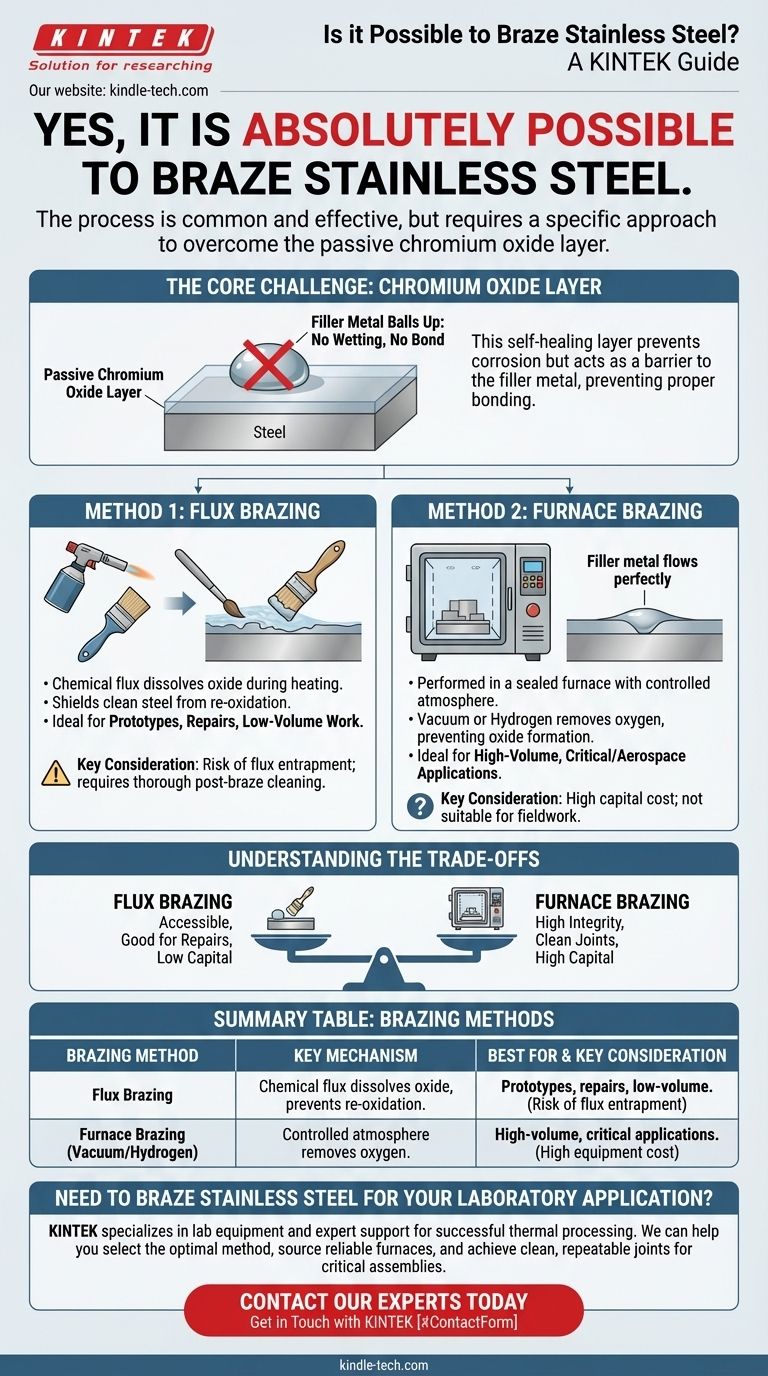
Yes, it is absolutely possible to braze stainless steel. The process is common and highly effective, but it requires a specific approach. Unlike plain carbon steel, stainless steel has a passive, self-healing layer of chromium oxide that gives it corrosion resistance, but this same layer prevents the molten braze filler metal from properly bonding to the surface.

Brazing stainless steel is a standard industrial practice, but success is entirely dependent on overcoming the tenacious chromium oxide layer on its surface. This is typically achieved using either a specialized chemical flux or a controlled atmosphere furnace.
Is it possible to braze stainless steel? A Guide to Overcoming the Oxide Barrier

The Core Challenge: The Chromium Oxide Layer

The key to understanding how to braze stainless steel is to first understand why it's "stainless." The solution to the brazing challenge lies in temporarily defeating this protective property.

What is This Protective Layer?

The chromium within the stainless steel alloy reacts with oxygen in the air to form a very thin, dense, and transparent layer of chromium oxide.

This passive layer is what prevents rust and corrosion. If scratched, it instantly reforms, providing continuous protection.

Why It Prevents a Good Braze Joint

Brazing works when a molten filler metal is drawn into a joint by capillary action and "wets" the surfaces of the parent metals. Wetting is the process of the liquid filler spreading out and making intimate contact with the base metal.

The chromium oxide layer acts as a barrier, preventing the filler metal from actually touching and bonding with the steel beneath. The filler will simply ball up and fail to flow, resulting in a weak or nonexistent joint.

Proven Methods for Brazing Stainless Steel

To create a strong brazed joint, the oxide layer must be removed and the surface kept clean during the heating process. There are two primary ways to accomplish this.

Method 1: Using a Brazing Flux

For torch brazing or induction brazing in open air, a chemical flux is required.

The flux is a chemical compound applied to the joint area before heating. It melts at a temperature below that of the filler metal, dissolving the chromium oxide layer and shielding the now-clean steel from re-oxidizing as it is heated.

Method 2: Controlled Atmosphere Furnace Brazing

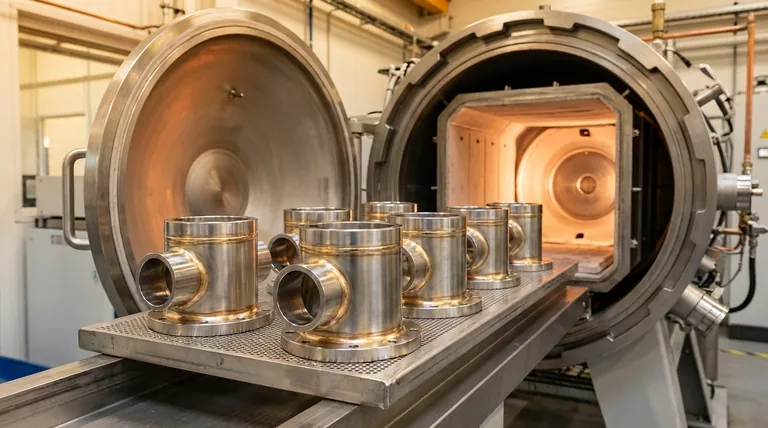
For higher volume production or applications requiring maximum cleanliness, parts are brazed inside a sealed furnace. The air is removed and replaced with a specific atmosphere that manages the oxides.

Vacuum Brazing is a common technique where a powerful vacuum pump removes virtually all oxygen from the furnace. With no oxygen present, the oxide layer cannot form or re-form during the heating cycle, allowing the filler metal to wet the surface perfectly.

Hydrogen Brazing is another furnace method that uses a "reducing" atmosphere. The hydrogen gas actively reacts with and removes the chromium oxide from the steel's surface, leaving it perfectly clean for the brazing alloy.

Understanding the Trade-offs

Choosing between flux and furnace brazing depends entirely on your application, volume, and quality requirements. Neither method is universally superior.

Flux Brazing: Pros and Cons

This is the most accessible method, often done with a simple hand torch. It is ideal for repairs, one-off assemblies, and low-volume work.

The primary disadvantage is the risk of flux entrapment. If flux becomes trapped inside the finished joint, it can lead to corrosion over time. Thorough post-braze cleaning is mandatory to remove all residual flux, which can be difficult in complex geometries.

Furnace Brazing: Pros and Cons

This method produces extremely clean, high-integrity joints with excellent repeatability, making it ideal for critical applications and mass production. Since no flux is used, there is no risk of post-braze corrosion from entrapped chemicals.

The main drawback is the high capital cost and complexity of the equipment. Furnace brazing is a batch process that is not suitable for fieldwork or quick repairs.

Making the Right Choice for Your Goal

Your decision should be driven by the specific demands of your project.

  • If your primary focus is a simple prototype or a one-off repair: Use a high-quality black brazing flux designed specifically for stainless steel and a standard torch.
  • If your primary focus is high-volume production or aerospace-grade quality: Furnace brazing in a vacuum or a reducing atmosphere is the correct choice for its cleanliness and repeatability.
  • If your primary focus is joining stainless steel to another metal (like copper): Brazing is an excellent method, but the rule remains the same—you must use a flux or atmosphere that can manage the stainless steel's oxide layer.

Success in brazing stainless steel comes down to selecting the right technique to manage its protective oxide layer for the duration of the heating process.

Summary Table:

Brazing Method Key Mechanism Best For Key Consideration
Flux Brazing Chemical flux dissolves oxide layer and prevents re-oxidation. Prototypes, repairs, low-volume work. Risk of flux entrapment; requires thorough cleaning.
Furnace Brazing Vacuum or hydrogen atmosphere removes oxygen, preventing oxide formation. High-volume production, critical/aerospace applications. High equipment cost; not suitable for fieldwork.

Need to Braze Stainless Steel for Your Laboratory Application?

Brazing stainless steel components for your lab equipment requires precision and the right technique to ensure joint integrity and prevent corrosion. KINTEK specializes in providing the lab equipment and expert support needed for successful thermal processing.

We can help you:

  • Select the optimal brazing method for your specific stainless steel alloy and application.
  • Source reliable furnaces and accessories for controlled atmosphere brazing.
  • Achieve clean, strong, and repeatable joints for your critical laboratory assemblies.

Contact our experts today to discuss your project and ensure your brazing process is a success.

Get in Touch with KINTEK

Visual Guide

Is it possible to braze stainless steel? A Guide to Overcoming the Oxide Barrier Visual Guide

Related Products

People Also Ask

Related Products

Vacuum Heat Treat Sintering Brazing Furnace

Vacuum Heat Treat Sintering Brazing Furnace

A vacuum brazing furnace is a type of industrial furnace used for brazing, a metalworking process that joins two pieces of metal using a filler metal that melts at a lower temperature than the base metals. Vacuum brazing furnaces are typically used for high-quality applications where a strong, clean joint is required.

Ultra-High Temperature Graphite Vacuum Graphitization Furnace

Ultra-High Temperature Graphite Vacuum Graphitization Furnace

The ultra-high temperature graphitization furnace utilizes medium frequency induction heating in a vacuum or inert gas environment. The induction coil generates an alternating magnetic field, inducing eddy currents in the graphite crucible, which heats up and radiates heat to the workpiece, bringing it to the desired temperature. This furnace is primarily used for graphitization and sintering of carbon materials, carbon fiber materials, and other composite materials.

Vacuum Dental Porcelain Sintering Furnace

Vacuum Dental Porcelain Sintering Furnace

Get precise and reliable results with KinTek's Vacuum Porcelain Furnace. Suitable for all porcelain powders, it features hyperbolic ceramic furnace function, voice prompt, and automatic temperature calibration.

Vertical High Temperature Graphite Vacuum Graphitization Furnace

Vertical High Temperature Graphite Vacuum Graphitization Furnace

Vertical high temperature graphitization furnace for carbonization and graphitization of carbon materials up to 3100℃.Suitable for shaped graphitization of carbon fiber filaments and other materials sintered in a carbon environment.Applications in metallurgy, electronics, and aerospace for producing high-quality graphite products like electrodes and crucibles.

High Temperature Muffle Oven Furnace for Laboratory Debinding and Pre Sintering

High Temperature Muffle Oven Furnace for Laboratory Debinding and Pre Sintering

KT-MD High temperature debinding and pre-sintering furnace for ceramic materials with various molding processes. Ideal for electronic components such as MLCC and NFC.

Horizontal High Temperature Graphite Vacuum Graphitization Furnace

Horizontal High Temperature Graphite Vacuum Graphitization Furnace

Horizontal Graphitization Furnace: This type of furnace is designed with the heating elements placed horizontally, allowing for uniform heating of the sample. It's well-suited for graphitizing large or bulky samples that require precise temperature control and uniformity.

Graphite Vacuum Furnace Bottom Discharge Graphitization Furnace for Carbon Materials

Graphite Vacuum Furnace Bottom Discharge Graphitization Furnace for Carbon Materials

Bottom-out graphitization furnace for carbon materials, ultra-high temperature furnace up to 3100°C, suitable for graphitization and sintering of carbon rods and carbon blocks. Vertical design, bottom discharging, convenient feeding and discharging, high temperature uniformity, low energy consumption, good stability, hydraulic lifting system, convenient loading and unloading.

Graphite Vacuum Continuous Graphitization Furnace

Graphite Vacuum Continuous Graphitization Furnace

High-temperature graphitization furnace is a professional equipment for graphitization treatment of carbon materials. It is a key equipment for the production of high-quality graphite products. It has high temperature, high efficiency and uniform heating. It is suitable for various high-temperature treatments and graphitization treatments. It is widely used in metallurgy, electronics, aerospace, etc. industry.

Dental Porcelain Zirconia Sintering Ceramic Furnace Chairside with Transformer

Dental Porcelain Zirconia Sintering Ceramic Furnace Chairside with Transformer

Experience top-notch sintering with Chairside Sintering Furnace with Transformer. Easy to operate, noise-free pallet, and automatic temperature calibration. Order now!

Vacuum Heat Treat and Pressure Sintering Furnace for High Temperature Applications

Vacuum Heat Treat and Pressure Sintering Furnace for High Temperature Applications

Vacuum pressure sintering furnaces are designed for high temperature hot pressing applications in metal and ceramic sintering. Its advanced features ensure precise temperature control, reliable pressure maintenance, and a robust design for seamless operation.

Vacuum Heat Treat and Molybdenum Wire Sintering Furnace for Vacuum Sintering

Vacuum Heat Treat and Molybdenum Wire Sintering Furnace for Vacuum Sintering

A vacuum molybdenum wire sintering furnace is a vertical or bedroom structure, which is suitable for withdrawal, brazing, sintering and degassing of metal materials under high vacuum and high temperature conditions. It is also suitable for dehydroxylation treatment of quartz materials.

Dental Porcelain Zirconia Sintering Ceramic Vacuum Press Furnace

Dental Porcelain Zirconia Sintering Ceramic Vacuum Press Furnace

Get precise dental results with Dental Vacuum Press Furnace. Automatic temperature calibration, low noise tray, and touch screen operation. Order now!

Spark Plasma Sintering Furnace SPS Furnace

Spark Plasma Sintering Furnace SPS Furnace

Discover the benefits of Spark Plasma Sintering Furnaces for rapid, low-temperature material preparation. Uniform heating, low cost & eco-friendly.

Vacuum Heat Treat Furnace with Ceramic Fiber Liner

Vacuum Heat Treat Furnace with Ceramic Fiber Liner

Vacuum furnace with polycrystalline ceramic fiber insulation liner for excellent heat insulation and uniform temperature field. Choose from 1200℃ or 1700℃ max. working temperature with high vacuum performance and precise temperature control.

2200 ℃ Graphite Vacuum Heat Treat Furnace

2200 ℃ Graphite Vacuum Heat Treat Furnace

Discover the power of the KT-VG Graphite Vacuum Furnace - with a maximum working temperature of 2200℃, it's perfect for vacuum sintering of various materials. Learn more now.

Mesh belt controlled atmosphere furnace

Mesh belt controlled atmosphere furnace

Discover our KT-MB mesh belt sintering furnace - perfect for high-temperature sintering of electronic components & glass insulators. Available for open air or controlled atmosphere environments.

600T Vacuum Induction Hot Press Furnace for Heat Treat and Sintering

600T Vacuum Induction Hot Press Furnace for Heat Treat and Sintering

Discover the 600T Vacuum Induction Hot Press Furnace, designed for high-temperature sintering experiments in vacuum or protected atmospheres. Its precise temperature and pressure control, adjustable working pressure, and advanced safety features make it ideal for nonmetal materials, carbon composites, ceramics, and metal powders.

1700℃ Controlled Atmosphere Furnace Nitrogen Inert Atmosphere Furnace

1700℃ Controlled Atmosphere Furnace Nitrogen Inert Atmosphere Furnace

KT-17A Controlled atmosphere furnace: 1700℃ heating, vacuum sealing technology, PID temperature control, and versatile TFT smart touch screen controller for laboratory and industrial use.

Non Consumable Vacuum Arc Induction Melting Furnace

Non Consumable Vacuum Arc Induction Melting Furnace

Explore the benefits of Non-Consumable Vacuum Arc Furnace with high melting point electrodes. Small, easy to operate & eco-friendly. Ideal for laboratory research on refractory metals & carbides.

Controlled Nitrogen Inert Hydrogen Atmosphere Furnace

Controlled Nitrogen Inert Hydrogen Atmosphere Furnace

KT-AH Hydrogen atmosphere furnace - induction gas furnace for sintering/annealing with built-in safety features, dual housing design, and energy-saving efficiency. Ideal for lab and industrial use.


Leave Your Message