Knowledge Is PVD coating waterproof? Discover the Ultimate Corrosion Protection for Your Products
Author avatar

Tech Team · Kintek Solution

Updated 6 days ago

Is PVD coating waterproof? Discover the Ultimate Corrosion Protection for Your Products


In practice, yes, a PVD coating itself is effectively waterproof. The Physical Vapor Deposition process creates an extremely dense, non-porous film that is molecularly bonded to the surface. This layer forms a stable barrier that prevents water and other molecules from penetrating through to the underlying material, making it highly resistant to corrosion, oxidation, and tarnish.

The core function of a PVD coating is not to make an object waterproof, but to make its surface incredibly durable and resistant to corrosion. While the PVD film itself is a waterproof barrier, the true benefit lies in how it protects the underlying material from the damaging effects of moisture and wear.
Is PVD coating waterproof? Discover the Ultimate Corrosion Protection for Your Products

How PVD Creates a Water-Resistant Barrier

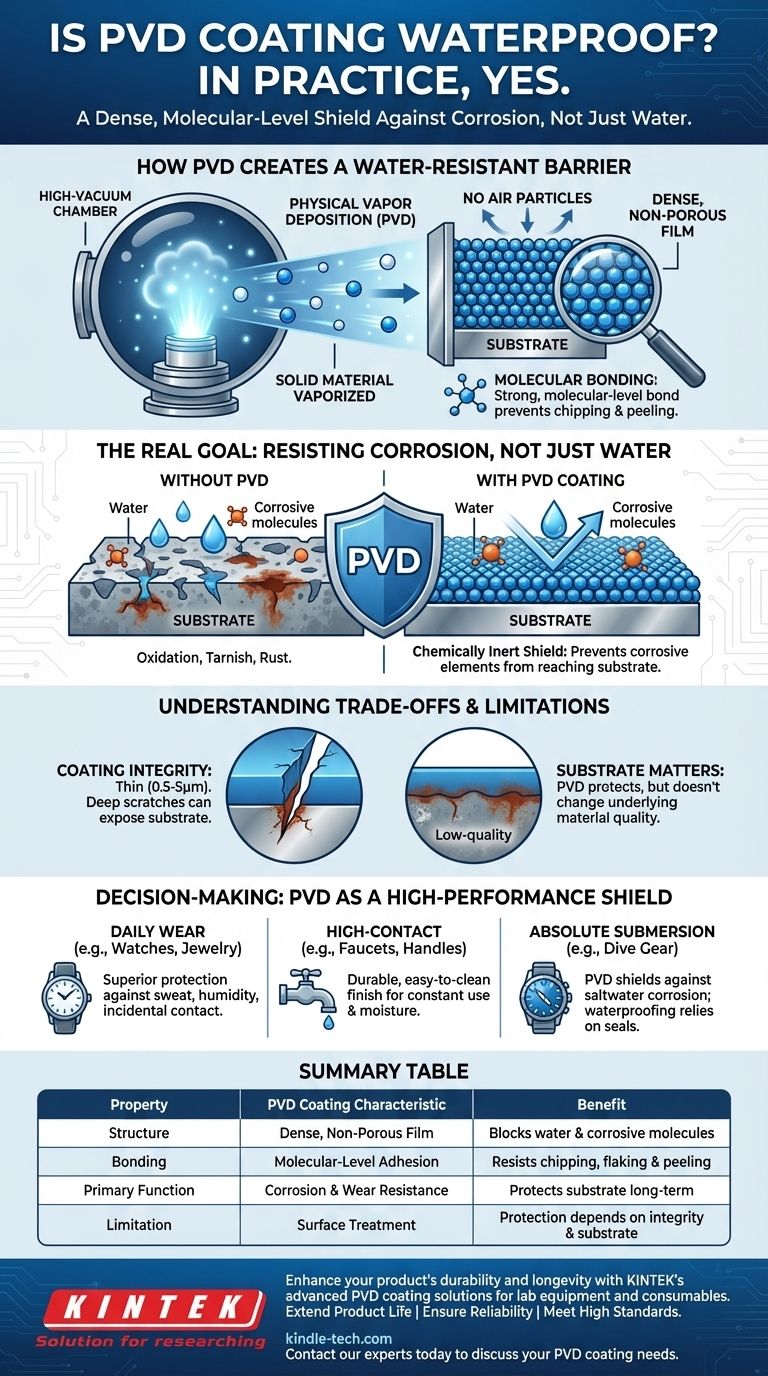
Physical Vapor Deposition is a process performed in a high-vacuum environment where a solid material is vaporized, and its atoms are deposited one by one onto a substrate. This meticulous layering process is key to its protective qualities.

The Role of Molecular Bonding

PVD is not like paint, which simply sits on a surface. The deposited material forms a strong, molecular-level bond with the substrate. This exceptional adhesion means the coating won't easily chip, flake, or peel away, ensuring the protective barrier remains intact.

A Dense, Non-Porous Film

Because the process occurs in a vacuum, there are no air particles or contaminants to create imperfections. The atoms condense into a solid, uniform film that is virtually free of pores or gaps. It is this dense structure that blocks water molecules from passing through.

The Real Goal: Resisting Corrosion, Not Just Water

When you ask if something is "waterproof," you are often really asking if it will be damaged by water. PVD's primary purpose is to prevent this very damage on a long-term basis.

Preventing Oxidation and Tarnish

Water, especially when combined with salt from sweat or chemicals in the air, accelerates corrosion (like rust) and tarnish. A PVD coating is chemically inert and highly stable, acting as a shield that prevents these corrosive elements from ever reaching the metal underneath.

Enhancing the Substrate

PVD is typically applied to materials like stainless steel or titanium that already have good corrosion resistance. The coating elevates this property to a much higher level, ensuring the product's finish and structural integrity are preserved even with frequent exposure to moisture.

Understanding the Trade-offs and Limitations

While extremely effective, it's important to understand the context of PVD's protection. It is a surface treatment, not an intrinsic property of the object.

A Coating Is Only as Good as Its Integrity

PVD coatings are exceptionally hard and wear-resistant, but they are also very thin (typically 0.5 to 5 microns). A deep scratch or gouge that fully penetrates the coating can expose the underlying substrate. If the substrate is susceptible to rust, corrosion can begin at that point of damage.

The Substrate Still Matters

The overall durability of the product is a combination of the PVD coating and the base material. If a coating on a low-quality, rust-prone metal is compromised, rust can potentially begin to creep under the edges of the intact film over time. The PVD coating protects the surface, but it doesn't change the fundamental nature of the material it covers.

How to Apply This to Your Decision

Consider the PVD coating as a high-performance protective shield rather than a simple waterproofing seal. Its value is in preserving the look and life of the product against environmental exposure.

  • If your primary focus is daily-wear items like watches or jewelry: PVD is an excellent choice, offering superior protection against sweat, humidity, and incidental water contact that would otherwise cause tarnish or wear.
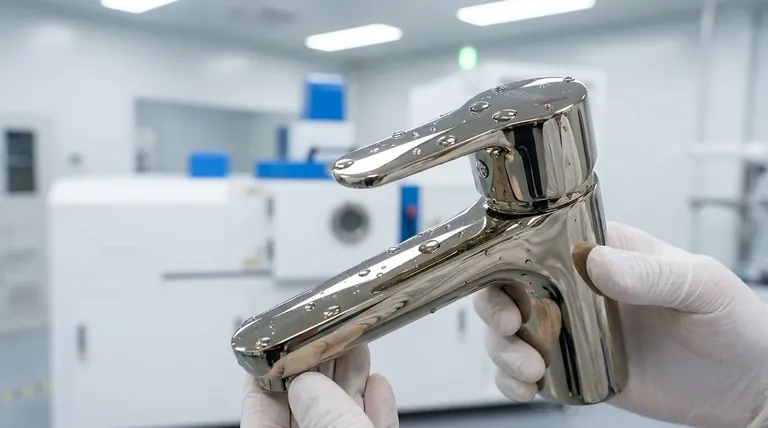
  • If your primary focus is high-contact fixtures like faucets or door handles: The hardness and corrosion resistance of PVD provide a durable, long-lasting finish that is easy to clean and withstands constant use and moisture.
  • If your primary focus is absolute waterproofing for submersion: The waterproofing of an object like a dive watch depends on its gaskets, seals, and case construction; the PVD coating's role here is to provide an external shield against corrosion from saltwater.

Ultimately, you can trust a PVD-coated surface to be impervious to water, protecting the material beneath it from corrosion and preserving its intended finish.

Summary Table:

Property PVD Coating Characteristic Benefit
Structure Dense, Non-Porous Film Blocks water and corrosive molecules
Bonding Molecular-Level Adhesion Resists chipping, flaking, and peeling
Primary Function Corrosion & Wear Resistance Protects the underlying substrate long-term
Limitation Surface Treatment Protection depends on coating integrity and substrate quality

Enhance your product's durability and longevity with KINTEK's advanced PVD coating solutions.

Specializing in lab equipment and consumables, we understand the critical need for reliable, corrosion-resistant surfaces. Our PVD coatings provide a superior protective barrier that safeguards your instruments and components against moisture, chemicals, and daily wear.

Partner with KINTEK to:

  • Extend Product Life: Protect valuable equipment from corrosion and tarnish.
  • Ensure Reliability: Benefit from a durable, non-porous finish that maintains integrity.
  • Meet High Standards: Achieve consistent, high-quality results for your laboratory needs.

Contact our experts today to discuss how our PVD coating services can protect your laboratory investments.

Visual Guide
Is PVD coating waterproof? Discover the Ultimate Corrosion Protection for Your Products Visual Guide

Related Products

People Also Ask

Related Products

RF PECVD System Radio Frequency Plasma-Enhanced Chemical Vapor Deposition RF PECVD

RF PECVD System Radio Frequency Plasma-Enhanced Chemical Vapor Deposition RF PECVD

RF-PECVD is an acronym for "Radio Frequency Plasma-Enhanced Chemical Vapor Deposition." It deposits DLC (Diamond-like carbon film) on germanium and silicon substrates. It is utilized in the 3-12um infrared wavelength range.

Vacuum Hot Press Furnace Machine for Lamination and Heating

Vacuum Hot Press Furnace Machine for Lamination and Heating

Experience clean and precise lamination with Vacuum Lamination Press. Perfect for wafer bonding, thin-film transformations, and LCP lamination. Order now!

Chemical Vapor Deposition CVD Equipment System Chamber Slide PECVD Tube Furnace with Liquid Gasifier PECVD Machine

Chemical Vapor Deposition CVD Equipment System Chamber Slide PECVD Tube Furnace with Liquid Gasifier PECVD Machine

KT-PE12 Slide PECVD System: Wide power range, programmable temp control, fast heating/cooling with sliding system, MFC mass flow control & vacuum pump.

Split Chamber CVD Tube Furnace with Vacuum Station Chemical Vapor Deposition System Equipment Machine

Split Chamber CVD Tube Furnace with Vacuum Station Chemical Vapor Deposition System Equipment Machine

Efficient split chamber CVD furnace with vacuum station for intuitive sample checking and quick cooling. Up to 1200℃ max temperature with accurate MFC mass flowmeter control.

VHP Sterilization Equipment Hydrogen Peroxide H2O2 Space Sterilizer

VHP Sterilization Equipment Hydrogen Peroxide H2O2 Space Sterilizer

A hydrogen peroxide space sterilizer is a device that uses vaporized hydrogen peroxide to decontaminate enclosed spaces. It kills microorganisms by damaging their cellular components and genetic material.

Molybdenum Tungsten Tantalum Special Shape Evaporation Boat

Molybdenum Tungsten Tantalum Special Shape Evaporation Boat

Tungsten Evaporation Boat is ideal for vacuum coating industry and sintering furnace or vacuum annealing. we offers tungsten evaporation boats that are designed to be durable and robust, with long operating lifetimes and to ensure consistent smooth and even spreading of the molten metals.

Vacuum Hot Press Furnace Heated Vacuum Press Machine Tube Furnace

Vacuum Hot Press Furnace Heated Vacuum Press Machine Tube Furnace

Reduce forming pressure & shorten sintering time with Vacuum Tube Hot Press Furnace for high-density, fine-grain materials. Ideal for refractory metals.

600T Vacuum Induction Hot Press Furnace for Heat Treat and Sintering

600T Vacuum Induction Hot Press Furnace for Heat Treat and Sintering

Discover the 600T Vacuum Induction Hot Press Furnace, designed for high-temperature sintering experiments in vacuum or protected atmospheres. Its precise temperature and pressure control, adjustable working pressure, and advanced safety features make it ideal for nonmetal materials, carbon composites, ceramics, and metal powders.

1200℃ Controlled Atmosphere Furnace Nitrogen Inert Atmosphere Furnace

1200℃ Controlled Atmosphere Furnace Nitrogen Inert Atmosphere Furnace

Discover our KT-12A Pro Controlled atmosphere furnace - high precision, heavy duty vacuum chamber, versatile smart touch screen controller, and excellent temperature uniformity up to 1200C. Ideal for both laboratory and industrial application.

Oil Free Diaphragm Vacuum Pump for Laboratory and Industrial Use

Oil Free Diaphragm Vacuum Pump for Laboratory and Industrial Use

Oil-free diaphragm vacuum pump for labs: clean, reliable, chemical-resistant. Ideal for filtration, SPE, and rotary evaporation. Maintenance-free operation.

1400℃ Controlled Atmosphere Furnace with Nitrogen and Inert Atmosphere

1400℃ Controlled Atmosphere Furnace with Nitrogen and Inert Atmosphere

Achieve precise heat treatment with KT-14A controlled atmosphere furnace. Vacuum sealed with a smart controller, it's ideal for lab and industrial use up to 1400℃.

Molybdenum Vacuum Heat Treat Furnace

Molybdenum Vacuum Heat Treat Furnace

Discover the benefits of a high-configuration molybdenum vacuum furnace with heat shield insulation. Ideal for high-purity, vacuum environments like sapphire crystal growth and heat treatment.

Vacuum Heat Treat Furnace with Ceramic Fiber Liner

Vacuum Heat Treat Furnace with Ceramic Fiber Liner

Vacuum furnace with polycrystalline ceramic fiber insulation liner for excellent heat insulation and uniform temperature field. Choose from 1200℃ or 1700℃ max. working temperature with high vacuum performance and precise temperature control.

Vacuum Heat Treat and Molybdenum Wire Sintering Furnace for Vacuum Sintering

Vacuum Heat Treat and Molybdenum Wire Sintering Furnace for Vacuum Sintering

A vacuum molybdenum wire sintering furnace is a vertical or bedroom structure, which is suitable for withdrawal, brazing, sintering and degassing of metal materials under high vacuum and high temperature conditions. It is also suitable for dehydroxylation treatment of quartz materials.

Vacuum Dental Porcelain Sintering Furnace

Vacuum Dental Porcelain Sintering Furnace

Get precise and reliable results with KinTek's Vacuum Porcelain Furnace. Suitable for all porcelain powders, it features hyperbolic ceramic furnace function, voice prompt, and automatic temperature calibration.

Small Vacuum Heat Treat and Tungsten Wire Sintering Furnace

Small Vacuum Heat Treat and Tungsten Wire Sintering Furnace

The small vacuum tungsten wire sintering furnace is a compact experimental vacuum furnace specially designed for universities and scientific research institutes. The furnace features a CNC welded shell and vacuum piping to ensure leak-free operation. Quick-connect electrical connections facilitate relocation and debugging, and the standard electrical control cabinet is safe and convenient to operate.

Circulating Water Vacuum Pump for Laboratory and Industrial Use

Circulating Water Vacuum Pump for Laboratory and Industrial Use

Efficient circulating water vacuum pump for labs - oil-free, corrosion-resistant, quiet operation. Multiple models available. Get yours now!

Laboratory Benchtop Water Circulating Vacuum Pump for Lab Use

Laboratory Benchtop Water Circulating Vacuum Pump for Lab Use

Need a water circulating vacuum pump for your lab or small-scale industry? Our Benchtop Water Circulating Vacuum Pump is perfect for evaporation, distillation, crystallization, and more.

Ultra-High Temperature Graphite Vacuum Graphitization Furnace

Ultra-High Temperature Graphite Vacuum Graphitization Furnace

The ultra-high temperature graphitization furnace utilizes medium frequency induction heating in a vacuum or inert gas environment. The induction coil generates an alternating magnetic field, inducing eddy currents in the graphite crucible, which heats up and radiates heat to the workpiece, bringing it to the desired temperature. This furnace is primarily used for graphitization and sintering of carbon materials, carbon fiber materials, and other composite materials.

1700℃ Controlled Atmosphere Furnace Nitrogen Inert Atmosphere Furnace

1700℃ Controlled Atmosphere Furnace Nitrogen Inert Atmosphere Furnace

KT-17A Controlled atmosphere furnace: 1700℃ heating, vacuum sealing technology, PID temperature control, and versatile TFT smart touch screen controller for laboratory and industrial use.


Leave Your Message