Knowledge What are 2 examples of deposition in chemistry? From Frost to Soot Explained
Author avatar

Tech Team · Kintek Solution

Updated 6 days ago

What are 2 examples of deposition in chemistry? From Frost to Soot Explained


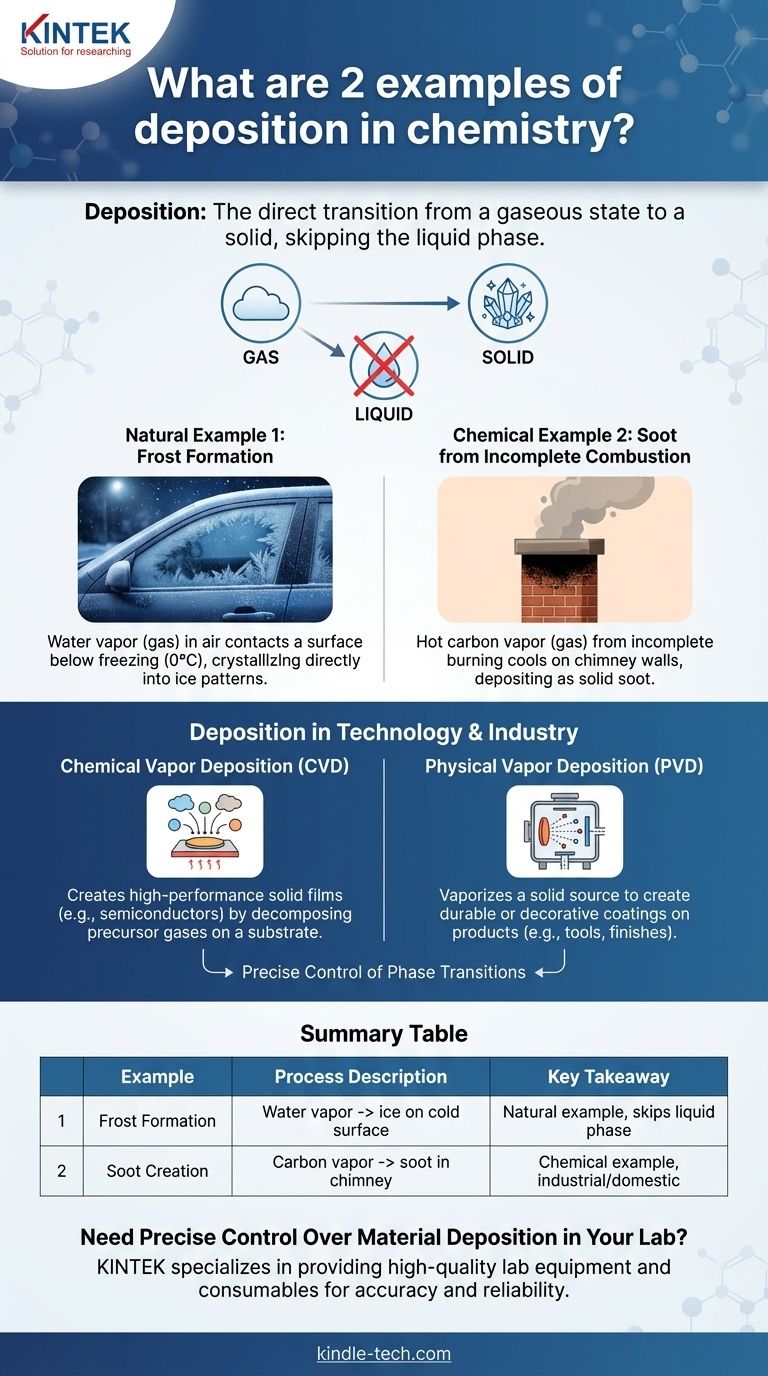
Two clear examples of deposition are the formation of frost on a cold window and the creation of soot in a chimney. In both cases, a substance in a gaseous state turns directly into a solid, completely skipping the intermediate liquid phase. This occurs when gas molecules rapidly lose energy upon contacting a cold surface, causing them to lock into a solid structure.

Deposition is a fundamental phase transition where matter changes directly from a gas to a solid. It is the reverse process of sublimation and is governed by specific conditions of temperature and pressure, playing a crucial role in both natural weather patterns and advanced industrial manufacturing.
What are 2 examples of deposition in chemistry? From Frost to Soot Explained

What is Deposition? A Deeper Look

The Gas-to-Solid Transition

Deposition is a thermodynamic process. It stands in contrast to the more familiar process of condensation, where a gas turns into a liquid (like water droplets on a cold glass).

Instead of condensing, the gas molecules bypass the liquid state entirely. This direct jump from a high-energy gas phase to a low-energy, ordered solid phase is what defines deposition.

The Role of Thermal Energy

This transition happens when a gas cools rapidly below its freezing point. The molecules lose thermal energy so quickly that they do not have time to form the loosely bonded structure of a liquid.

Instead, they immediately arrange themselves into a fixed, crystalline lattice, characteristic of a solid. Pressure also plays a key role, but a significant drop in temperature is the most common trigger.

Sublimation: The Reverse Process

To fully grasp deposition, it is helpful to understand its opposite: sublimation. This is the process where a solid turns directly into a gas, again skipping the liquid phase.

A common example of sublimation is dry ice (solid carbon dioxide) turning into a cloud of CO2 gas at room temperature. Deposition and sublimation are two sides of the same coin, representing the direct exchange between the solid and gas states.

Analyzing the Examples

Example 1: The Formation of Frost

Frost is a perfect natural example of deposition. It is not frozen dew.

When the temperature of a surface, like a car windshield or a blade of grass, drops below the freezing point of water (0°C or 32°F), deposition can occur. Water vapor (a gas) in the surrounding air comes into direct contact with this cold surface.

The water vapor molecules instantly lose their energy and crystallize into ice. The intricate, feathery patterns of frost are the direct result of these ice crystals forming from a gas.

Example 2: Soot from Incomplete Combustion

Soot formation is a chemical example of deposition. During the incomplete burning of hydrocarbons, like wood or fossil fuels, tiny carbon particles are created and carried in hot gas.

As these hot gases travel up a chimney or exhaust pipe, they cool down upon contact with the cooler surfaces. The carbon vapor deposits directly onto these surfaces as a black, powdery solid we know as soot, without ever becoming liquid carbon.

Deposition in Technology and Industry

Chemical Vapor Deposition (CVD)

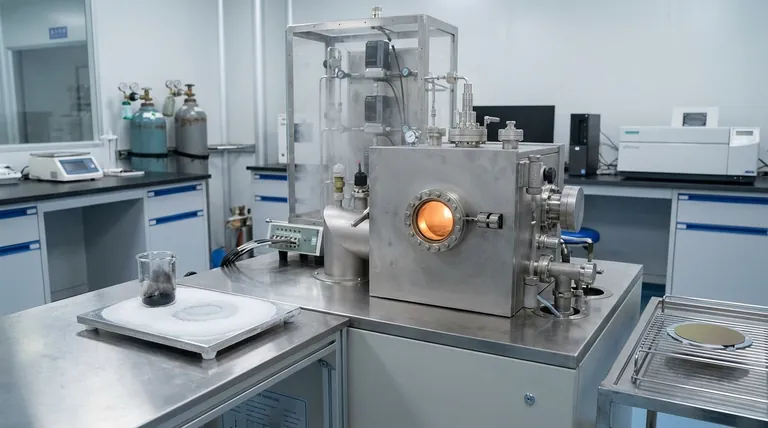
In the technology sector, deposition is a highly controlled and essential process. Chemical Vapor Deposition (CVD) is a technique used to create ultra-pure, high-performance solid films.

In CVD, precursor gases are introduced into a reaction chamber. These gases decompose on a heated substrate, causing a solid material to deposit and form a thin, uniform layer. This process is critical for manufacturing semiconductors, optical coatings, and synthetic diamonds.

Physical Vapor Deposition (PVD)

Physical Vapor Deposition (PVD) is another industrial technique that relies on this principle. A solid source material is vaporized in a vacuum chamber, often by bombarding it with ions (a process called sputtering).

This vapor then travels and deposits onto the surface of a product, creating a durable and often decorative coating. PVD is used for putting hard coatings on cutting tools, wear-resistant films on engine parts, and metallic finishes on plastics.

Key Takeaways for Different Contexts

  • If your primary focus is understanding natural phenomena: Recognize deposition as the process that forms frost and snow, where water vapor in the air crystallizes directly into ice without first becoming rain or dew.
  • If your primary focus is chemistry and manufacturing: View deposition as a powerful technique (like CVD and PVD) for building materials layer by layer, enabling the creation of advanced electronics and durable coatings.

Ultimately, deposition is the direct pathway from the disordered chaos of a gas to the ordered structure of a solid.

Summary Table:

Example Process Description Key Takeaway
Frost Formation Water vapor in air turns directly into ice crystals on a cold surface. A natural example of deposition, skipping the liquid phase.
Soot Creation Carbon vapor from incomplete combustion deposits as solid soot in a chimney. A chemical example common in industrial and domestic settings.

Need Precise Control Over Material Deposition in Your Lab?

From fundamental research to advanced manufacturing processes like CVD and PVD, precise control over phase transitions is critical. KINTEK specializes in providing high-quality lab equipment and consumables that ensure accuracy and reliability in your experiments.

Contact our experts today to find the perfect solution for your laboratory's deposition and material science needs.

Visual Guide
What are 2 examples of deposition in chemistry? From Frost to Soot Explained Visual Guide

Related Products

People Also Ask

Related Products

Inclined Rotary Plasma Enhanced Chemical Vapor Deposition PECVD Equipment Tube Furnace Machine

Inclined Rotary Plasma Enhanced Chemical Vapor Deposition PECVD Equipment Tube Furnace Machine

Upgrade your coating process with PECVD coating equipment. Ideal for LED, power semiconductors, MEMS and more. Deposits high-quality solid films at low temps.

915MHz MPCVD Diamond Machine Microwave Plasma Chemical Vapor Deposition System Reactor

915MHz MPCVD Diamond Machine Microwave Plasma Chemical Vapor Deposition System Reactor

915MHz MPCVD Diamond Machine and its multi-crystal effective growth, the maximum area can reach 8 inches, the maximum effective growth area of single crystal can reach 5 inches. This equipment is mainly used for the production of large-size polycrystalline diamond films, the growth of long single crystal diamonds, the low-temperature growth of high-quality graphene, and other materials that require energy provided by microwave plasma for growth.

Customer Made Versatile CVD Tube Furnace Chemical Vapor Deposition Chamber System Equipment

Customer Made Versatile CVD Tube Furnace Chemical Vapor Deposition Chamber System Equipment

Get your exclusive CVD furnace with KT-CTF16 Customer Made Versatile Furnace. Customizable sliding, rotating, and tilting functions for precise reactions. Order now!

HFCVD Machine System Equipment for Drawing Die Nano-Diamond Coating

HFCVD Machine System Equipment for Drawing Die Nano-Diamond Coating

The nano-diamond composite coating drawing die uses cemented carbide (WC-Co) as the substrate, and uses the chemical vapor phase method ( CVD method for short ) to coat the conventional diamond and nano-diamond composite coating on the surface of the inner hole of the mold.

CVD Diamond Cutting Tool Blanks for Precision Machining

CVD Diamond Cutting Tool Blanks for Precision Machining

CVD Diamond Cutting Tools: Superior Wear Resistance, Low Friction, High Thermal Conductivity for Non-Ferrous Materials, Ceramics, Composites Machining

Vacuum Hot Press Furnace Machine for Lamination and Heating

Vacuum Hot Press Furnace Machine for Lamination and Heating

Experience clean and precise lamination with Vacuum Lamination Press. Perfect for wafer bonding, thin-film transformations, and LCP lamination. Order now!

Laboratory CVD Boron Doped Diamond Materials

Laboratory CVD Boron Doped Diamond Materials

CVD boron-doped diamond: A versatile material enabling tailored electrical conductivity, optical transparency, and exceptional thermal properties for applications in electronics, optics, sensing, and quantum technologies.

Laboratory Sterilizer Lab Autoclave Pulse Vacuum Lifting Sterilizer

Laboratory Sterilizer Lab Autoclave Pulse Vacuum Lifting Sterilizer

The pulse vacuum lifting sterilizer is a state-of-the-art equipment for efficient and precise sterilization. It uses pulsating vacuum technology, customizable cycles, and a user-friendly design for easy operation and safety.

Anti-Cracking Press Mold for Lab Use

Anti-Cracking Press Mold for Lab Use

The anti-cracking press mold is a specialized equipment designed for molding various shapes and sizes of film using high pressure and electric heating.

Laboratory Test Sieves and Sieving Machines

Laboratory Test Sieves and Sieving Machines

Precision lab test sieves & sieving machines for accurate particle analysis. Stainless steel, ISO-compliant, 20μm-125mm range. Request specs now!

Laboratory Sterilizer Lab Autoclave Vertical Pressure Steam Sterilizer for Liquid Crystal Display Automatic Type

Laboratory Sterilizer Lab Autoclave Vertical Pressure Steam Sterilizer for Liquid Crystal Display Automatic Type

Liquid crystal display automatic vertical sterilizer is a safe, reliable and automatic control sterilization equipment, which is composed of heating system, microcomputer control system and overheating and overvoltage protection system.

Benchtop Laboratory Vacuum Freeze Dryer

Benchtop Laboratory Vacuum Freeze Dryer

Benchtop laboratory freeze dryer for efficient lyophilization of biological, pharmaceutical, and food samples. Features intuitive touchscreen, high-performance refrigeration, and durable design. Preserve sample integrity—consult now!

Variable Speed Peristaltic Pump

Variable Speed Peristaltic Pump

KT-VSP Series Smart Variable Speed Peristaltic Pumps offer precise flow control for labs, medical, and industrial applications. Reliable, contamination-free liquid transfer.

Benchtop Laboratory Freeze Dryer for Lab Use

Benchtop Laboratory Freeze Dryer for Lab Use

Premium benchtop laboratory freeze dryer for lyophilization, preserving samples with ≤ -60°C cooling. Ideal for pharmaceuticals & research.

Small Vacuum Heat Treat and Tungsten Wire Sintering Furnace

Small Vacuum Heat Treat and Tungsten Wire Sintering Furnace

The small vacuum tungsten wire sintering furnace is a compact experimental vacuum furnace specially designed for universities and scientific research institutes. The furnace features a CNC welded shell and vacuum piping to ensure leak-free operation. Quick-connect electrical connections facilitate relocation and debugging, and the standard electrical control cabinet is safe and convenient to operate.

Laboratory Vibratory Sieve Shaker Machine Slap Vibrating Sieve

Laboratory Vibratory Sieve Shaker Machine Slap Vibrating Sieve

KT-T200TAP is a slapping and oscillating sieving instrument for laboratory desktop use, with 300 rpm horizontal circular motion and 300 vertical slapping motions to simulate manual sieving to help sample particles pass through better.

Custom PTFE Teflon Parts Manufacturer for PTFE Buchner Funnel and Triangular Funnel

Custom PTFE Teflon Parts Manufacturer for PTFE Buchner Funnel and Triangular Funnel

The PTFE funnel is a piece of laboratory equipment used primarily for filtration processes, particularly in the separation of solid and liquid phases in a mixture. This setup allows for efficient and rapid filtration, making it indispensable in various chemical and biological applications.

Isostatic Molding Pressing Molds for Lab

Isostatic Molding Pressing Molds for Lab

Explore high-performance isostatic pressing molds for advanced material processing. Ideal for achieving uniform density and strength in manufacturing.

Vacuum Heat Treat and Molybdenum Wire Sintering Furnace for Vacuum Sintering

Vacuum Heat Treat and Molybdenum Wire Sintering Furnace for Vacuum Sintering

A vacuum molybdenum wire sintering furnace is a vertical or bedroom structure, which is suitable for withdrawal, brazing, sintering and degassing of metal materials under high vacuum and high temperature conditions. It is also suitable for dehydroxylation treatment of quartz materials.

Vacuum Dental Porcelain Sintering Furnace

Vacuum Dental Porcelain Sintering Furnace

Get precise and reliable results with KinTek's Vacuum Porcelain Furnace. Suitable for all porcelain powders, it features hyperbolic ceramic furnace function, voice prompt, and automatic temperature calibration.


Leave Your Message