Knowledge What are 2 properties of carbon nanotubes that make it special? Unmatched Strength & Conductivity
Author avatar

Tech Team · Kintek Solution

Updated 6 days ago

What are 2 properties of carbon nanotubes that make it special? Unmatched Strength & Conductivity


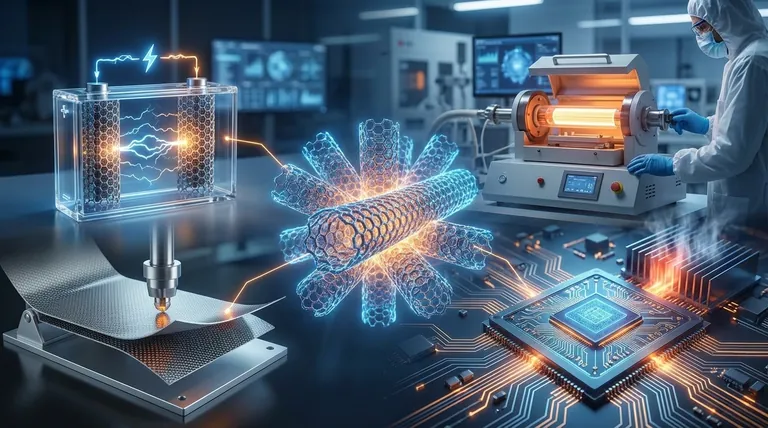
At their core, two of the most remarkable properties of carbon nanotubes (CNTs) are their exceptional mechanical strength and their unique electrical conductivity. These attributes, possessed by a material that is essentially a rolled-up sheet of single-atom-thick graphite, allow CNTs to outperform traditional materials in a vast range of applications, from reinforcing concrete to building next-generation batteries.

The true significance of carbon nanotubes is not just having one elite property, but combining world-class strength, low weight, and tunable electrical and thermal conductivity at the nanoscale. This unprecedented combination is what makes them a foundational material for future technology.
What are 2 properties of carbon nanotubes that make it special? Unmatched Strength & Conductivity

The Core Properties Explained

To understand why CNTs are so revolutionary, we must look at their specific characteristics. While they have many unique qualities, their mechanical and electrical properties are the most transformative.

Unprecedented Mechanical Strength

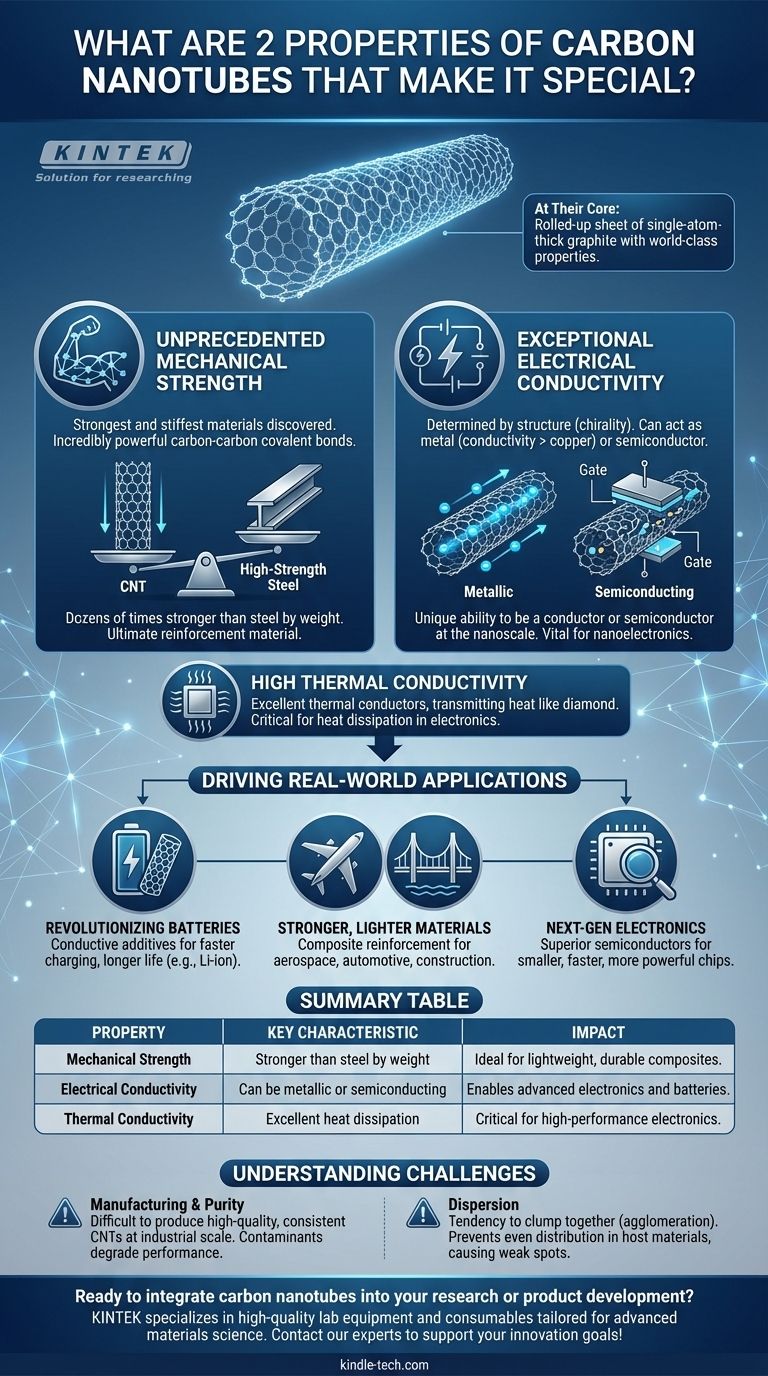
Carbon nanotubes are the strongest and stiffest materials yet discovered in terms of tensile strength and elastic modulus. The carbon-carbon covalent bonds that form their structure are incredibly powerful.

To put this into perspective, a CNT is dozens of times stronger than high-strength steel by weight. This phenomenal strength-to-weight ratio makes them the ultimate reinforcement material.

Exceptional Electrical Conductivity

The electrical properties of a carbon nanotube are determined by its structure—specifically, the angle at which the graphite sheet is "rolled up" (its chirality).

Depending on this structure, a CNT can act as a metal with conductivity higher than copper, or it can behave as a semiconductor, similar to silicon. This ability to be either a conductor or a semiconductor at the molecular level is unique and highly valuable for nanoelectronics.

High Thermal Conductivity

In addition to their other properties, CNTs are also excellent thermal conductors. They can transmit heat as effectively as diamond or graphite along their length.

This ability to efficiently manage and dissipate heat is critical for applications in electronics, where overheating is a primary cause of performance degradation and failure.

Understanding the Trade-offs and Challenges

Despite their groundbreaking potential, the widespread adoption of carbon nanotubes is hindered by significant practical challenges. Their performance in a lab is often difficult to replicate in mass-produced products.

The Challenge of Manufacturing and Purity

Producing high-quality CNTs with consistent properties (like length, diameter, and chirality) at an industrial scale is difficult and expensive.

Contaminants, such as amorphous carbon or residual metal catalysts from the production process, can degrade their performance and create reliability issues in sensitive applications like electronics.

The Problem of Dispersion

Carbon nanotubes have a strong tendency to clump together due to powerful intermolecular forces. This agglomeration prevents them from being evenly distributed within a host material, like a polymer or concrete mix.

If not properly dispersed, you get a composite with weak spots rather than a uniformly reinforced material, completely negating the benefits of adding CNTs in the first place.

How These Properties Drive Real-World Applications

The unique combination of properties in CNTs directly translates into tangible benefits across multiple industries.

Revolutionizing Energy Storage

In lithium-ion batteries, CNTs are used as conductive additives. Their high conductivity creates an efficient electrical network within the electrode, allowing for faster charging and discharging and improving overall battery longevity. This is one of their most successful commercial applications to date.

Creating Stronger, Lighter Materials

By integrating CNTs into polymers, metals, or concrete, engineers can create composite materials that are significantly stronger and lighter. This has profound implications for the aerospace, automotive, and construction industries, enabling more fuel-efficient vehicles and more durable infrastructure.

Powering Next-Generation Electronics

Because CNTs can act as superior semiconductors, they are a leading candidate to replace silicon in future transistors. Their small size could allow for even more densely packed and powerful computer chips, pushing beyond the physical limits of current technology.

Making the Right Choice for Your Goal

Understanding the core properties of CNTs allows you to see where they can provide the most value for a specific objective.

  • If your primary focus is energy storage: Leverage their electrical conductivity to enhance the performance and lifespan of batteries and supercapacitors.
  • If your primary focus is materials science: Use their mechanical strength as a lightweight reinforcement agent to create next-generation composite materials.
  • If your primary focus is advanced electronics: Explore their unique semiconductor properties to design smaller, faster, and more efficient transistors and sensors.

Ultimately, mastering the use of carbon nanotubes is about harnessing their combination of elite properties while navigating the very real challenges of manufacturing and implementation.

Summary Table:

Property Key Characteristic Impact
Mechanical Strength Stronger than steel by weight Ideal for lightweight, durable composites
Electrical Conductivity Can be metallic or semiconducting Enables advanced electronics and batteries
Thermal Conductivity Excellent heat dissipation Critical for high-performance electronics

Ready to integrate carbon nanotubes into your research or product development? KINTEK specializes in providing high-quality lab equipment and consumables tailored for advanced materials science. Our expertise ensures you have the right tools to harness the unique properties of CNTs for your specific applications, from energy storage to composite materials. Contact our experts today to discuss how we can support your innovation goals!

Visual Guide
What are 2 properties of carbon nanotubes that make it special? Unmatched Strength & Conductivity Visual Guide

Related Products

People Also Ask

Related Products

Customer Made Versatile CVD Tube Furnace Chemical Vapor Deposition Chamber System Equipment

Customer Made Versatile CVD Tube Furnace Chemical Vapor Deposition Chamber System Equipment

Get your exclusive CVD furnace with KT-CTF16 Customer Made Versatile Furnace. Customizable sliding, rotating, and tilting functions for precise reactions. Order now!

Inclined Rotary Plasma Enhanced Chemical Vapor Deposition PECVD Equipment Tube Furnace Machine

Inclined Rotary Plasma Enhanced Chemical Vapor Deposition PECVD Equipment Tube Furnace Machine

Upgrade your coating process with PECVD coating equipment. Ideal for LED, power semiconductors, MEMS and more. Deposits high-quality solid films at low temps.

Split Chamber CVD Tube Furnace with Vacuum Station Chemical Vapor Deposition System Equipment Machine

Split Chamber CVD Tube Furnace with Vacuum Station Chemical Vapor Deposition System Equipment Machine

Efficient split chamber CVD furnace with vacuum station for intuitive sample checking and quick cooling. Up to 1200℃ max temperature with accurate MFC mass flowmeter control.

Microwave Plasma Chemical Vapor Deposition MPCVD Machine System Reactor for Lab and Diamond Growth

Microwave Plasma Chemical Vapor Deposition MPCVD Machine System Reactor for Lab and Diamond Growth

Get high-quality diamond films with our Bell-jar Resonator MPCVD machine designed for lab and diamond growth. Discover how Microwave Plasma Chemical Vapor Deposition works for growing diamonds using carbon gas and plasma.

Cylindrical Resonator MPCVD Machine System Reactor for Microwave Plasma Chemical Vapor Deposition and Lab Diamond Growth

Cylindrical Resonator MPCVD Machine System Reactor for Microwave Plasma Chemical Vapor Deposition and Lab Diamond Growth

Learn about Cylindrical Resonator MPCVD Machine, the microwave plasma chemical vapor deposition method used for growing diamond gemstones and films in the jewelry and semi-conductor industries. Discover its cost-effective advantages over traditional HPHT methods.

Customizable High Pressure Reactors for Advanced Scientific and Industrial Applications

Customizable High Pressure Reactors for Advanced Scientific and Industrial Applications

This laboratory-scale high-pressure reactor is a high-performance autoclave engineered for precision and safety in demanding research and development environments.

1200℃ Split Tube Furnace with Quartz Tube Laboratory Tubular Furnace

1200℃ Split Tube Furnace with Quartz Tube Laboratory Tubular Furnace

KT-TF12 split tube furnace: high-purity insulation, embedded heating wire coils, and max. 1200C. Widely used for new materials and chemical vapour deposition.

Graphite Vacuum Continuous Graphitization Furnace

Graphite Vacuum Continuous Graphitization Furnace

High-temperature graphitization furnace is a professional equipment for graphitization treatment of carbon materials. It is a key equipment for the production of high-quality graphite products. It has high temperature, high efficiency and uniform heating. It is suitable for various high-temperature treatments and graphitization treatments. It is widely used in metallurgy, electronics, aerospace, etc. industry.

Vacuum Heat Treat Furnace with Ceramic Fiber Liner

Vacuum Heat Treat Furnace with Ceramic Fiber Liner

Vacuum furnace with polycrystalline ceramic fiber insulation liner for excellent heat insulation and uniform temperature field. Choose from 1200℃ or 1700℃ max. working temperature with high vacuum performance and precise temperature control.

Mini SS High Pressure Autoclave Reactor for Laboratory Use

Mini SS High Pressure Autoclave Reactor for Laboratory Use

Mini SS High Pressure Reactor - Ideal for medicine, chemical, and scientific research industries. Programmed heating temp and stirring speed, up to 22Mpa pressure.

Ultra-High Temperature Graphite Vacuum Graphitization Furnace

Ultra-High Temperature Graphite Vacuum Graphitization Furnace

The ultra-high temperature graphitization furnace utilizes medium frequency induction heating in a vacuum or inert gas environment. The induction coil generates an alternating magnetic field, inducing eddy currents in the graphite crucible, which heats up and radiates heat to the workpiece, bringing it to the desired temperature. This furnace is primarily used for graphitization and sintering of carbon materials, carbon fiber materials, and other composite materials.

High Pressure Laboratory Autoclave Reactor for Hydrothermal Synthesis

High Pressure Laboratory Autoclave Reactor for Hydrothermal Synthesis

Discover the applications of Hydrothermal Synthesis Reactor - a small, corrosion-resistant reactor for chemical labs. Achieve rapid digestion of insoluble substances in a safe and reliable way. Learn more now.

Vertical High Temperature Graphite Vacuum Graphitization Furnace

Vertical High Temperature Graphite Vacuum Graphitization Furnace

Vertical high temperature graphitization furnace for carbonization and graphitization of carbon materials up to 3100℃.Suitable for shaped graphitization of carbon fiber filaments and other materials sintered in a carbon environment.Applications in metallurgy, electronics, and aerospace for producing high-quality graphite products like electrodes and crucibles.

Multi Zone Laboratory Quartz Tube Furnace Tubular Furnace

Multi Zone Laboratory Quartz Tube Furnace Tubular Furnace

Experience precise, efficient thermal testing with our Multi Zone Tube Furnace. Independent heating zones and temperature sensors allow for controlled high-temperature gradient heating fields. Order now for advanced thermal analysis!

Vacuum Sealed Continuous Working Rotary Tube Furnace Rotating Tube Furnace

Vacuum Sealed Continuous Working Rotary Tube Furnace Rotating Tube Furnace

Experience efficient material processing with our vacuum-sealed rotary tube furnace. Perfect for experiments or industrial production, equipped with optional features for controlled feeding and optimized results. Order now.

Small Vacuum Heat Treat and Tungsten Wire Sintering Furnace

Small Vacuum Heat Treat and Tungsten Wire Sintering Furnace

The small vacuum tungsten wire sintering furnace is a compact experimental vacuum furnace specially designed for universities and scientific research institutes. The furnace features a CNC welded shell and vacuum piping to ensure leak-free operation. Quick-connect electrical connections facilitate relocation and debugging, and the standard electrical control cabinet is safe and convenient to operate.

600T Vacuum Induction Hot Press Furnace for Heat Treat and Sintering

600T Vacuum Induction Hot Press Furnace for Heat Treat and Sintering

Discover the 600T Vacuum Induction Hot Press Furnace, designed for high-temperature sintering experiments in vacuum or protected atmospheres. Its precise temperature and pressure control, adjustable working pressure, and advanced safety features make it ideal for nonmetal materials, carbon composites, ceramics, and metal powders.

Rotary Tube Furnace Split Multi Heating Zone Rotating Tube Furnace

Rotary Tube Furnace Split Multi Heating Zone Rotating Tube Furnace

Multi zone rotary furnace for high-precision temperature control with 2-8 independent heating zones. Ideal for lithium ion battery electrode materials and high-temperature reactions. Can work under vacuum and controlled atmosphere.

High Temperature Muffle Oven Furnace for Laboratory Debinding and Pre Sintering

High Temperature Muffle Oven Furnace for Laboratory Debinding and Pre Sintering

KT-MD High temperature debinding and pre-sintering furnace for ceramic materials with various molding processes. Ideal for electronic components such as MLCC and NFC.

Laboratory Vacuum Tilt Rotary Tube Furnace Rotating Tube Furnace

Laboratory Vacuum Tilt Rotary Tube Furnace Rotating Tube Furnace

Discover the versatility of Laboratory Rotary Furnace: Ideal for calcination, drying, sintering, and high-temperature reactions. Adjustable rotating and tilting functions for optimal heating. Suitable for vacuum and controlled atmosphere environments. Learn more now!


Leave Your Message