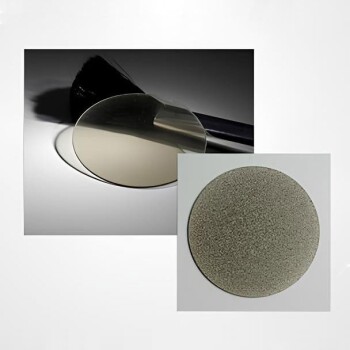
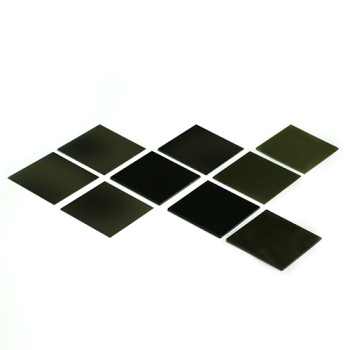
Microwave Plasma Chemical Vapour Deposition (MPCVD) is the premier technology for synthesizing high-purity hard films and crystals, most notably large-size single-crystal diamonds. By utilizing microwave energy to excite reactive gases into a plasma state, it achieves a unique combination of large-area uniformity, high purity, and excellent crystalline morphology that other deposition methods struggle to match.
Core Takeaway MPCVD distinguishes itself through an electrodeless discharge mechanism that eliminates electrode contamination and reduces ion damage. This creates a stable, pure plasma environment essential for growing defect-free, high-quality materials like single-crystal diamonds over long durations.
The Mechanics of Purity and Quality
The primary advantage of MPCVD lies in its fundamental operation, which differs significantly from traditional Direct Current (DC) methods.
The Electrodeless Advantage
Unlike DC Plasma Assisted CVD, MPCVD is an electrodeless process. This eliminates the formation of a plasma sheath, which is a common source of instability and contamination in other systems.
Because there are no electrodes to degrade or sputter material into the chamber, the resulting plasma remains exceptionally pure. This is critical when synthesizing materials where even trace impurities can compromise performance.
Preserving Surface Integrity
In many deposition processes, high-energy ions can bombard the growing material, causing etching or structural damage.
MPCVD generates ions with low kinetic energy. This gentler approach prevents the corrosion of the growing film. For sensitive crystalline structures, this ensures the final product retains excellent morphology without surface defects caused by the process itself.
Operational Efficiency and Scalability
Beyond purity, MPCVD offers distinct operational benefits that make it suitable for both research and industrial scaling.
Stability for Long-Duration Growth
The process utilizes a stable, reproducible, non-isothermal plasma.
This stability allows for continuous deposition that can last for many hours or even days. For materials that require slow, controlled growth to achieve single-crystal status, this reliability is non-negotiable.
Large-Area Uniformity
By adjusting the reactor structure, operators can generate a large, stable plasma ball.
This concentration of plasma energy facilitates uniform deposition across large substrates. The method is highly scalable; because the growth rate is proportional to microwave power, scaling up often involves utilizing readily available modular power units (e.g., 1-2 KW).
Primary Applications
While the technique is versatile, its specific advantages have made it the standard for specific high-value applications.
Single-Crystal Diamond Growth
MPCVD is currently considered the mainstream equipment and one of the most effective methods for preparing large-size single-crystal diamonds.
The process typically uses a mixture of hydrogen (H2) and methane (CH4) to activate atomic groups like atomic hydrogen. The high purity and lack of surface corrosion allow for the growth of gem-quality and industrial-grade diamonds that require perfect crystalline structure.
High-Quality Hard Films
Beyond bulk crystals, MPCVD is extensively used to prepare high-quality hard films.
The ability to control the plasma ball ensures these films possess good homogeneity over large areas, making them suitable for protective coatings and advanced electronic applications where uniformity is paramount.
Operational Considerations
To fully leverage MPCVD, one must understand the relationship between power and output.
Power Dependency and Control
The growth rate in an MPCVD system is directly proportional to microwave power.
While this allows for scalability, it requires precise control of the microwave source and the reactor geometry. Successfully maintaining the shape and stability of the plasma ball is necessary to ensure the uniformity of the deposition, particularly as the substrate size increases.
Making the Right Choice for Your Goal
When evaluating whether MPCVD is the correct method for your project, consider your specific material requirements.
- If your primary focus is Purity: MPCVD is the superior choice because its electrodeless discharge eliminates metallic contamination from the process.
- If your primary focus is Diamond Synthesis: This is the industry-standard method for producing large, single-crystal diamonds with excellent morphology.
- If your primary focus is Large-Scale Uniformity: The ability to shape the plasma ball allows for consistent, homogeneous films across larger substrate areas.
MPCVD transforms the complexity of plasma physics into a stable, reproducible tool for creating the world's hardest and most pristine materials.
Summary Table:
| Feature | Advantage of MPCVD |
|---|---|
| Plasma Source | Electrodeless discharge; eliminates electrode contamination |
| Material Purity | Superior; ideal for gem-quality and industrial-grade diamonds |
| Surface Integrity | Low kinetic energy ions prevent etching and structural damage |
| Growth Stability | Non-isothermal plasma allows for long-duration, stable deposition |
| Scalability | Large-area uniformity via adjustable plasma ball shape |
| Primary Application | Large-size single-crystal diamond growth and hard film coating |
Elevate Your Material Research with KINTEK
Ready to harness the power of MPCVD technology for your next breakthrough? KINTEK specializes in advanced laboratory solutions, offering state-of-the-art high-temperature furnaces (CVD, PECVD, MPCVD) designed for precision and purity.
Whether you are growing large-scale single-crystal diamonds or developing high-quality hard films, our expert team is here to provide the high-performance equipment and consumables you need—from PTFE products and ceramics to specialized reactors and crushing systems.
Maximize your lab's potential today. Contact us now to discuss your custom solution!
Related Products
- 915MHz MPCVD Diamond Machine Microwave Plasma Chemical Vapor Deposition System Reactor
- Cylindrical Resonator MPCVD Machine System Reactor for Microwave Plasma Chemical Vapor Deposition and Lab Diamond Growth
- Microwave Plasma Chemical Vapor Deposition MPCVD Machine System Reactor for Lab and Diamond Growth
- Multi Heating Zones CVD Tube Furnace Machine Chemical Vapor Deposition Chamber System Equipment
- Inclined Rotary Plasma Enhanced Chemical Vapor Deposition PECVD Equipment Tube Furnace Machine
People Also Ask
- How does a microwave plasma reactor facilitate the synthesis of diamond? Master MPCVD with Precision Technology
- What are the advantages of a Microwave Plasma CVD reactor for MCD/NCD coatings? Precision Multilayer Diamond Engineering
- How do vacuum pumps and valves collaborate in MPCVD? Achieve Precise Pressure Control for Superior CNT Synthesis
- What are the primary advantages of the CVD method for growing diamonds? Engineering High-Purity Gems and Components
- How is a diamond formed from CVD? The Science of Growing Diamonds Atom by Atom