Knowledge What are the advantages of electron beam hardening? Achieve Superior Precision and Speed
Author avatar

Tech Team · Kintek Solution

Updated 6 days ago

What are the advantages of electron beam hardening? Achieve Superior Precision and Speed


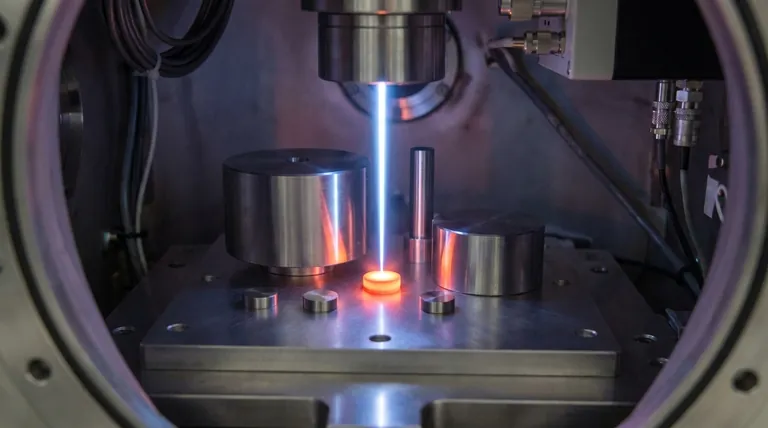
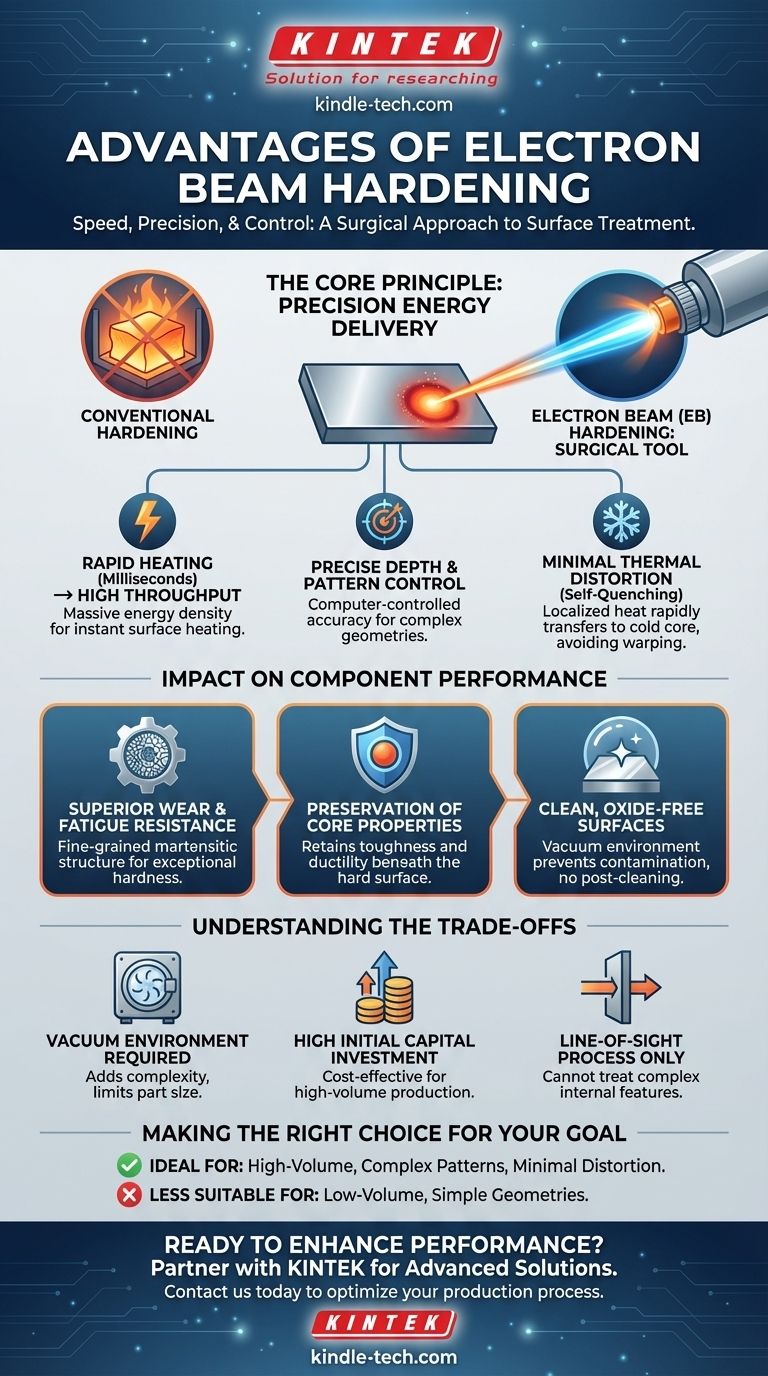
In essence, electron beam hardening offers significant advantages in speed, precision, and control over traditional methods. It uses a highly focused beam of electrons to rapidly heat a specific surface area, which then quickly cools (or "self-quenches") by transferring heat to the cold bulk material beneath it. This process creates a very hard surface layer with minimal distortion to the overall part.

While conventional hardening often involves heating an entire component, leading to potential warping and costly rework, electron beam hardening acts like a surgical tool. It delivers precise energy exactly where needed, preserving the part's core properties and dimensional integrity.
What are the advantages of electron beam hardening? Achieve Superior Precision and Speed

The Core Principle: Precision Energy Delivery

The strategic advantage of electron beam (EB) hardening comes from its ability to treat the material's surface without affecting the bulk of the component. This is achieved through the unique physics of the process.

High Energy Density and Speed

An electron beam concentrates a massive amount of energy into a tiny spot. This allows the surface temperature to rise to the required level for hardening in milliseconds.

This rapid heating cycle makes EB hardening one of the fastest surface treatment processes available, enabling high throughput for mass production environments.

Precise Depth and Area Control

The depth of hardening is a direct function of the beam's power and the travel speed, both of which are under precise computer control. This allows for hardening depths to be controlled with extreme accuracy.

Furthermore, the beam can be steered to follow complex patterns, ensuring that only the specific functional surfaces requiring high hardness and wear resistance are treated.

Minimal Thermal Distortion

Because the heating is so fast and localized, the vast majority of the component remains cool. The heat from the surface is rapidly conducted away into this cold mass, causing a "self-quenching" effect.

This process avoids the large-scale heating and cooling cycles of furnace or induction hardening, which are the primary causes of part distortion, warping, and changes in dimension.

The Impact on Component Performance

These process advantages directly translate into a higher-quality and more reliable finished product.

Superior Wear and Fatigue Resistance

The extremely rapid quench rates possible with EB hardening can produce a very fine-grained martensitic microstructure. This fine structure results in exceptional hardness and superior resistance to abrasion and contact fatigue.

Preservation of Core Properties

Since only the surface is altered, the core of the component retains its original properties, such as toughness and ductility. This creates a part with an ideal combination of a hard, wear-resistant surface and a tough, fracture-resistant core.

Clean, Oxide-Free Surfaces

Electron beam hardening is typically performed in a vacuum. This environment prevents oxidation and other surface contamination during the heating process, resulting in a clean finish that often requires no subsequent cleaning steps.

Understanding the Trade-offs and Limitations

No process is perfect. To make an informed decision, you must understand the specific constraints of electron beam hardening.

Requirement for a Vacuum Environment

The process must be conducted in a vacuum chamber to prevent the electron beam from scattering off air molecules. This adds to the equipment's complexity and can limit the size of the parts that can be processed.

High Initial Capital Investment

Electron beam systems are sophisticated and represent a significant capital expenditure compared to more conventional heat-treating equipment. The process is most cost-effective in high-volume production where the cost can be amortized over many parts.

Line-of-Sight Process

The electron beam travels in a straight line. Therefore, it can only harden surfaces that are in its direct line of sight, making it unsuitable for treating complex internal features or hidden surfaces.

Making the Right Choice for Your Goal

Selecting the right hardening process depends entirely on your project's specific priorities, from part geometry to production volume.

  • If your primary focus is high-volume production and minimal distortion: Electron beam hardening is an exceptional choice due to its speed, repeatability, and low thermal impact.
  • If your primary focus is hardening specific, complex patterns on distortion-prone parts: The precision and control of an EB system are likely superior to any bulk heating alternative.
  • If your primary focus is low-volume production or treating simple geometries: The high capital cost of EB may be prohibitive, and traditional methods like induction or flame hardening might be more economical.

Ultimately, choosing electron beam hardening is a strategic decision to prioritize precision and metallurgical quality over initial equipment cost.

Summary Table:

Advantage Description
Speed & Throughput Millisecond heating cycles enable high-volume production.
Precision Control Computer-controlled depth and pattern hardening for complex geometries.
Minimal Distortion Localized heating and self-quenching preserve part dimensions.
Superior Hardness Fine-grained martensitic microstructure for exceptional wear resistance.
Clean Process Vacuum environment prevents oxidation, eliminating post-cleaning.

Ready to enhance your component performance with precision hardening?

At KINTEK, we specialize in providing advanced lab equipment and consumables tailored to your laboratory's needs. Our expertise in electron beam technology can help you achieve superior surface hardening with minimal distortion and maximum efficiency.

Contact us today to discuss how our solutions can optimize your production process and deliver the metallurgical quality your projects demand.

Visual Guide
What are the advantages of electron beam hardening? Achieve Superior Precision and Speed Visual Guide

Related Products

People Also Ask

Related Products

Anti-Cracking Press Mold for Lab Use

Anti-Cracking Press Mold for Lab Use

The anti-cracking press mold is a specialized equipment designed for molding various shapes and sizes of film using high pressure and electric heating.

HFCVD Machine System Equipment for Drawing Die Nano-Diamond Coating

HFCVD Machine System Equipment for Drawing Die Nano-Diamond Coating

The nano-diamond composite coating drawing die uses cemented carbide (WC-Co) as the substrate, and uses the chemical vapor phase method ( CVD method for short ) to coat the conventional diamond and nano-diamond composite coating on the surface of the inner hole of the mold.

Laboratory Test Sieves and Sieving Machines

Laboratory Test Sieves and Sieving Machines

Precision lab test sieves & sieving machines for accurate particle analysis. Stainless steel, ISO-compliant, 20μm-125mm range. Request specs now!

Laboratory Sterilizer Lab Autoclave Pulse Vacuum Lifting Sterilizer

Laboratory Sterilizer Lab Autoclave Pulse Vacuum Lifting Sterilizer

The pulse vacuum lifting sterilizer is a state-of-the-art equipment for efficient and precise sterilization. It uses pulsating vacuum technology, customizable cycles, and a user-friendly design for easy operation and safety.

Graphite Vacuum Furnace High Thermal Conductivity Film Graphitization Furnace

Graphite Vacuum Furnace High Thermal Conductivity Film Graphitization Furnace

The high thermal conductivity film graphitization furnace has uniform temperature, low energy consumption and can operate continuously.

Laboratory Sterilizer Lab Autoclave Vertical Pressure Steam Sterilizer for Liquid Crystal Display Automatic Type

Laboratory Sterilizer Lab Autoclave Vertical Pressure Steam Sterilizer for Liquid Crystal Display Automatic Type

Liquid crystal display automatic vertical sterilizer is a safe, reliable and automatic control sterilization equipment, which is composed of heating system, microcomputer control system and overheating and overvoltage protection system.

Vacuum Heat Treat and Molybdenum Wire Sintering Furnace for Vacuum Sintering

Vacuum Heat Treat and Molybdenum Wire Sintering Furnace for Vacuum Sintering

A vacuum molybdenum wire sintering furnace is a vertical or bedroom structure, which is suitable for withdrawal, brazing, sintering and degassing of metal materials under high vacuum and high temperature conditions. It is also suitable for dehydroxylation treatment of quartz materials.

Laboratory Vibratory Sieve Shaker Machine Slap Vibrating Sieve

Laboratory Vibratory Sieve Shaker Machine Slap Vibrating Sieve

KT-T200TAP is a slapping and oscillating sieving instrument for laboratory desktop use, with 300 rpm horizontal circular motion and 300 vertical slapping motions to simulate manual sieving to help sample particles pass through better.

High Energy Vibratory Ball Mill for Lab Use

High Energy Vibratory Ball Mill for Lab Use

The high-energy vibrating ball mill is a high-energy oscillating and impacting multifunctional laboratory ball mill. The table-top type is easy to operate, small in size, comfortable and safe.

Engineering Advanced Fine Ceramics Aluminum Oxide Al2O3 Heat Sink for Insulation

Engineering Advanced Fine Ceramics Aluminum Oxide Al2O3 Heat Sink for Insulation

The hole structure of the ceramic heat sink increases the heat dissipation area in contact with the air, which greatly enhances the heat dissipation effect, and the heat dissipation effect is better than that of super copper and aluminum.

Laboratory Hybrid Tissue Grinding Mill

Laboratory Hybrid Tissue Grinding Mill

KT-MT20 is a versatile laboratory device used for rapid grinding or mixing of small samples, whether dry, wet, or frozen. It comes with two 50ml ball mill jars and various cell wall breaking adapters for biological applications such as DNA/RNA and protein extraction.

Benchtop Laboratory Freeze Dryer for Lab Use

Benchtop Laboratory Freeze Dryer for Lab Use

Premium benchtop laboratory freeze dryer for lyophilization, preserving samples with ≤ -60°C cooling. Ideal for pharmaceuticals & research.

Benchtop Laboratory Vacuum Freeze Dryer

Benchtop Laboratory Vacuum Freeze Dryer

Benchtop laboratory freeze dryer for efficient lyophilization of biological, pharmaceutical, and food samples. Features intuitive touchscreen, high-performance refrigeration, and durable design. Preserve sample integrity—consult now!

915MHz MPCVD Diamond Machine Microwave Plasma Chemical Vapor Deposition System Reactor

915MHz MPCVD Diamond Machine Microwave Plasma Chemical Vapor Deposition System Reactor

915MHz MPCVD Diamond Machine and its multi-crystal effective growth, the maximum area can reach 8 inches, the maximum effective growth area of single crystal can reach 5 inches. This equipment is mainly used for the production of large-size polycrystalline diamond films, the growth of long single crystal diamonds, the low-temperature growth of high-quality graphene, and other materials that require energy provided by microwave plasma for growth.

Vacuum Hot Press Furnace Machine for Lamination and Heating

Vacuum Hot Press Furnace Machine for Lamination and Heating

Experience clean and precise lamination with Vacuum Lamination Press. Perfect for wafer bonding, thin-film transformations, and LCP lamination. Order now!

Precision Machined Zirconia Ceramic Ball for Engineering Advanced Fine Ceramics

Precision Machined Zirconia Ceramic Ball for Engineering Advanced Fine Ceramics

zirconia ceramic ball have the characteristics of high strength, high hardness, PPM wear level, high fracture toughness, good wear resistance, and high specific gravity.

Graphite Vacuum Furnace IGBT Experimental Graphitization Furnace

Graphite Vacuum Furnace IGBT Experimental Graphitization Furnace

IGBT experimental graphitization furnace, a tailored solution for universities and research institutions, with high heating efficiency, user-friendliness, and precise temperature control.

Precision Machined Yttrium Stabilized Zirconia Ceramic Rod for Engineering Advanced Fine Ceramics

Precision Machined Yttrium Stabilized Zirconia Ceramic Rod for Engineering Advanced Fine Ceramics

Zirconia ceramic rods are prepared by isostatic pressing, and a uniform, dense and smooth ceramic layer and transition layer are formed at high temperature and high speed.

High Energy Vibratory Laboratory Ball Mill Grinding Mill Single Tank Type

High Energy Vibratory Laboratory Ball Mill Grinding Mill Single Tank Type

High-energy vibration ball mill is a small desktop laboratory grinding instrument.It can be ball-milled or mixed with different particle sizes and materials by dry and wet methods.

Small Vacuum Heat Treat and Tungsten Wire Sintering Furnace

Small Vacuum Heat Treat and Tungsten Wire Sintering Furnace

The small vacuum tungsten wire sintering furnace is a compact experimental vacuum furnace specially designed for universities and scientific research institutes. The furnace features a CNC welded shell and vacuum piping to ensure leak-free operation. Quick-connect electrical connections facilitate relocation and debugging, and the standard electrical control cabinet is safe and convenient to operate.


Leave Your Message