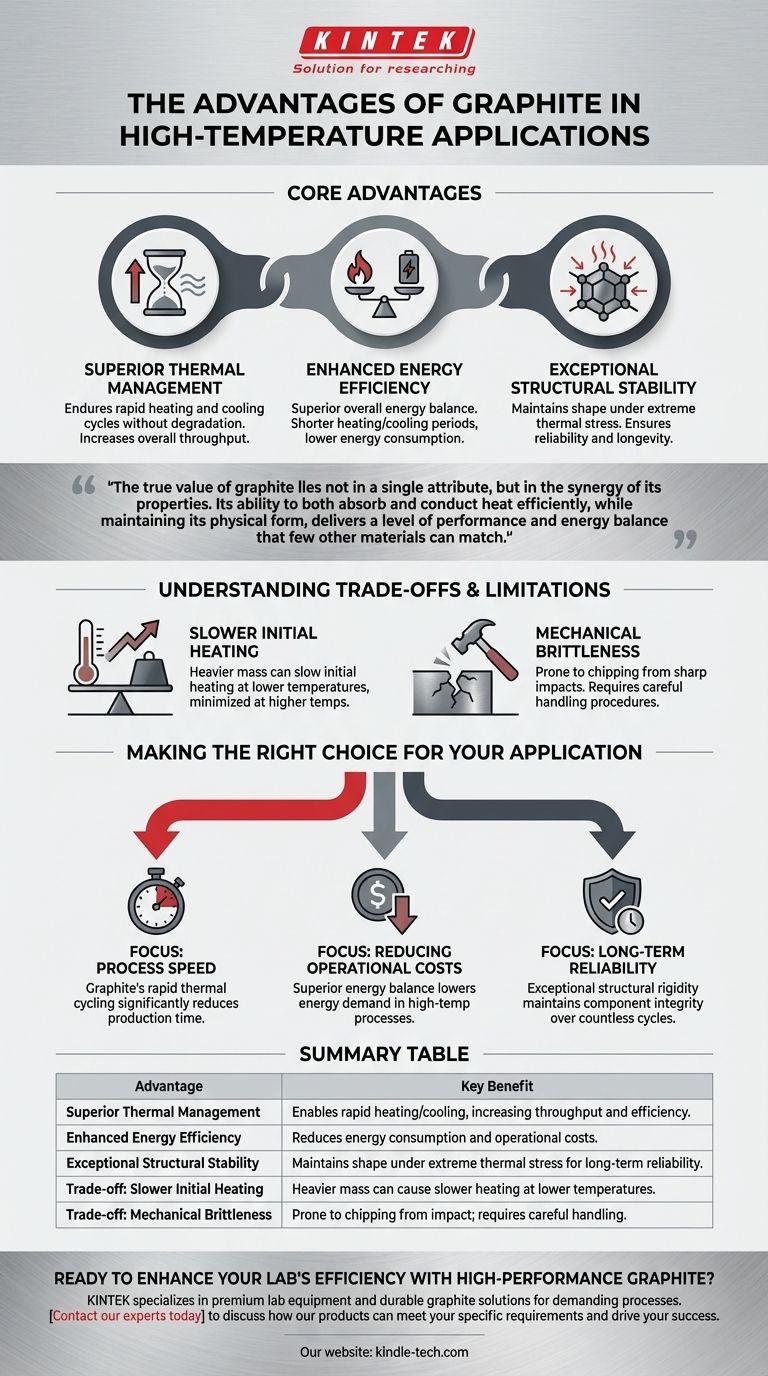
At its core, graphite is prized for three primary advantages: its exceptional energy efficiency, superior thermal management capabilities, and high structural stability in extreme heat. These properties make it a definitive material choice for demanding, high-temperature industrial processes.
The true value of graphite lies not in a single attribute, but in the synergy of its properties. Its ability to both absorb and conduct heat efficiently, while maintaining its physical form, delivers a level of performance and energy balance that few other materials can match.
The Core Advantages in High-Temperature Applications
To understand if graphite is the right material for your needs, it's essential to break down how each of its core properties translates into a practical advantage.
Superior Thermal Management
Graphite possesses excellent thermo-mechanical properties. This allows it to endure rapid heating and cooling cycles without degradation.
This capacity for fast thermal cycling directly reduces the time required for each process, increasing overall throughput and operational efficiency.
Enhanced Energy Efficiency
While graphite has a high capacity to absorb heat, it provides a superior overall energy balance compared to many metals.
This efficiency results in shorter heating and cooling periods. In high-temperature equipment like induction furnaces, this translates directly to lower energy consumption and reduced operational costs.
Exceptional Structural Stability
Graphite is a very rigid material that maintains its shape almost indefinitely, even under extreme thermal stress.
This structural integrity ensures reliability and longevity for components like furnace hearths, where dimensional stability is critical for consistent, long-term performance.
Understanding the Trade-offs and Limitations
No material is without its drawbacks. An objective evaluation of graphite must include its potential limitations to ensure it is correctly applied.
Slower Initial Heating
The heavier mass of graphite can result in slower initial heating rates, particularly at lower temperatures, when compared to some lighter materials.
However, its high thermal conductivity tends to minimize this effect as the temperature climbs, quickly overcoming the initial inertia.
Mechanical Brittleness
The primary mechanical weakness of graphite is its brittleness. Components like hearth rails can be prone to chipping or damage if subjected to sharp impacts during the loading or unloading of furnace parts.
This necessitates careful handling procedures to avoid mechanical shock and ensure the longevity of the graphite components.
Making the Right Choice for Your Application
Selecting graphite depends entirely on your primary operational goal. Its unique profile makes it ideal for specific outcomes but less suited for others.
- If your primary focus is process speed: Graphite's ability to handle rapid thermal cycling is its key advantage, significantly reducing the time for each production run.
- If your primary focus is reducing operational costs: Its superior energy balance is the most important factor, as it directly lowers the energy demand of high-temperature processes.
- If your primary focus is long-term reliability: Graphite's exceptional structural rigidity ensures components maintain their shape and integrity through countless high-heat cycles.
Ultimately, graphite is the material of choice when you need precise control and efficiency in the most demanding thermal environments.
Summary Table:
| Advantage | Key Benefit |
|---|---|
| Superior Thermal Management | Enables rapid heating/cooling cycles, increasing throughput and efficiency. |
| Enhanced Energy Efficiency | Reduces energy consumption and operational costs in high-temperature equipment. |
| Exceptional Structural Stability | Maintains shape and integrity under extreme thermal stress for long-term reliability. |
| Trade-off: Slower Initial Heating | Heavier mass can cause slower heating at lower temperatures. |
| Trade-off: Mechanical Brittleness | Prone to chipping from impact; requires careful handling. |
Ready to enhance your lab's efficiency and reliability with high-performance graphite components?
KINTEK specializes in premium lab equipment and consumables, including durable graphite solutions designed for demanding high-temperature processes. Our components deliver the superior thermal management, energy efficiency, and structural stability your laboratory needs for consistent, cost-effective results.
Contact our experts today to discuss how our graphite products can meet your specific application requirements and drive your success.
Visual Guide
Related Products
- Graphite Vacuum Furnace High Thermal Conductivity Film Graphitization Furnace
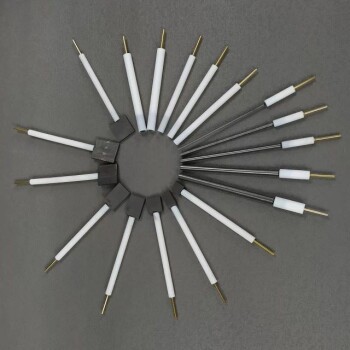
- Graphite Disc Rod and Sheet Electrode Electrochemical Graphite Electrode
- Ultra-High Temperature Graphite Vacuum Graphitization Furnace
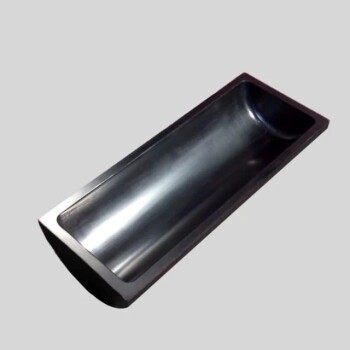
- High Purity Pure Graphite Crucible for Evaporation
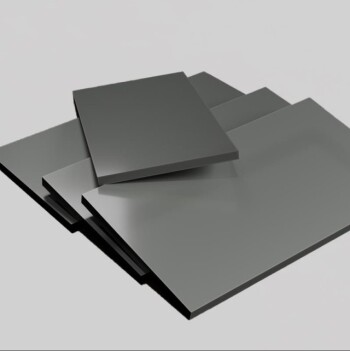
- Carbon Graphite Plate Manufactured by Isostatic Pressing Method
People Also Ask
- What is the use of graphite furnace? Achieve Extreme-Temperature Processing for Advanced Materials
- What is the disadvantage of graphite furnace? Managing Reactivity and Contamination Risks
- What is the temperature range of a graphite furnace? Unlock up to 3000°C for advanced materials processing.
- What are the interferences of graphite furnace? Overcome Matrix & Spectral Issues for Accurate GFAAS
- What does a graphite furnace do? Achieve Extreme Heat and Ultra-Sensitive Analysis