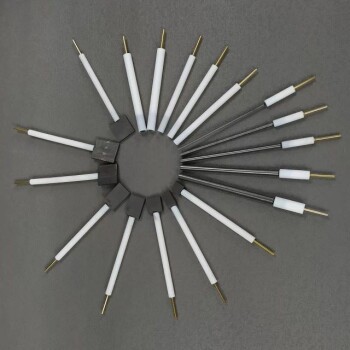
High-purity graphite rods are the preferred choice for long-term Oxygen Evolution Reaction (OER) stability tests primarily because they prevent metallic contamination of the working electrode. During a 72-hour test, metallic counter electrodes (like platinum or nickel) can undergo slow dissolution, releasing cations that migrate and deposit onto the catalyst surface, leading to "false" stability readings. High-purity graphite provides the necessary electrical conductivity and chemical inertness to ensure that the observed performance is an objective measure of the catalyst's intrinsic durability.
The central advantage of using a high-purity graphite rod is its ability to maintain a clean electrochemical environment by eliminating metal ion migration. This ensures that the data collected during extended 72-hour cycles accurately reflects the catalyst's behavior rather than artifacts caused by electrode degradation.
Eliminating Metal Ion Contamination
Preventing Dissolution in Harsh Environments
In OER testing, which often occurs in strong alkaline (e.g., 1 M KOH) or acidic electrolytes, many metallic electrodes are susceptible to corrosion. High-purity graphite is chemically inert, meaning it does not dissolve into the electrolyte even under the high-potential conditions required for oxygen evolution.
Avoiding Migration and Redeposition
When metal electrodes dissolve, they release ions into the solution that can migrate toward the working electrode (WE). These ions may deposit on the catalyst's surface, potentially enhancing or poisoning its activity and leading to unreliable durability data.
Ensuring Purity of the Catalyst Surface
By using graphite, researchers can be certain that the surface of the working electrode remains chemically pure throughout the 72-hour duration. This is critical for evaluating advanced catalysts like CoFePS or NiMoN without interference from foreign species.
Maintaining Circuit Integrity Over Long Durations
Sustaining High Electrical Conductivity
A counter electrode must effectively close the electrical circuit to balance the charge transfer occurring at the working electrode. High-purity graphite rods offer excellent electrical conductivity, ensuring that the system can handle the current densities required for long-cycle chronopotentiometry (CP) tests.
Stability Under High-Potential Stress
OER tests subject the counter electrode to significant electrochemical stress over 72 hours. Graphite remains stable under these conditions, providing a consistent site for redox reactions without the mechanical or chemical failure common in less robust materials.
Uniform Current Distribution
In a three-electrode system, the physical form of a graphite rod allows for a stable current loop. This ensures that the current distribution across the working electrode remains uniform, which is vital for the accuracy of long-term polarization and stability measurements.
Understanding the Trade-offs
Potential for Graphite Oxidation
While graphite is generally inert, it can undergo slow surface oxidation (forming CO2 or carbon sub-oxides) at extremely high potentials over very long periods. This may lead to the physical disintegration of the rod or a slight change in the electrolyte's local pH if the system is not properly buffered.
Mechanical Fragility and Surface Area
Graphite rods are more brittle than metallic wires or meshes and may have a lower effective surface area compared to platinum or nickel meshes. In high-current applications, a rod with insufficient surface area might become the rate-limiting factor or cause significant gas evolution that could physically disturb the cell.
Purity Grade Requirements
The "high-purity" designation is critical; lower-grade graphite contains trace metal impurities (like iron or vanadium). If these impurities are present, the primary benefit of using graphite—preventing contamination—is lost, as those trace metals will leach into the electrolyte during the 72-hour test.
Making the Right Choice for Your Goal
How to Apply This to Your Project
To ensure the highest quality data during your 72-hour stability experiments, consider your primary objective:
- If your primary focus is absolute catalyst purity: Use the highest grade (99.999%) graphite rod to eliminate the risk of metallic cross-contamination during long-cycle tests.
- If your primary focus is high-current density testing: Ensure the graphite rod has a significantly larger surface area than your working electrode to prevent it from becoming the bottleneck of the reaction.
- If your primary focus is acidic OER/HER testing: Leverage graphite's superior acid resistance compared to common metals like nickel or copper, which would dissolve instantly.
By choosing a high-purity graphite rod, you isolate the performance of your catalyst from the variables of electrode degradation, ensuring your 72-hour stability results are both reproducible and scientifically sound.
Summary Table:
| Feature | High-Purity Graphite Rod | Metallic Counter Electrodes (Pt/Ni) |
|---|---|---|
| Contamination Risk | Extremely Low (No metal leaching) | High (Dissolution & redeposition) |
| Chemical Inertness | High (Stable in 1M KOH/Acid) | Variable (Prone to corrosion) |
| Data Accuracy | Precise (Reflects intrinsic activity) | Potential for "False" stability readings |
| Best Use Case | Long-term OER/HER stability tests | Short-term characterization |
| Potential Issues | Slow surface oxidation | Surface poisoning/activity enhancement |
Achieve Uncompromising Precision in Your OER Research
Don't let electrode contamination compromise your 72-hour stability data. KINTEK specializes in premium laboratory solutions, offering high-purity graphite rods, electrolytic cells, and high-performance electrodes specifically designed for rigorous electrochemical testing.
Beyond electrodes, we provide a full suite of research tools—from high-temperature furnaces (CVD, PECVD, Vacuum) for catalyst synthesis to battery research consumables and precision hydraulic presses.
Ready to elevate your lab's performance? Contact our experts today to find the perfect equipment tailored to your specific application and ensure every result is scientifically sound.
References
- Kai Yu, Ziliang Chen. Immobilization of Oxyanions on the Reconstructed Heterostructure Evolved from a Bimetallic Oxysulfide for the Promotion of Oxygen Evolution Reaction. DOI: 10.1007/s40820-023-01164-9
This article is also based on technical information from Kintek Solution Knowledge Base .
Related Products
- High Purity Pure Graphite Crucible for Evaporation
- High Purity Pure Graphite Crucible for Electron Beam Evaporation
- Graphite Disc Rod and Sheet Electrode Electrochemical Graphite Electrode
- Horizontal High Temperature Graphite Vacuum Graphitization Furnace
- Ultra-High Temperature Graphite Vacuum Graphitization Furnace
People Also Ask
- Why are high-purity graphite crucibles preferred for sulfide solid electrolytes? Achieve Superior Material Purity
- Why is a high-purity graphite crucible required for Chromel-TaC composites? Ensure Peak Purity at 1400°C
- What role do high-purity graphite crucibles play in molten salt corrosion research? Ensure Reactor-Grade Precision
- Why are high-purity graphite crucibles used for magnesium distillation? Ensure 3N8 Purity & Thermal Stability
- Why is a high-purity graphite crucible ideal for nitrogen-doped graphene at 1500 °C? Maximize Purity and Stability