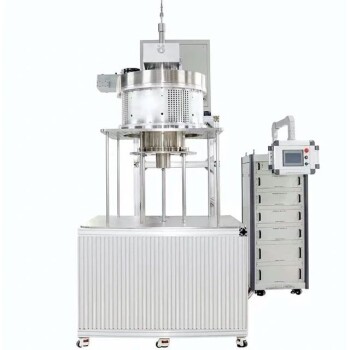
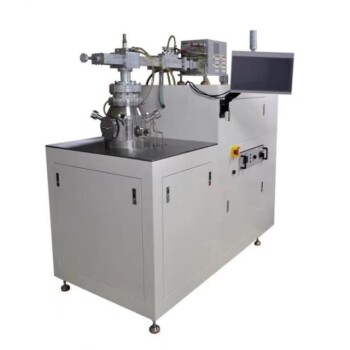
The primary advantage of a hot-wall Low-Pressure Metal-Organic Chemical Vapor Deposition (LP-MOCVD) system is its ability to produce highly conformal, uniform coatings on complex three-dimensional geometries. Unlike physical deposition methods that often struggle with line-of-sight limitations, this technique ensures high-fidelity coverage across difficult substrates, such as metal wire meshes. It achieves this by precisely manipulating the pressure and temperature within the reaction chamber to facilitate uniform film growth.
The LP-MOCVD process solves the challenge of coating intricate structures by delivering a polycrystalline anatase phase film with consistent thickness and excellent crystallinity, even within the deep pores and intersections of the substrate.
Overcoming Geometric Limitations
Conformal Coverage on Complex Shapes
The defining strength of hot-wall LP-MOCVD is its capability to coat non-planar surfaces. The gas-phase reaction allows the precursor to envelop complex 3D objects, such as wire meshes.
Penetration into Pores and Intersections
Physical deposition often leaves "shadowed" areas uncoated. In contrast, this system ensures titanium dioxide forms uniformly on internal walls, external surfaces, and intricate intersections.
Uniform Thickness Distribution
Regardless of the substrate's complexity, the film maintains a consistent thickness. This uniformity is critical for applications relying on precise surface properties across the entire component.
Material Quality and Phase Control
Achieving the Anatase Phase
For many titanium dioxide applications, the specific crystal phase is crucial. The LP-MOCVD system specifically facilitates the growth of the polycrystalline anatase phase.
Superior Crystallinity
The controlled environment leads to excellent crystallinity in the resulting thin film. This structural integrity is maintained throughout the coating, ensuring reliable performance of the material.
Understanding Operational Requirements
Reliance on Environmental Precision
To achieve these high-fidelity results, the system requires rigorous control over the reaction environment. The uniformity of the film is directly dependent on maintaining precise pressure and temperature settings within the hot-wall chamber.
Comparison to Physical Methods
While physical deposition methods may be sufficient for flat surfaces, they lack the omni-directional coating capability of LP-MOCVD. However, opting for LP-MOCVD implies a commitment to a chemical process capable of penetrating geometries that physical methods cannot reach.
Making the Right Choice for Your Goal
If you are deciding whether this deposition method fits your specific engineering requirements, consider the following:
- If your primary focus is coating complex 3D structures: Choose this system for its ability to penetrate pores and coat wire meshes without shadowing effects.
- If your primary focus is material quality: Rely on this method to ensure the formation of a high-crystallinity polycrystalline anatase phase.
- If your primary focus is film uniformity: Use this process to guarantee consistent thickness across both internal and external surfaces.
This system is the definitive choice when geometric complexity demands a chemical approach to ensure uniform, high-quality crystallization.
Summary Table:
| Feature | LP-MOCVD Advantage | Impact on Quality |
|---|---|---|
| Geometric Coverage | Non-line-of-sight conformal coating | Uniform films on 3D meshes and pores |
| Phase Control | Polycrystalline Anatase formation | Optimized photocatalytic/material properties |
| Crystallinity | High-fidelity structural integrity | Enhanced durability and performance |
| Thickness | Precise, consistent distribution | Reliable surface properties across components |
Elevate Your Material Research with KINTEK Precision
Maximize your thin-film deposition results with KINTEK’s advanced laboratory solutions. Whether you are developing titanium dioxide coatings or researching next-generation materials, KINTEK specializes in high-performance CVD and PECVD systems, high-temperature furnaces, and specialized vacuum equipment designed for rigorous environmental precision.
Our comprehensive portfolio supports every stage of your workflow—from crushing and milling systems to high-pressure reactors and PTFE consumables. Contact KINTEK today to discover how our expert-grade equipment can help you achieve the perfect anatase phase and unmatched coating uniformity for your most complex 3D substrates.
References
- Naida El Habra, Lidia Armelao. Supported MOCVD TiO2 Thin Films Grown on Modified Stainless Steel Mesh for Sensing Applications. DOI: 10.3390/nano13192678
This article is also based on technical information from Kintek Solution Knowledge Base .
Related Products
- 915MHz MPCVD Diamond Machine Microwave Plasma Chemical Vapor Deposition System Reactor
- Microwave Plasma Chemical Vapor Deposition MPCVD Machine System Reactor for Lab and Diamond Growth
- Multi Heating Zones CVD Tube Furnace Machine Chemical Vapor Deposition Chamber System Equipment
- HFCVD Machine System Equipment for Drawing Die Nano-Diamond Coating
- Cylindrical Resonator MPCVD Machine System Reactor for Microwave Plasma Chemical Vapor Deposition and Lab Diamond Growth
People Also Ask
- How does a microwave plasma reactor facilitate the synthesis of diamond? Master MPCVD with Precision Technology
- What are the advantages of a Microwave Plasma CVD reactor for MCD/NCD coatings? Precision Multilayer Diamond Engineering
- How do vacuum pumps and valves collaborate in MPCVD? Achieve Precise Pressure Control for Superior CNT Synthesis
- What are the primary advantages of the CVD method for growing diamonds? Engineering High-Purity Gems and Components
- How is a diamond formed from CVD? The Science of Growing Diamonds Atom by Atom