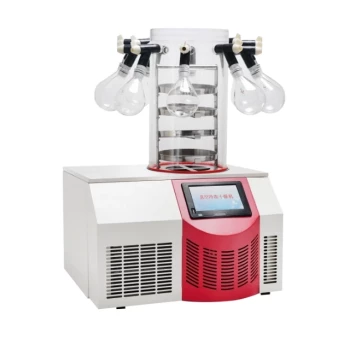
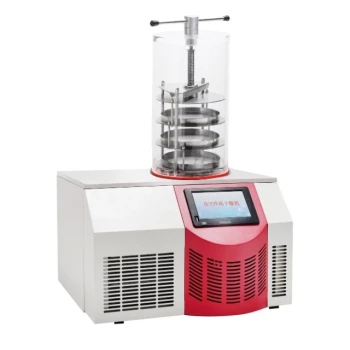
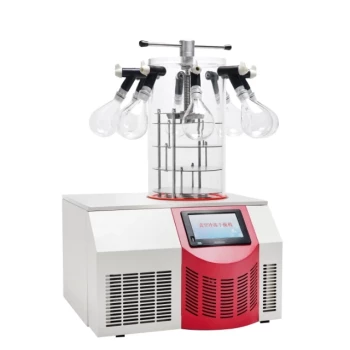
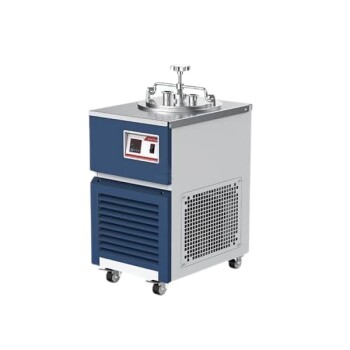
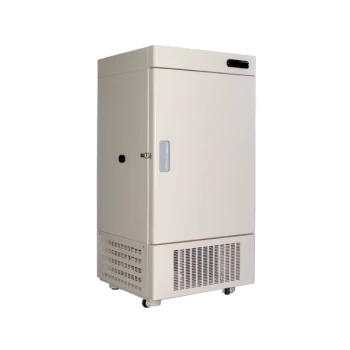
The decisive advantage of using a vacuum freeze dryer lies in its ability to bypass the liquid phase entirely through sublimation. Unlike traditional thermal drying, which relies on evaporation, freeze drying effectively neutralizes the surface tension forces that typically destroy the delicate structure of carbon nitride nanosheets.
Core Takeaway Traditional thermal drying causes nanosheets to collapse and stick together due to the surface tension of evaporating liquids. Vacuum freeze drying preserves the material's original morphology by removing solvents as vapor directly from the solid state, ensuring the high specific surface area required for peak chemical reactivity.
The Mechanism of Preservation
Sublimation Over Evaporation
A vacuum freeze dryer operates by freezing the sample and then lowering the pressure. This allows solvents to transition directly from a solid (ice) to a gas (vapor), a process known as sublimation.
Eliminating Surface Tension
In traditional thermal drying, the retreat of the liquid phase creates high surface tension. This force pulls adjacent nanosheets together, leading to irreversible structural damage. Freeze drying eliminates this liquid-phase migration entirely.
Structural and Functional Gains
Preventing Agglomeration and Restacking
The primary failure mode in thermal drying is the agglomeration and restacking of nanosheets. Because freeze drying occurs at low temperatures without liquid water, the nanosheets remain dispersed and do not bond together into dense clumps.
Maximizing Specific Surface Area
By avoiding the collapse of the material's internal architecture, freeze drying preserves the porous structure of the carbon nitride. This results in a final powder that retains an ultra-high specific surface area compared to thermally dried alternatives.
Enhancing Reactive Activity
The direct consequence of a larger surface area is a dramatic increase in reactive activity. By preventing surface functional group inactivation and keeping the structure open, the nanosheets offer significantly more active sites for subsequent applications, such as photocatalysis.
Common Pitfalls to Avoid
The Risk of Hornification
If you revert to thermal drying for these materials, you risk a phenomenon known as hornification. This is where microporous structures collapse and surfaces harden due to capillary forces, rendering the internal surface area inaccessible.
Irreversible Aggregation
It is critical to understand that the aggregation caused by liquid-phase evaporation is often irreversible. Once the nanosheets have restacked and the nanopores have collapsed during thermal drying, you cannot recover the original dispersion properties or biological activity through simple reconstitution.
Making the Right Choice for Your Goal
To maximize the performance of your carbon nitride nanosheets, select your drying method based on your specific technical requirements:
- If your primary focus is Photocatalytic Efficiency: Use vacuum freeze drying to maximize the number of exposed active sites and ensure high reactive activity.
- If your primary focus is Structural Integrity: Use vacuum freeze drying to prevent pore collapse and maintain the original three-dimensional porous network.
By prioritizing the preservation of the nanosheet's physical architecture, you ensure the material performs to its full potential in its final application.
Summary Table:
| Feature | Vacuum Freeze Drying | Traditional Thermal Drying |
|---|---|---|
| Drying Mechanism | Sublimation (Solid to Gas) | Evaporation (Liquid to Gas) |
| Surface Tension | Eliminated (No liquid phase) | High (Causes structural collapse) |
| Morphology | Preserves porous nanosheet structure | Causes restacking & agglomeration |
| Surface Area | Maximized / High Porosity | Low / Dense Clumping |
| Reactive Activity | High (More active sites) | Reduced (Inactivated functional groups) |
Elevate Your Nanomaterial Research with KINTEK
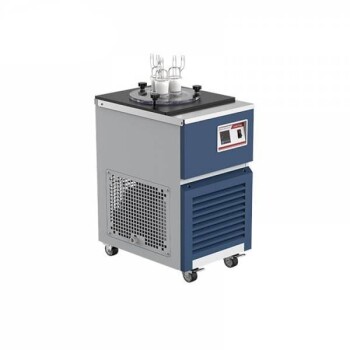
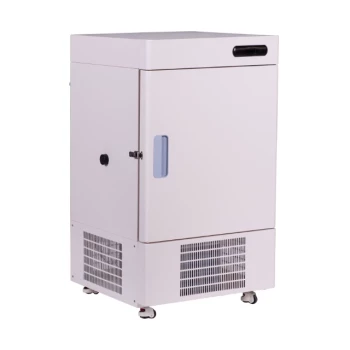
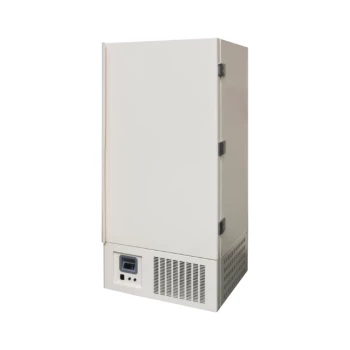
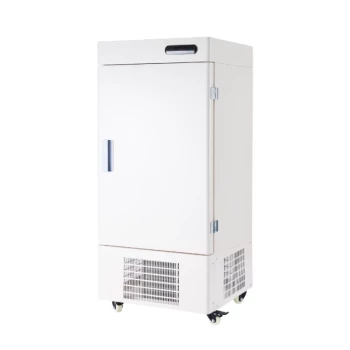
Don't let traditional drying methods compromise your material's performance. At KINTEK, we specialize in high-precision laboratory equipment designed to protect your delicate samples. Our advanced vacuum freeze dryers and cooling solutions—including ULT freezers and freeze dryers—ensure your carbon nitride nanosheets maintain their critical porous structure and maximum surface area.
Whether you are focusing on photocatalysis or advanced battery research, KINTEK provides the comprehensive tools you need, from high-temperature furnaces to electrolytic cells and crushing systems.
Ready to achieve peak chemical reactivity? Contact our experts today to find the perfect drying solution for your lab!
References
- Changchao Jia, Jian Liu. Facile assembly of a graphitic carbon nitride film at an air/water interface for photoelectrochemical NADH regeneration. DOI: 10.1039/d0qi00182a
This article is also based on technical information from Kintek Solution Knowledge Base .
Related Products
- Benchtop Laboratory Vacuum Freeze Dryer
- High Performance Laboratory Freeze Dryer
- High Performance Laboratory Freeze Dryer for Research and Development
- Benchtop Laboratory Freeze Dryer for Lab Use
- Vacuum Cold Mounting Machine for Sample Preparation
People Also Ask
- What are the technical advantages of using a laboratory freeze dryer for porous carbon precursors? Preserve 3D Networks
- How do laboratory freeze dryers support scientific research? Preserve Sample Integrity for Reproducible Results
- Why is a laboratory freeze dryer preferred over traditional heating? Preserve Biochar Structure & Maximize Porosity
- What types of liquid samples can be processed using a laboratory freeze dryer? Preserve Your Sensitive Materials
- What role do laboratory freeze dryers play in the food industry? Unlock Superior Food Preservation