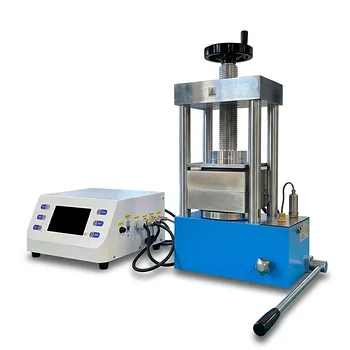
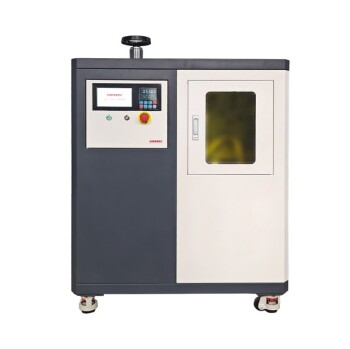
The primary advantage of Cold Sintering Process (CSP) equipment is its ability to facilitate the densification of ceramic materials at temperatures strictly below 300°C. By utilizing equipment such as a heated hydraulic press, this process enables the co-sintering of ceramics with thermally sensitive polymers (like PTFE) without causing the polymer degradation inevitable in traditional high-temperature methods.
Core Insight: The fundamental challenge in creating ceramic/polymer composites is thermal incompatibility: ceramics require high heat to densify, while polymers disintegrate under those same conditions. CSP equipment bridges this gap by substituting extreme thermal energy with mechanical pressure, allowing distinct material classes to be processed simultaneously.
Overcoming the Thermal Bottleneck
The Traditional Sintering Limitation
Traditional electric sintering furnaces rely on high thermal energy to bond ceramic particles.
This approach creates a prohibitively harsh environment for organic materials. If you attempt to co-sinter a ceramic and a polymer in a standard furnace, the polymer components will thermally decompose or burn off long before the ceramic matrix achieves density.
The Low-Temperature Solution (<300°C)
CSP equipment fundamentally changes the processing window.
By operating below 300°C, CSP remains well within the thermal stability range of many distinct polymers, including PTFE. This allows the ceramic matrix to densify around the polymer reinforcement, preserving the chemical and structural integrity of both phases.
The Role of Pressure in Densification
Substituting Heat with Mechanics
To achieve densification at such low temperatures, CSP equipment—typically a heated hydraulic press—utilizes significant uniaxial pressure.
While traditional sintering relies on heat to drive diffusion, CSP uses mechanical force to aid the consolidation process. This allows the ceramic particles to pack tightly and bond without requiring the extreme temperatures of conventional firing.
Enabling "Impossible" Composites
This capability opens the door to material combinations that were previously chemically impossible to process together.
Designers can now engineer composites that combine the dielectric or structural properties of ceramics with the flexibility or low friction of polymers, creating a single, cohesive unit in one processing step.
Understanding the Trade-offs: CSP vs. Other Assisted Techniques
It is critical to distinguish CSP from other "pressure-assisted" sintering methods found in advanced manufacturing.
Contrast with Vacuum Hot Pressing
Vacuum hot pressing is excellent for metals and achieving high density (up to 98%), as noted in standard metallurgy.
However, this equipment typically operates between 900°C and 1300°C. While it effectively prevents oxidation in metals (like Copper or Aluminum matrices) and reduces porosity through plastic deformation, these temperatures remain far too high for polymer survival.
Contrast with Spark Plasma Sintering (SPS)
SPS and Current-Assisted Melt Infiltration (CAMI) offer rapid heating and reduced processing times (seconds vs. hours).
While beneficial for inhibiting grain growth in metal composites (such as W-Cu), the high current density and rapid thermal spikes are generally designed for refractory materials or metals, not delicate polymer composites. CSP remains the specialized choice for low-temperature needs.
Making the Right Choice for Your Goal
Select your equipment based on the thermal limitations of your most sensitive component.
- If your primary focus is Ceramic/Polymer Composites: Choose Cold Sintering Process (CSP) equipment to densify the matrix below 300°C without degrading the polymer.
- If your primary focus is Metal/Ceramic or Pure Metal Density: Choose Vacuum Hot Pressing or SPS to utilize high heat (900°C+) and pressure for maximum density and improved metallic bonding.
True process innovation lies in matching the energy input (thermal vs. mechanical) to the chemical limits of your materials.
Summary Table:
| Feature | Cold Sintering Process (CSP) | Traditional Sintering | Vacuum Hot Pressing |
|---|---|---|---|
| Operating Temp | < 300°C | 1000°C - 1600°C | 900°C - 1300°C |
| Mechanism | Pressure + Transient Solvent | High Thermal Energy | Pressure + High Heat |
| Best For | Ceramic/Polymer (e.g., PTFE) | Pure Ceramics | Metals & Refractories |
| Polymer Integrity | Preserved | Destroyed | Destroyed |
| Equipment Used | Heated Hydraulic Press | Muffle/Tube Furnace | Vacuum Pressing System |
Unlock New Material Possibilities with KINTEK
Ready to bridge the gap between ceramics and polymers? KINTEK specializes in advanced laboratory solutions designed to push the boundaries of material science. Whether you need a precision heated hydraulic press for Cold Sintering, specialized pellet presses, or isostatic presses, we provide the mechanical energy required to densify your most sensitive composites without thermal degradation.
Our extensive portfolio also includes high-performance muffle and vacuum furnaces, high-temperature high-pressure reactors, and PTFE consumables to support every stage of your research.
Enhance your lab's capabilities and achieve "impossible" material combinations today.
Contact a KINTEK Specialist Now
Related Products
- 600T Vacuum Induction Hot Press Furnace for Heat Treat and Sintering
- 30T 40T Split Automatic Heated Hydraulic Press Machine with Heated Plates for Laboratory Hot Press
- Automatic Heated Hydraulic Press Machine with Heated Plates for Laboratory Hot Press
- 24T 30T 60T Heated Hydraulic Press Machine with Heated Plates for Laboratory Hot Press
- Automatic Heated Hydraulic Press Machine with Heated Plates for Laboratory Hot Press 25T 30T 50T
People Also Ask
- What role does an induction vacuum hot pressing furnace play in sintering? Achieve 98% Density in Carbide Blocks
- What advantages does a vacuum hot press furnace provide for LSLBO ceramic electrolytes? Achieve 94% Relative Density
- What role does a Vacuum Hot Press (VHP) furnace play in the densification of austenitic stainless steel 316 composites?
- What are the advantages of a vacuum hot press furnace for W-50%Cu? Achieve 99.6% Density at Lower Temperatures
- What role does mechanical pressure play during the vacuum diffusion bonding of tungsten and copper? Keys to Solid Bonding