Knowledge What are the advantages of using vacuum hot pressing? Superior Density vs. Stir Casting
Author avatar

Tech Team · Kintek Solution

Updated 4 days ago

What are the advantages of using vacuum hot pressing? Superior Density vs. Stir Casting


Vacuum Hot Pressing (VHP) offers a distinct technological advantage over traditional stir casting by utilizing a solid-state powder metallurgy approach rather than liquid-phase processing. By simultaneously applying heat, pressure, and a vacuum, VHP effectively eliminates the defects common in casting, producing metal matrix composites (MMCs) with superior density and mechanical performance.

The core advantage of VHP is its ability to consolidate materials at temperatures below the melting point. This circumvents the fluid dynamics issues of stir casting—such as particle settling and air entrapment—resulting in a highly uniform and dense microstructure.

Solving the "Liquid State" Problems

Traditional stir casting relies on mixing particles into molten metal. While common, this method introduces significant quality control issues. VHP addresses these fundamental flaws through its distinct processing environment.

Overcoming Poor Wettability

In stir casting, getting liquid metal to adhere to ceramic reinforcement particles is difficult. This is known as poor wettability.

If the liquid does not "wet" the particle, the interface is weak.

VHP solves this by applying high mechanical pressure. This forces the metal matrix around the particles, ensuring a strong bond without relying solely on surface tension.

Eliminating Porosity

A major downside of stirring molten metal is the introduction of turbulence and air pockets.

When the metal solidifies, these pockets become voids (porosity), which weaken the material.

VHP operates in a vacuum environment. This actively removes gases during the heating phase, resulting in high material densification and significantly reduced porosity.

Achieving Uniform Distribution

Gravity is the enemy of stir casting. Reinforcement particles often sink or float depending on their density relative to the liquid melt.

This leads to an uneven composite with weak spots.

Because VHP uses powder metallurgy techniques, the particles are mechanically mixed in a solid state and locked in place during consolidation. This guarantees an even, uniform distribution throughout the matrix.

The Impact on Material Performance

The shift from liquid casting to VHP is not just about the process; it is about the final mechanical properties of the material.

Solid-State Densification

VHP achieves consolidation at temperatures below the melting point.

This prevents the adverse chemical reactions that can occur between the matrix and particles at extreme liquid temperatures.

The result is a composite that retains the intended properties of both the metal and the reinforcement.

Superior Mechanical Properties

The combination of low porosity and uniform particle distribution directly enhances performance.

Composites produced via VHP exhibit higher strength and better structural integrity compared to those produced via stir casting.

Understanding the Operational Shift

While VHP offers superior material quality, it represents a shift in manufacturing philosophy.

Process Requirements

Stir casting is a liquid-metal process. VHP is a powder metallurgy process.

This requires the preparation of metal powders rather than bulk ingots.

Equipment Complexity

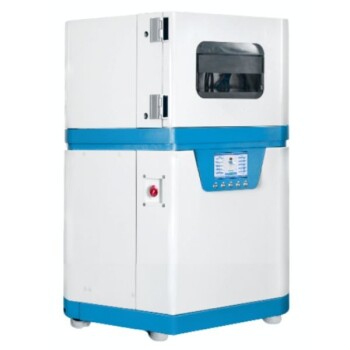
VHP utilizes a specialized furnace capable of simultaneous vacuum, heat, and pressure application.

This is a more sophisticated setup than a standard casting crucible, designed specifically for high-performance applications where material failure is not an option.

Making the Right Choice for Your Goal

When deciding between continuing with stir casting or adopting vacuum hot pressing, consider your specific performance requirements.

  • If your primary focus is eliminating defects: VHP provides the vacuum environment necessary to remove porosity and ensure high densification.
  • If your primary focus is microstructural uniformity: VHP prevents particle segregation, ensuring the reinforcement is evenly distributed throughout the part.

By transitioning to Vacuum Hot Pressing, you are effectively prioritizing material reliability and mechanical strength over the simplicity of traditional liquid casting.

Summary Table:

Feature Stir Casting (Liquid-Phase) Vacuum Hot Pressing (Solid-State)
Processing State Molten liquid metal Solid-state powders
Porosity High (due to air entrapment) Minimal (vacuum environment)
Particle Distribution Poor (settling/floating) Excellent (uniform mechanical mix)
Wettability Low (surface tension issues) High (forced mechanical bonding)
Density Variable Near-theoretical density
Interfacial Reactions Higher risk at melting points Lower risk (below melting point)

Elevate Your Materials Research with KINTEK Precision

Don't let porosity and poor particle distribution compromise your material performance. KINTEK specializes in advanced laboratory solutions designed to solve your toughest consolidation challenges. Our high-performance vacuum hot presses (VHP), alongside our extensive range of high-temperature furnaces, hydraulic presses, and crushing systems, provide the precision required for superior metal matrix composite (MMC) fabrication.

Whether you are focusing on high-density ceramics, metal-matrix research, or advanced sintering, our expert team is ready to equip your lab with the industry's most reliable tools.

Ready to achieve near-theoretical density in your next project?

Contact KINTEK Today for a Professional Consultation

Related Products

People Also Ask

Related Products

Vacuum Hot Press Furnace Heated Vacuum Press Machine Tube Furnace

Vacuum Hot Press Furnace Heated Vacuum Press Machine Tube Furnace

Reduce forming pressure & shorten sintering time with Vacuum Tube Hot Press Furnace for high-density, fine-grain materials. Ideal for refractory metals.

Vacuum Hot Press Furnace Machine Heated Vacuum Press

Vacuum Hot Press Furnace Machine Heated Vacuum Press

Discover the advantages of Vacuum Hot Press Furnace! Manufacture dense refractory metals & compounds, ceramics, and composites under high temp and pressure.

600T Vacuum Induction Hot Press Furnace for Heat Treat and Sintering

600T Vacuum Induction Hot Press Furnace for Heat Treat and Sintering

Discover the 600T Vacuum Induction Hot Press Furnace, designed for high-temperature sintering experiments in vacuum or protected atmospheres. Its precise temperature and pressure control, adjustable working pressure, and advanced safety features make it ideal for nonmetal materials, carbon composites, ceramics, and metal powders.

High Pressure Laboratory Vacuum Tube Furnace Quartz Tubular Furnace

High Pressure Laboratory Vacuum Tube Furnace Quartz Tubular Furnace

KT-PTF High Pressure Tube Furnace: Compact split tube furnace with strong positive pressure resistance. Working temp up to 1100°C and pressure up to 15Mpa. Also works under controller atmosphere or high vacuum.

2200 ℃ Tungsten Vacuum Heat Treat and Sintering Furnace

2200 ℃ Tungsten Vacuum Heat Treat and Sintering Furnace

Experience the ultimate refractory metal furnace with our Tungsten vacuum furnace. Capable of reaching 2200℃, perfect for sintering advanced ceramics and refractory metals. Order now for high-quality results.

Vacuum Heat Treat and Sintering Furnace with 9MPa Air Pressure

Vacuum Heat Treat and Sintering Furnace with 9MPa Air Pressure

The air pressure sintering furnace is a high-tech equipment commonly used for the sintering of advanced ceramic materials. It combines vacuum sintering and pressure sintering techniques to achieve high-density and high-strength ceramics.

Vacuum Heat Treat Furnace with Ceramic Fiber Liner

Vacuum Heat Treat Furnace with Ceramic Fiber Liner

Vacuum furnace with polycrystalline ceramic fiber insulation liner for excellent heat insulation and uniform temperature field. Choose from 1200℃ or 1700℃ max. working temperature with high vacuum performance and precise temperature control.

Laboratory Vacuum Tilt Rotary Tube Furnace Rotating Tube Furnace

Laboratory Vacuum Tilt Rotary Tube Furnace Rotating Tube Furnace

Discover the versatility of Laboratory Rotary Furnace: Ideal for calcination, drying, sintering, and high-temperature reactions. Adjustable rotating and tilting functions for optimal heating. Suitable for vacuum and controlled atmosphere environments. Learn more now!

Molybdenum Vacuum Heat Treat Furnace

Molybdenum Vacuum Heat Treat Furnace

Discover the benefits of a high-configuration molybdenum vacuum furnace with heat shield insulation. Ideal for high-purity, vacuum environments like sapphire crystal growth and heat treatment.

Ultra-High Temperature Graphite Vacuum Graphitization Furnace

Ultra-High Temperature Graphite Vacuum Graphitization Furnace

The ultra-high temperature graphitization furnace utilizes medium frequency induction heating in a vacuum or inert gas environment. The induction coil generates an alternating magnetic field, inducing eddy currents in the graphite crucible, which heats up and radiates heat to the workpiece, bringing it to the desired temperature. This furnace is primarily used for graphitization and sintering of carbon materials, carbon fiber materials, and other composite materials.

Vacuum Heat Treat Sintering Brazing Furnace

Vacuum Heat Treat Sintering Brazing Furnace

A vacuum brazing furnace is a type of industrial furnace used for brazing, a metalworking process that joins two pieces of metal using a filler metal that melts at a lower temperature than the base metals. Vacuum brazing furnaces are typically used for high-quality applications where a strong, clean joint is required.

Graphite Vacuum Furnace High Thermal Conductivity Film Graphitization Furnace

Graphite Vacuum Furnace High Thermal Conductivity Film Graphitization Furnace

The high thermal conductivity film graphitization furnace has uniform temperature, low energy consumption and can operate continuously.

Horizontal High Temperature Graphite Vacuum Graphitization Furnace

Horizontal High Temperature Graphite Vacuum Graphitization Furnace

Horizontal Graphitization Furnace: This type of furnace is designed with the heating elements placed horizontally, allowing for uniform heating of the sample. It's well-suited for graphitizing large or bulky samples that require precise temperature control and uniformity.

Small Vacuum Heat Treat and Tungsten Wire Sintering Furnace

Small Vacuum Heat Treat and Tungsten Wire Sintering Furnace

The small vacuum tungsten wire sintering furnace is a compact experimental vacuum furnace specially designed for universities and scientific research institutes. The furnace features a CNC welded shell and vacuum piping to ensure leak-free operation. Quick-connect electrical connections facilitate relocation and debugging, and the standard electrical control cabinet is safe and convenient to operate.

1200℃ Controlled Atmosphere Furnace Nitrogen Inert Atmosphere Furnace

1200℃ Controlled Atmosphere Furnace Nitrogen Inert Atmosphere Furnace

Discover our KT-12A Pro Controlled atmosphere furnace - high precision, heavy duty vacuum chamber, versatile smart touch screen controller, and excellent temperature uniformity up to 1200C. Ideal for both laboratory and industrial application.

Graphite Vacuum Furnace IGBT Experimental Graphitization Furnace

Graphite Vacuum Furnace IGBT Experimental Graphitization Furnace

IGBT experimental graphitization furnace, a tailored solution for universities and research institutions, with high heating efficiency, user-friendliness, and precise temperature control.

Laboratory Rapid Thermal Processing (RTP) Quartz Tube Furnace

Laboratory Rapid Thermal Processing (RTP) Quartz Tube Furnace

Get lightning-fast heating with our RTP Rapid Heating Tube Furnace. Designed for precise, high-speed heating and cooling with convenient sliding rail and TFT touch screen controller. Order now for ideal thermal processing!

2200 ℃ Graphite Vacuum Heat Treat Furnace

2200 ℃ Graphite Vacuum Heat Treat Furnace

Discover the power of the KT-VG Graphite Vacuum Furnace - with a maximum working temperature of 2200℃, it's perfect for vacuum sintering of various materials. Learn more now.

Vacuum Heat Treat Furnace and Levitation Induction Melting Furnace

Vacuum Heat Treat Furnace and Levitation Induction Melting Furnace

Experience precise melting with our Vacuum Levitation Melting Furnace. Ideal for high melting point metals or alloys, with advanced technology for effective smelting. Order now for high-quality results.

1200℃ Split Tube Furnace with Quartz Tube Laboratory Tubular Furnace

1200℃ Split Tube Furnace with Quartz Tube Laboratory Tubular Furnace

KT-TF12 split tube furnace: high-purity insulation, embedded heating wire coils, and max. 1200C. Widely used for new materials and chemical vapour deposition.


Leave Your Message